
On 21 September 2026 we looked at the 3,000 most scanned products in our food database. Of those, 1,506 products (50.2%) list at least one additive. Of those 1,506, 378 products (25.1%) carry at least one additive our public table flags for young children. The flagged additive that parents meet most often is not a dye. It is a phosphate. Below is what we found, why the phosphates stand out, and how we counted.
TL;DR
- Half of the 3,000 most scanned products (1,506, or 50.2%) list at least one additive.
- One in four of those 1,506 (378, or 25.1%) carries an additive our table flags for young children.
- The flagged additive met most often is a phosphate, E450, in 4.9% of products with a list. A Sito scan scores the product for your child's age.
Check the product in your hand with Sito
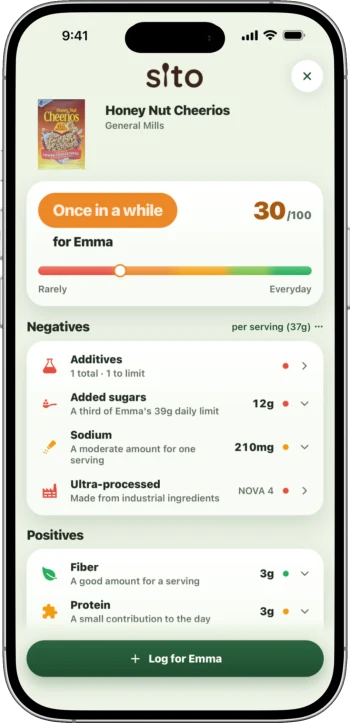
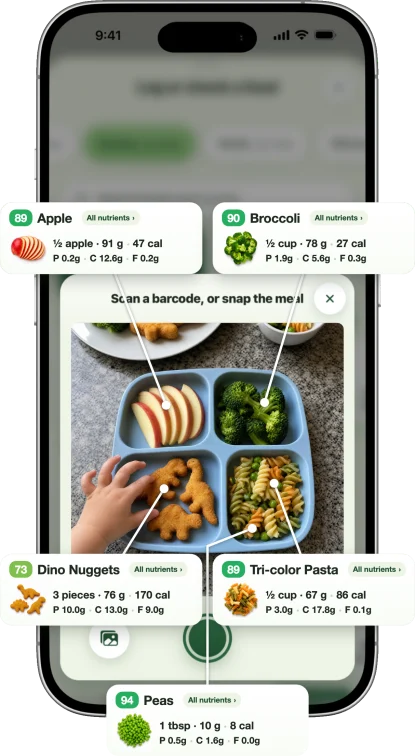
Sito is our app. Scan a barcode and it shows a score out of 100 for your child's own age, stricter under 6. The classes behind that score come from our public table of 253 additives with 597 citations, so you can read why any row is flagged. Then log the product into your child's day.
Every class in this study comes from that same table, which anyone can read at sito.kids/additives.
Check the product in your hand
Scan a packaged food and Sito names the additives in it, then scores the product out of 100 for your child's age.
What we found in the 3,000 most scanned products
Most additives a parent meets are in our no-risk class. That is the honest headline, and the table below shows it.
One thing to be clear about before the numbers. The risk classes are ours. The findings they rest on are the regulators' own, quoted below from the opinion that set each limit.
A product that lists additives lists a median of 2 that our table rates. The mean is 2.5. The most in a single product is 19.
Of the eight additives met most often, seven carry no risk class in our table. One, ammonium carbonates, is class low. Lecithins lead, in 33.2% of the 1,506 products with a list.
| Additive | E number | Our class | Share of the 1,506 products with a list |
|---|---|---|---|
| Lecithins | E322 | none | 33.2% |
| Citric acid | E330 | none | 22.6% |
| Sodium carbonates | E500 | none | 20.1% |
| Ascorbic acid | E300 | none | 12.8% |
| Ammonium carbonates | E503 | low | 11.7% |
| Potassium sorbate | E202 | none | 7.2% |
| Mono- and diglycerides of fatty acids | E471 | none | 7% |
| Pectins | E440 | none | 6% |
Now the other side of the count. Of the 1,506 products with a list, 378 (25.1%) carry at least one additive our table flags for young children. 346 (23%) carry one we class high or moderate risk. 19% carry a high one.
For scale, our table has 253 additives, and 137 of those 253 rows carry no risk class at all. A flag is the exception in the table, and it is the exception on the shelf.
The surprise: phosphates, not dyes
Dyes get the attention. In this sample, the child-flagged additives met most often are phosphates.
| Additive | E number | Our class | Share of the 1,506 products with a list |
|---|---|---|---|
| Diphosphates | E450 | high | 4.9% |
| Glycerol | E422 | low | 4.2% |
| Polyphosphates | E452 | high | 3.1% |
| Carrageenan | E407 | high | 2.8% |
| Phosphoric acid | E338 | high | 1.8% |
| Sodium benzoate | E211 | high | 1.8% |
Three of the six are phosphates: E450, E452 and E338. Together they are the reason this page exists.
The class comes from one document. In 2019 the European Food Safety Authority re-evaluated phosphates and set a group limit. Its panel wrote (EFSA Journal 2019;17(6):5674) that it "derived a group acceptable daily intake (ADI) for phosphates expressed as phosphorus of 40 mg/kg body weight (bw) per day and concluded that this ADI is protective for the human population."
Then it checked how much people actually get. In the same opinion the panel noted that "in the estimated exposure scenario based on analytical data exposure estimates exceeded the proposed ADI for infants, toddlers and other children at the mean level, and for infants, toddlers, children and adolescents at the 95th percentile."
The words that matter are mean level. Most additive limits are only in question for the heaviest eaters. Here the panel named children at the average too. That is why E450, E452 and E338 sit in our high class, and why they lead this list.
Two more rows on that table have a regulator's wording behind them. On carrageenan the panel concluded in 2018 (EFSA Journal 2018;16(4):5238) that "the existing group acceptable daily intake (ADI) for carrageenan (E 407) and processed Eucheuma seaweed (E 407a) of 75 mg/kg bw per day should be considered temporary, while the database should be improved within 5 years after publication of this opinion."
On sodium benzoate the panel wrote in 2016 (EFSA Journal 2016;14(3):4433) that "the group ADI was exceeded in the brand-loyal scenario in particular for toddlers and children consuming on a regular basis flavoured drinks."
What this means at your table
We call no product in this study unsafe, and we name no brand. A flag is set only where a regulator's own exposure work shows toddlers or children near or over the limit, or where a regulator used child-specific wording. It does not say one serving harms a child.
What a parent can do is simple. Read the label. Phosphates appear as diphosphates, polyphosphates, phosphoric acid, or E450, E452 and E338. If a product your child eats often lists one, that is worth knowing. If it appears once a month, it matters less.
The sample tells us where to look. Three in four products with an additive list carry nothing we flag for young children. The flagged one in four is where a scan earns its place.
If you want the full E number background, our guide to E numbers in kids' food explains the classes one by one.
How we counted
We want a stranger to be able to check this, so here is the method in plain words.
- The sample. The 3,000 most scanned products in our database on 21 September 2026. Our catalogue holds 4.4 million rows, but what a parent meets is what people actually scan. The list comes from an index scan on popularity, and the same query returns the same list.
- The denominator. 1,506 of the 3,000 products (50.2%) list at least one additive. The rest list none, which can mean no additives or a gap in the record. So every percentage on this page is against the 1,506, never against the 3,000.
- Why the flagged share is a floor. Some products carry sub-variant tags our table does not rate, such as en:e322i under lecithins. We count those as unrated. So 25.1% is the lowest the flagged share can be, not the highest.
- The classes. Each additive is matched to our public table of 253 additives, 597 citations. The classes are ours; the finding on every flagged row is a named regulator's. The table is at sito.kids/additives, with a CSV and a JSON download, and a page per additive. How the classes feed the score is on our score method page.
- No user data. Not one number here comes from a child, a meal or a log. It is product data and our published table.
- The file. The measurement is published as it came out, at sito.kids/data/additive-study-2026-09-21.json. Every figure on this page is in it.
For journalists and researchers
The table behind every class on this page is public at sito.kids/additives, with a CSV and a JSON download and a citation on every flagged row. The measurement itself is public too, at sito.kids/data/additive-study-2026-09-21.json. The sample is the 3,000 most scanned products in our database on 21 September 2026, and the denominator for every share is the 1,506 products that list an additive. Quote the numbers with that denominator and the date, and they hold. The classes are ours and we say so; the findings under them belong to the regulators, quoted from the opinions listed at the end. For the list behind a figure, or a question about the method, write to berkay@sitonutri.com and we will answer.
Frequently asked questions
How many products did you check?
3,000, the most scanned products in our database on 21 September 2026. Of those, 1,506 (50.2%) list at least one additive, and every percentage on this page is a share of those 1,506. In that group, 378 products (25.1%) carry at least one additive our table flags for young children.
Is an additive on this list unsafe?
No product in this study is called unsafe. A flag in our table means a named regulator set a limit and raised a question about children's exposure. For the phosphates, EFSA's 2019 opinion reported exposure "exceeded the proposed ADI for infants, toddlers and other children at the mean level" (EFSA Journal 2019;17(6):5674). The same opinion concluded that the limit itself "is protective for the human population". Read the label, notice what your child eats often, and scan it in Sito to see the score for your child's age.
Where do the risk classes come from?
The classes are ours. The reason behind each flagged row is a named regulator's, quoted from its own opinion. They live in our public table of 253 additives with 597 citations, at sito.kids/additives, and 137 of the 253 rows carry no risk class at all. For monosodium glutamate, for example, the EFSA panel in 2017 derived "a group acceptable daily intake (ADI) of 30 mg/kg bw per day, expressed as glutamic acid, for glutamic acid and glutamates (E 620-625)" and noted that "in the non-brand-loyal scenario, the mean exposure exceeded the dose which has been associated with the MSG symptom complex (> 42.9 mg/kg bw per day) in toddlers and children" (EFSA Journal 2017;15(7):4910).
Sources
- Sito additive table, 253 additives with 597 citations, CSV and JSON download: sito.kids/additives
- The measurement behind this page, as the script wrote it: sito.kids/data/additive-study-2026-09-21.json
- EFSA, Re-evaluation of phosphoric acid-phosphates, di-, tri- and polyphosphates (E 338-341, E 343, E 450-452) as food additives and the safety of proposed extension of use, EFSA Journal 2019;17(6):5674: doi:10.2903/j.efsa.2019.5674, full text PMC7009158
- EFSA, Re-evaluation of carrageenan (E 407) and processed Eucheuma seaweed (E 407a) as food additives, EFSA Journal 2018;16(4):5238: doi:10.2903/j.efsa.2018.5238, full text PMC7009739
- EFSA, Scientific Opinion on the re-evaluation of benzoic acid (E 210), sodium benzoate (E 211), potassium benzoate (E 212) and calcium benzoate (E 213) as food additives, EFSA Journal 2016;14(3):4433: doi:10.2903/j.efsa.2016.4433, EFSA Journal record
- EFSA, Re-evaluation of glutamic acid (E 620), sodium glutamate (E 621), potassium glutamate (E 622), calcium glutamate (E 623), ammonium glutamate (E 624) and magnesium glutamate (E 625) as food additives, EFSA Journal 2017;15(7):4910: doi:10.2903/j.efsa.2017.4910, full text PMC7009848