
- A free one-page checklist to print (PDF), and below, all 100 foods by food group with how to serve each at 6 months.
- None of the AAP, CDC, NHS, WHO or ASCIA names a number of foods to try before 1. Variety from each food group, and repeat tastes, are what help.
- Sito puts a check on each food your baby tries, and shows how to serve it at their age.
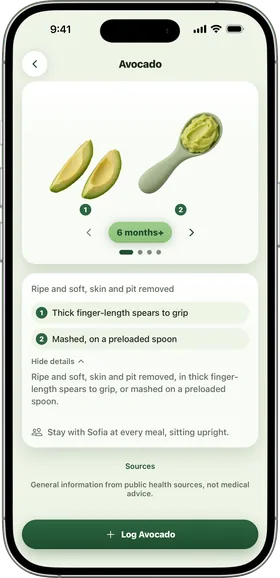
In Sito: how to serve each food at your baby's age
Sito is our app. Every food on this list is a card in its Starting Solids, one of 583 foods. Each card shows how to serve the food at your baby's age, with a choking note and an allergen flag where they apply.
The Allergen Ladder takes the nine common allergens (egg, peanut, milk, wheat, soy, sesame, tree nuts, fish and shellfish) one at a time, with a check-in after each. Sito puts a check on each food your baby tries. From 4 to 11 months, the report you can show your doctor lists every food your baby has tasted.
See how to serve each of the 100 at your baby's age
Add your baby and Starting Solids shows how to serve 583 foods at their age, puts a check on each food your baby tries and runs the Allergen Ladder for 9 allergens. Free to download, free to try.
Why 100 foods before 1, and is it a rule?
No. We checked the AAP, the CDC, the NHS, the WHO and ASCIA. None names a number of foods to try before 1. The trend is 100 different foods before the first birthday, and the 100 is a handy list size, not a target.
What they ask for is variety. The AAP says that within a few months of starting, your baby's daily diet should include a variety of foods: breast milk or formula, meats, cereal, vegetables, fruits, eggs and fish (AAP). The NHS says a variety of foods from around 6 months, and the WHO says to raise texture and variety step by step (NHS, WHO). ASCIA says babies need to learn to eat a variety of foods from each food group (ASCIA).
Repeat tastes matter too. The NHS says it may take 10 tries or more for a baby to get used to a new food, flavor or texture (NHS). So a food your baby has already tried is worth offering again. Let your baby decide how much they want; pushing food away can be a sign they are full (CDC).
The 100 foods checklist, by food group
Download the one-page PDF to print. Check a food when your baby tastes it, and offer it again another day.
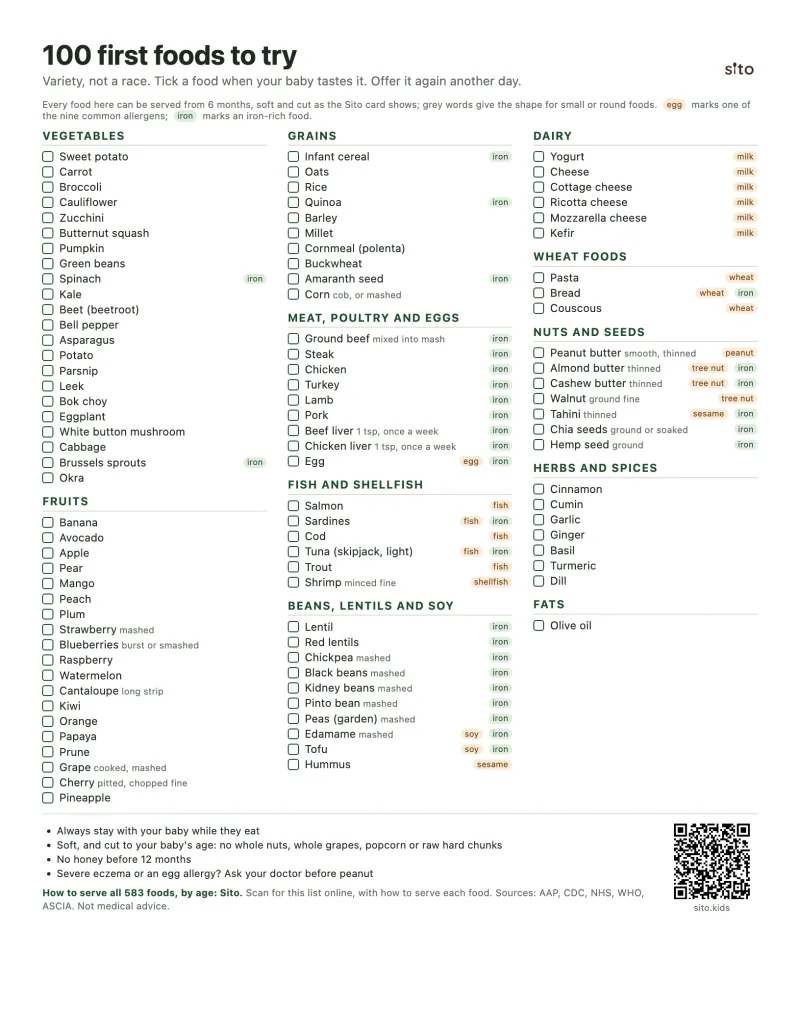
All 100 foods come from our Starting Solids table, and each can be served from 6 months. The serving line is the one Sito shows at 6 months. An age in the choking column, such as "Until 4", means the food is a choking risk in its usual shape until that age, so serve it as the line says. "Iron-rich" means at least 1.0 mg of iron per 100 g and at least 0.15 mg in the 6-month portion.
Vegetables
| Food | At 6 months | Choking risk | Allergen | Iron-rich |
|---|---|---|---|---|
| Sweet potato | Roasted or steamed until soft, in finger-length wedges, or mashed onto a preloaded spoon. | |||
| Carrot | Cooked until soft enough to squash with a finger, cut in thick finger-length sticks. | Until 4 (hard when raw) | ||
| Broccoli | Steamed until soft enough to squash, as a whole floret held by its stalk, or mashed. | Until 4 (hard when raw) | ||
| Cauliflower | Steamed until very soft, as one big floret with a long stalk to hold, or mashed. | Until 4 (hard when raw) | ||
| Zucchini | Steamed until very soft, in spears about as long and wide as two adult fingers with the skin on for grip, or mashed smooth. | Until 4 (firm and crunchy when raw) | ||
| Butternut squash | Roasted or steamed until very soft, skin off, mashed onto a preloaded spoon or cut in finger-length strips. | |||
| Pumpkin | Roasted or steamed until very soft, skin and seeds off, in finger-length wedges or mashed. | |||
| Green beans | Whole beans, ends trimmed, steamed until they squash easily between your fingers. | Until 4 (hard and crisp when raw) | ||
| Spinach | Cooked, squeezed dry and chopped fine, then stirred into mashed potato, egg or porridge. Spinach is high in nitrate. Serve spinach purees and smoothies fresh, or cool them quickly and freeze them; never leave them standing. One spinach meal a day at most, and none during a stomach infection. | Yes | ||
| Kale | Stems off, cooked soft, chopped very fine and stirred into mashed potato, egg or porridge. | |||
| Beet (beetroot) | Peeled and roasted or boiled until very soft, in finger-length wedges or mashed. | Until 4 (hard when raw) | ||
| Bell pepper | Stem, seeds and white ribs out, roasted or steamed until floppy, skin slipped off, in strips as long as a finger. | Until 4 (crisp and tough-skinned when raw) | ||
| Asparagus | Steamed or roasted until very soft, woody ends snapped off; a whole thick spear to hold, or split lengthwise, chopped fine and stirred into mash. | Until 4 (stringy and hard when raw) | ||
| Potato | Boiled, steamed or baked until it squashes between finger and thumb, in finger-length wedges, or mashed without salt. | |||
| Parsnip | Peeled and steamed or roasted until very soft, cut lengthwise into finger-length sticks, or mashed smooth. | Until 4 (hard when raw) | ||
| Leek | Cooked until very soft and chopped fine, stirred into mash, porridge or egg, or blended into a thick soup on a preloaded spoon. | |||
| Bok choy | Steamed until the white stem is very soft: a whole rib to hold with the leaf cut off, or leaves chopped fine into mash. | |||
| Eggplant | Roasted or steamed until very soft, peeled, in finger-length strips or mashed. | |||
| White button mushroom | Cooked until soft and chopped very fine, stirred into mash or porridge or cooked into egg strips. | Until 4 (small, round and slippery) | ||
| Cabbage | Cooked until very soft, then chopped fine or grated and stirred into mashed potato or porridge. | Until 4 (hard and crunchy when raw) | ||
| Brussels sprouts | Steamed very soft: a large sprout, about 5 cm, halved or quartered to hold; small sprouts chopped and stirred into mash. | Until 4 (round and firm, hard when raw) | Yes | |
| Okra | Cooked until it squashes easily between your fingers, stem cap cut off, as a whole pod to hold or mashed into other food. |
Fruits
| Food | At 6 months | Choking risk | Allergen | Iron-rich |
|---|---|---|---|---|
| Banana | Half a ripe banana, fully peeled, to hold in a fist, or mashed on a preloaded spoon. | |||
| Avocado | Ripe and soft, skin and pit removed, in thick finger-length spears to grip, or mashed on a preloaded spoon. | |||
| Apple | Baked or steamed until it squashes between finger and thumb, in finger-length wedges, peeled and cored, or grated and cooked soft in a bowl. | Until 4 (hard when raw) | ||
| Pear | Peeled, core out: a half cooked until soft, or a very ripe raw half or large thin slice; or very ripe pear grated and stirred into yogurt or porridge. | Until 4 (hard when raw and firm) | ||
| Mango | Ripe enough to squash easily between finger and thumb, peeled, in a thick finger-length spear to hold, or mashed. | |||
| Peach | Very ripe or cooked soft, peeled, pit out: a half to hold, or mashed into porridge or yogurt. | Until 4 (firm when underripe) | ||
| Plum | Very ripe, soft, pitted and peeled: a half to gnaw, or mashed. A firm plum is grated and cooked soft. | Until 4 (round and firm, with a hard pit) | ||
| Strawberry | Mashed into yogurt or porridge, or one whole very large, soft ripe berry, hulled, too big to fit in the mouth; take it away once it gets small. | Until 4 (small berries are round and firm) | ||
| Blueberries | Cooked until they burst, or smashed, then stirred into porridge or yogurt. | Until 4 (small, round and firm) | ||
| Raspberry | Ripe berries mashed with a fork, on a preloaded spoon or stirred into porridge or yogurt. | |||
| Watermelon | Rind and seeds removed, in finger-length spears about 4 cm wide and 2 cm thick, firm enough not to break apart. | |||
| Cantaloupe | Very ripe, rind and seeds off, in a long flat strip or crescent to hold. No melon balls or chunks. | Until 4 (firm and slippery, worst as balls or chunks) | ||
| Kiwi | Ripe and soft enough to squash between your fingers, peeled, in thick lengthwise wedges to hold, or mashed on a spoon. | |||
| Orange | Peeled, seeds out and the thin membrane cut away, in whole soft segments to grab. | |||
| Papaya | Very ripe and soft enough to squash between finger and thumb, peeled and seeded, in finger-length spears or mashed on a preloaded spoon. | |||
| Prune | Soaked or simmered until soft, pitted, then mashed smooth or stirred into porridge or yogurt. | Until 4 (sticky and chewy when whole) | ||
| Grape | Washed, cooked until the skins burst, skins slipped off, then mashed or blended smooth and stirred into yogurt or porridge. | Until 4 (small, round and firm) | ||
| Cherry | Pitted and chopped fine, then stirred into yogurt or porridge, or cooked until soft and burst. | Until 4 (small, round and firm, with a hard pit) | ||
| Pineapple | Very ripe and soft enough to squash between finger and thumb, skin, eyes and core cut away, in long flat strips about two fingers wide. No cubes yet. | Until 4 (firm and fibrous) |
Grains
| Food | At 6 months | Choking risk | Allergen | Iron-rich |
|---|---|---|---|---|
| Infant cereal | Dry cereal stirred with breast milk or formula into a smooth, thick porridge, offered on a preloaded spoon. | Yes | ||
| Oats | Cooked into a thick, soft porridge and offered on a preloaded spoon for the baby to grab. | |||
| Rice | Cooked extra soft and sticky, pressed into a large soft ball to hold in a fist, or simmered into a thick porridge. | |||
| Quinoa | Rinsed, cooked very soft and stirred into porridge, yogurt or mashed vegetables. | Yes | ||
| Barley | Cooked very soft and blended into a thick porridge, served on a preloaded spoon. | |||
| Millet | Cooked very soft into a thick porridge for a preloaded spoon, or pressed into soft patties. | |||
| Cornmeal (polenta) | Soft polenta on a preloaded spoon, or set polenta in finger-length sticks soft enough to squash, never fried crisp. | |||
| Buckwheat | Cooked into a thick, smooth porridge and served on a preloaded spoon. | |||
| Amaranth seed | Simmered into a thick, creamy porridge and offered on a preloaded spoon, plain or with mashed fruit. | Yes | ||
| Corn | Half a cooked cob to hold and gnaw, or kernels blended or mashed smooth. | Until 4 (loose kernels are small and firm) |
Meat, poultry and eggs
| Food | At 6 months | Choking risk | Allergen | Iron-rich |
|---|---|---|---|---|
| Ground beef | Cooked through and kept moist, mixed into mashed potato or another thick mash, or a soft patty at least 5 cm wide. Cook ground beef to 160°F (71°C), checked with a food thermometer in the center; color does not show it is done. | Until 4 (firm and round as meatballs) | Yes | |
| Steak | Cooked through, fat trimmed, in one strip about 7 cm long and 3 cm wide to gnaw and suck, or minced fine into mash. Cook steak to 145°F (63°C), checked with a food thermometer, and let it rest 3 minutes before cutting. | Until 4 (chewy and firm in chunks) | Yes | |
| Chicken | Moist slow-cooked thigh or breast in a long flat strip about 7 cm by 3 cm to gnaw, or shredded fine and mixed into mash. Cook chicken to 165°F (74°C), patties included, checked with a food thermometer. Remove every bone, the skin and any gristle before serving. | Until 4 (chewy in chunks) | Yes | |
| Turkey | Dark meat braised until very tender, bone and skin removed, in a long flat strip about 7 cm by 3 cm, or ground and mixed into mash. Cook turkey to 165°F (74°C), ground turkey and meatballs included, checked with a food thermometer. | Until 4 (firm and chewy in chunks) | Yes | |
| Lamb | Slow-cooked until very tender, fat trimmed, as a strip as wide as two adult fingers to gnaw, or minced and mixed into mash. | Until 4 (chewy in chunks) | Yes | |
| Pork | Cooked through and tender: a strip about two fingers wide to suck on, or ground pork stirred into mash. Cook ground pork to 160°F (71°C), checked with a food thermometer. | Until 4 (chewy chunks of meat) | Yes | |
| Beef liver | Cooked through and blended into a smooth spread: thin on a toast strip, a little on a preloaded spoon, or stirred into mash. Liver is very rich in vitamin A, so keep it to a teaspoon-sized portion and no more than once a week. | Until 4 (firm chunks of meat) | Yes | |
| Chicken liver | Cooked through and mashed or blended smooth, on a preloaded spoon or spread thin on a toast strip. Liver is very rich in vitamin A. Keep to a teaspoon-sized portion, no more than once a week. | Until 4 (firm in a chunk) | Yes | |
| Egg | Cooked firm all through: an omelet strip to hold, or hard-boiled egg mashed smooth with water, breast milk or formula. | Egg | Yes |
Fish and shellfish
| Food | At 6 months | Choking risk | Allergen | Iron-rich |
|---|---|---|---|---|
| Salmon | Cooked through with every bone picked out, as a soft finger-length piece or flaked into mash. | Fish | ||
| Sardines | Canned sardines mashed well with a fork, soft bones crushed in, on a preloaded spoon or toast finger. | Fish | Yes | |
| Cod | Cooked through, skin and every bone removed, in a strip about 7 cm long and 3 cm wide to hold, or flaked into mash. | Fish | ||
| Tuna (skipjack, light) | Drained well and flaked very fine, then mashed into avocado or potato so it holds together. | Fish | Yes | |
| Trout | Cooked through, skin and bones removed, in a strip about 7 cm by 3 cm to hold, or flaked into mashed potato. | Fish | ||
| Shrimp | Peeled, cooked through and minced fine, stirred into mash or pressed into a soft patty about 5 cm across. | Until 4 (firm and rubbery, curled into a round) | Shellfish |
Beans, lentils and soy
| Food | At 6 months | Choking risk | Allergen | Iron-rich |
|---|---|---|---|---|
| Lentil | Cooked until very soft and mashed, on a preloaded spoon or pressed into soft patties. | Yes | ||
| Red lentils | Simmered until they collapse into a thick mash, served on a preloaded spoon or shaped into soft patties. | Yes | ||
| Chickpea | Cooked until very soft and mashed, to scoop by hand, on a preloaded spoon or spread thin on toast. | Until 12 months (small, round and firm) | Yes | |
| Black beans | Cooked soft and mashed with a splash of water, on a preloaded spoon or stirred into rice. | Until 12 months (small and round) | Yes | |
| Kidney beans | Cooked very soft and mashed so the skins break, on a preloaded spoon or spread thin on a toast finger. Dried kidney beans: soak, then boil hard for at least 10 minutes; a slow cooker alone does not get hot enough. Canned beans are already cooked; rinse off the salt. | Until 12 months (round with a firm skin when whole) | Yes | |
| Pinto bean | Cooked very soft and mashed, spread thin on toast or served thick on a preloaded spoon. | Until 12 months (small and round) | Yes | |
| Peas (garden) | Cooked soft and mashed, served thick on a preloaded spoon or spread on a toast finger. | Until 12 months (small and round) | Yes | |
| Edamame | Shelled and cooked very soft, then mashed on a preloaded spoon or spread thin on toast strips. | Until 18 months (small, firm and slippery) | Soy | Yes |
| Tofu | Firm tofu in thick strips about 8 cm long and 3 cm wide, or silken tofu mashed into fruit or vegetables. | Soy | Yes | |
| Hummus | Homemade without salt, loosened with water, on a preloaded spoon or spread thin on a toast finger. | Sesame |
Dairy
| Food | At 6 months | Choking risk | Allergen | Iron-rich |
|---|---|---|---|---|
| Yogurt | Plain, full-fat and unsweetened, on a preloaded spoon your baby can grab. | Milk | ||
| Cheese | A long, thin, flat slice about 2 fingers wide, soft cheese spread thin on toast, or grated and sprinkled lightly into warm food. | Until 4 (firm in chunks) | Milk | |
| Cottage cheese | Plain, full-fat and small-curd, on a preloaded spoon or spread on a toast strip. | Milk | ||
| Ricotta cheese | Plain whole-milk ricotta on a preloaded spoon, or spread thin on a soft toast finger. | Milk | ||
| Mozzarella cheese | A wide, thin, flat slice of fresh mozzarella to hold, or a light sprinkle of shredded cheese melted into warm food. | Until 4 (chewy and stringy in chunks) | Milk | |
| Kefir | Plain and full-fat, stirred into porridge or mash, or strained thick like yogurt on a preloaded spoon; not as a drink yet. | Milk |
Wheat foods
| Food | At 6 months | Choking risk | Allergen | Iron-rich |
|---|---|---|---|---|
| Pasta | Big tube shapes such as rigatoni or penne, boiled until very soft, to grab with a fist. | Wheat | ||
| Bread | Toasted until firm and golden so it does not turn gummy, in strips about two fingers wide, crust on for grip. | Wheat | Yes | |
| Couscous | Cooked soft and stirred into yogurt or mash so the grains clump, on a preloaded spoon. | Wheat |
Nuts and seeds
| Food | At 6 months | Choking risk | Allergen | Iron-rich |
|---|---|---|---|---|
| Peanut butter | Smooth, thinned with a little warm water, then stirred into porridge or spread in a thin layer on a toast finger. Never a spoonful. | Until 4 (sticky in a glob) | Peanut | |
| Almond butter | Smooth almond butter loosened with a little water or breast milk until runny, then stirred into porridge or yogurt or spread very thin on a toast finger. | Until 4 (sticky in a glob) | Tree nut | Yes |
| Cashew butter | Smooth and unsalted, thinned with a little warm water and stirred into porridge or yogurt. Never a spoonful. | Until 4 (sticky in a glob) | Tree nut | Yes |
| Walnut | Ground to a fine powder for porridge or yogurt, or smooth walnut butter with no honey, thinned with water and spread very thin on toast. | Whole nuts until 5 (hard and round when whole) | Tree nut | |
| Tahini | Start small: plain tahini with no honey, thinned with water until runny, swirled into porridge or yogurt or spread very thin on toast. Never a spoonful. | Until 4 (sticky in a glob) | Sesame | Yes |
| Chia seeds | Ground, or soaked until it turns to a soft gel, then stirred into porridge or yogurt. | Until 4 (dry seeds clump into a sticky glob) | Yes | |
| Hemp seed | Hulled seeds (hemp hearts) ground to a fine meal and stirred into porridge, yogurt or mashed fruit. | Whole seeds until 4 (tiny whole seeds can slip into the airway) | Yes |
Herbs and spices
| Food | At 6 months | Choking risk | Allergen | Iron-rich |
|---|---|---|---|---|
| Cinnamon | A small pinch sprinkled over porridge, yogurt or soft fruit, with no sugar added. | Until 4 (a whole stick left in the pot is hard and woody) | ||
| Cumin | A small pinch of ground cumin cooked into lentils, beans or meat, with no salt. | |||
| Garlic | Minced and cooked into vegetables, beans or meat, or roasted soft and spread thin on toast. | |||
| Ginger | A pinch of finely grated fresh ginger or ground ginger, cooked into porridge, fruit or vegetables. | Until 4 (fibrous and hard in slices) | ||
| Basil | Fresh leaves minced fine and stirred into sauces, eggs or mashed vegetables. | |||
| Turmeric | A small pinch stirred into mashed lentils, vegetables or rice, with no salt added. | |||
| Dill | Fresh dill, tough stems removed, chopped very fine and stirred into yogurt, eggs, fish or potato. |
Fats
| Food | At 6 months | Choking risk | Allergen | Iron-rich |
|---|---|---|---|---|
| Olive oil | A small amount in cooking, or a few drops stirred into mashed vegetables. |
How to serve each food at 6 months, safely
- Start soft. The CDC says smooth mashed or pureed foods first, then thicker and lumpier foods. Prepare foods that dissolve easily with saliva and do not need chewing (CDC).
- Finger food should be big enough for your baby to hold in their fist with a bit sticking out (NHS).
- The AAP says to keep high-risk foods from children until age 4 or older, and to cut food into pieces no larger than one-half inch (AAP). That is a different shape from the NHS one. Our serving lines at 6 months follow the NHS.
- Under 1, the AAP's list to avoid includes hot dogs, nuts and seeds, chunks of meat or cheese, whole grapes, popcorn, chunks of peanut butter, raw vegetables, fruit chunks such as apple chunks, and hard, gooey or sticky candy (AAP).
- Have your baby sit down to eat, and always stay with them in case they start to choke (AAP, NHS, CDC).
Our baby-led weaning guide covers gagging versus choking.
The top 9 allergens: how to introduce them
The AAP says there is no evidence that waiting beyond 4 to 6 months to introduce baby-safe soft foods such as eggs, dairy, soy, peanut products or fish prevents food allergy (AAP). The NHS says they can be introduced from around 6 months, one at a time and in small amounts, so you can spot any reaction (NHS). ASCIA says to introduce them in the first year, by 12 months, and only one new allergen food at a meal. For egg and peanut, it says to mix a small amount (1/4 teaspoon) of hard-boiled egg or peanut butter into your baby's usual food. Once it is tolerated, keep it in at least once a week (ASCIA).
The wait between new foods differs by source. The AAP and the CDC say one new single-ingredient food every 3 to 5 days, watching for reactions (AAP, CDC). ASCIA sets no wait in days, only one new allergen food at a meal (ASCIA). Ask your pediatrician which to follow.
Signs of a reaction soon after a food include swelling of the lips, face or eyes, hives and vomiting. Stop the food and get medical advice (ASCIA). Difficult or noisy breathing, a swollen tongue, or a baby who turns pale and floppy are signs of a severe reaction, which ASCIA says should always be treated as a medical emergency (ASCIA). Call 911 (999 in the UK, 000 in Australia). More in our guide to introducing allergens.
Iron-rich foods early
The AAP says to be sure to include foods that provide iron and zinc, such as baby food made with meat or iron-fortified cereals (AAP). The CDC adds to vary infant cereals between oat, barley and multigrain, rather than rice alone (CDC). See iron rich foods for babies for amounts by age.
Foods to avoid before 1
- Honey. The CDC and the NHS say no honey before 12 months. The CDC says honey under 12 months may cause a severe food poisoning called botulism. Do not add it to your baby's food, water, formula or pacifier (CDC, NHS). Our table and our honey page wait until 24 months, because honey is also an added sugar.
- Juice, and cow's milk as a drink. The AAP says babies younger than 12 months should not be given juice (AAP). The CDC says no juice before 12 months, and that drinking cow's milk is not recommended until after 12 months (CDC). See our juice page.
- Added sugar and salt. The CDC says children younger than 24 months should not have added sugars, and to avoid high-salt foods (CDC). The NHS says little salt (NHS).
- Whole nuts. The AAP lists nuts as a high-risk food until age 4 or older (AAP). The NHS says whole nuts should not be given to children under 5 (NHS). Our table follows the later age, 5. Smooth nut butters, thinned and spread thin, are on the list.
- High-mercury fish. The CDC says to avoid it (CDC). The NHS names shark, swordfish and marlin, and also advises against raw or lightly cooked shellfish and unpasteurized cheese (NHS).
Frequently asked questions about 100 foods before 1
Does it count if my baby spits it out?
Yes. The NHS says it may take 10 tries or more for a baby to get used to a new food, flavor or texture (NHS). Let your child decide how much they want (CDC). Offer the food again another day.
What if allergies run in the family?
Allergies in the family are not a reason to wait. ASCIA says that if other family members have food allergies, it is still important to introduce those foods to your baby (ASCIA). The AAP names two signs in the baby that call for the doctor first: severe eczema, or an egg allergy. For those babies it recommends testing for peanut allergy, and says to check with your child's doctor about how and when to give peanut products (AAP). If you are unsure, ask your pediatrician before you start.
Is there an app for 100 foods before 1?
Sito, our app. Each of the 100 foods is a card in its Starting Solids, with how to serve it at your baby's age, and Sito puts a check on each food your baby tries. The Allergen Ladder takes the nine allergens one at a time. Start with our starting solids guide.
Sources
- American Academy of Pediatrics (HealthyChildren.org), Starting Solid Foods
- American Academy of Pediatrics (HealthyChildren.org), Choking Prevention
- Centers for Disease Control and Prevention (CDC), When, What, and How to Introduce Solid Foods
- Centers for Disease Control and Prevention (CDC), Signs Your Child Is Hungry or Full
- Centers for Disease Control and Prevention (CDC), Foods and Drinks to Avoid or Limit
- NHS, Your baby's first solid foods
- NHS, Foods to avoid giving babies and young children
- World Health Organization (WHO), Complementary feeding
- Australasian Society of Clinical Immunology and Allergy (ASCIA), How to Introduce Solid Foods to Babies for Allergy Prevention
- Australasian Society of Clinical Immunology and Allergy (ASCIA), Anaphylaxis
- USDA Food Safety and Inspection Service, Safe Minimum Internal Temperature Chart
- Centers for Disease Control and Prevention (CDC), Safer Food Choices for Children Under 5 Years Old
- Health Canada, Lectins in legumes
- European Food Safety Authority (EFSA), Nitrate in vegetables
- European Food Safety Authority (EFSA), Statement on possible public health risks for infants and young children from the presence of nitrates in leafy vegetables
- NHS, Vitamin A