
Iron rich foods for babies include meat, fish, eggs, iron-fortified infant cereal, beans and lentils (CDC). Below we show the iron in one baby-sized serving at 6 and 9 months.
- The iron babies are born with lasts about six months. From 7 to 12 months they need 11 mg a day.
- Meat, fish, eggs, iron-fortified infant cereal, beans and lentils carry iron. Pair plant iron with vitamin C.
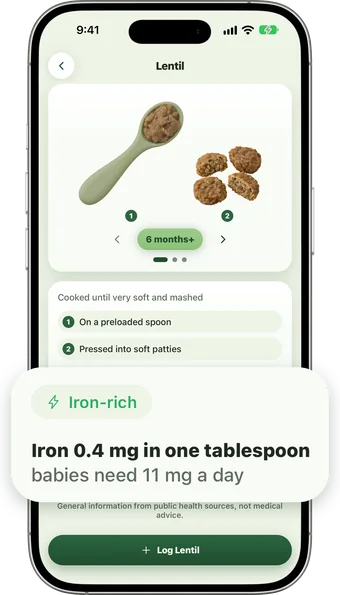
- By our math, most baby servings hold under 1 mg, and Sito's card for an iron-rich food shows that number.
The iron in one serving, on Sito's food cards
Sito is our app. From 4 months, Starting Solids shows how to serve each of 583 foods at your baby's age, with the serving for that age. On an iron-rich food, the card shows the iron in one serving, next to "babies need 11 mg a day".
- An "Iron-rich" chip on 149 of the 583 foods.
- Each food's own warning, a choking chip where it has a rule, and a Sources sheet.
- A quick log for each taste and how it went.
- A report for the doctor, made on your phone in six languages.
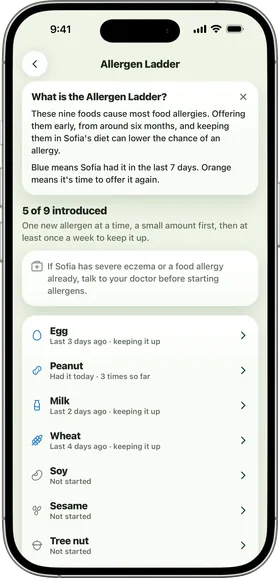
Sito keeps what your baby has tried, the allergens they have met and their growth. Full nutrition tracking opens at 12 months, on its own. See how Sito works for babies.
See the iron in your baby's serving
Add your baby and Starting Solids opens at 4 months. Free to download, free to try.
How much iron does a baby need?
Babies are born with enough iron to last about six months (MedlinePlus). Around 6 months, a baby's need for nutrients starts to outgrow what breast milk provides (WHO). So when solids start, the CDC says to choose foods that contain iron.
| Age | Iron a day |
|---|---|
| Under 6 months | 0.27 mg (Adequate Intake) |
| 7 months to 1 year | 11 mg |
| 1 to 3 years | 7 mg |
Source: MedlinePlus, from the National Academies' intake values.
Formula, breast milk and preterm babies
- Formula: standard iron-fortified infant formulas can meet a baby's iron needs for the first 12 months (CDC).
- Breast milk: ask your child's doctor or nurse if your baby needs iron supplements before 6 months (CDC). The AAP's July 2026 report lists iron supplements for exclusively breastfed babies by 6 months as part of prevention (AAP).
- Both, or born early: talk to the doctor or nurse about iron at the next checkup. Preterm babies may need extra iron beyond breast milk or formula (CDC).
Check with your pediatrician about iron and vitamin D supplements in the first year (AAP). For portion sizes, see how much a 6 month old should eat.
Iron rich foods for a 6 month old: the iron in one serving
How we worked it out: we took the iron per 100 g from USDA FoodData Central and multiplied it by the grams of the serving Sito's food card shows at that age, rounded to 0.1 mg. The arithmetic is ours. The serving is a first-foods portion, not a target.
| Food | At 6 months | Iron | At 9 months | Iron | Rule (from the table) |
|---|---|---|---|---|---|
| Oysters, cooked | 1 tbsp minced (14 g) | 1.3 mg | 1 oyster (25 g) | 2.3 mg | fully cooked; shellfish allergen |
| Mussels, cooked | 1 tbsp (14 g) | 0.9 mg | same | 0.9 mg | cooked through; shellfish allergen |
| Venison | 1 strip (20 g) | 0.9 mg | 1 patty (30 g) | 1.3 mg | ground: 160°F (71°C) |
| Iron-fortified infant cereal | 1 tbsp dry (2.5 g) | 0.8 mg | same | 0.8 mg | spoon, not bottle; rotate oat, barley, mixed; check label |
| Chicken liver | 1 tsp (5 g) | 0.6 mg | same | 0.6 mg | "Keep to a teaspoon-sized portion, no more than once a week." (vitamin A) |
| Steak | 1 strip (20 g) | 0.6 mg | 1 tbsp minced (12 g) | 0.4 mg | 145°F (63°C), rest 3 min |
| Ground beef | 1 small patty (20 g) | 0.5 mg | 1 tbsp (14 g) | 0.4 mg | 160°F (71°C) |
| Prunes | 1 tbsp mashed (18 g) | 0.5 mg | 1 prune (10 g) | 0.3 mg | prune juice waits to 12 months |
| Soybeans | 1 tbsp (10.7 g) | 0.5 mg | same | 0.5 mg | squash-soft; soy allergen |
Nine more iron foods
| Food | At 6 months | Iron | At 9 months | Iron | Rule (from the table) |
|---|---|---|---|---|---|
| Lentils | 1 tbsp (12.3 g) | 0.4 mg | same | 0.4 mg | red lentil patty at 9 mo (30 g): 1.0 mg |
| Chickpeas | 1 tbsp (15 g) | 0.4 mg | same | 0.4 mg | mashed or squashed flat |
| Sardines, canned | 1 tbsp mashed (15 g) | 0.4 mg | 1 piece (12 g) | 0.4 mg | no-added-salt cans |
| Spinach, cooked | 1 tbsp (12 g) | 0.4 mg | same | 0.4 mg | nitrate: serve fresh or freeze; one spinach meal a day at most |
| Tahini | 1 tsp (5 g) | 0.4 mg | same | 0.4 mg | thinned, never a spoonful; sesame allergen |
| Bread | 1 toast strip (10 g) | 0.4 mg | same | 0.4 mg | no added sugar or honey before 2 |
| Egg | 1 omelet strip (15 g) | 0.2 mg | half a hard-boiled egg (25 g) | 0.3 mg | cooked solid; egg allergen |
| Tofu, firm | 1 strip (15 g) | 0.2 mg | 1 tbsp (15 g) | 0.2 mg | plain only |
| Chicken | 1 strip (15 g) | 0.2 mg | 1 tbsp (12 g) | 0.1 mg | 165°F (74°C); bones, skin out |
Some 9 month servings are smaller, so the iron can drop at 9 months. By our math, at around 0.4 mg a tablespoon, no single baby serving comes near 11 mg. Iron comes from several iron foods plus breast milk or formula.
Heme iron, plant iron and vitamin C
Heme iron is found in animal foods such as red meat, fatty fish, chicken, turkey and eggs. The body absorbs it more easily than non-heme iron (CDC).
Non-heme iron is the plant kind, in iron-fortified infant cereals, tofu, beans, lentils and dark leafy greens. It is less easily absorbed. The CDC says getting enough from it alone "will require careful planning".
Two pairings help:
- Add vitamin C. Oranges, broccoli, cabbage, berries, papaya, tomatoes and sweet potatoes all carry it (CDC).
- Add meat, fish or poultry. Served with beans or greens, they can improve absorption of the plant iron up to three times (MedlinePlus).
Iron rich foods for baby led weaning
For meat at 6 months, offer soft, moist meat as a big strip to hold and suck, shredded, or minced into mash. Never offer small hard chunks. The NHS lists boneless meat, such as chicken and lamb, as a finger food. The AAP says to avoid "chunks of meat or cheese" before age 1. The CDC warns against "tough or large chunks of meat".
The NHS says a finger food should be big enough to hold in the fist with a bit sticking out. Fish without bones, boiled eggs, beans and lentils work too. It also says there is no more risk of choking when a baby feeds themselves than with a spoon.
- Have your baby sit up to eat, and stay to watch them the whole time (NHS, CDC).
- When you cut pieces, keep them no larger than one-half inch (AAP).
- Skip nuts, seeds, hot dogs and meat sticks, and spread nut butters thinly (AAP).
- Take a certified CPR and first aid course (AAP).
For how meals grow, see our baby feeding schedule by month.
Cow's milk, honey and other first year rules
- Cow's milk: not as a drink before 12 months. It can cause blood loss in the stool and lower iron absorption (AAP). It can go into cooking or be mixed with food from around 6 months (NHS).
- Honey: not before 12 months. It may cause botulism, a severe food poisoning (CDC).
- High-mercury fish: avoid shark, swordfish, king mackerel and bigeye tuna (CDC).
- Shellfish: skip it raw or lightly cooked (NHS).
For toddlers, see our guide to iron rich foods for picky eaters.
Signs of low iron and when to call the doctor
The AAP lists these signs of low iron:
- Pale, yellowish or ashy skin
- Faded color in the cheeks, lips, nail beds and eyelids
- A low or irritable mood
- Mild muscle weakness
- Seeming tired or needing more naps
- Chewing things that are not food (pica)
Severe signs include shortness of breath, a rapid heart rate and swollen hands and feet. If you notice any of these signs, call your pediatrician. Only a doctor can tell what they mean, and an app cannot diagnose.
The CDC says your child's doctor or nurse will likely test for anemia at around 12 months. The AAP describes screening from about 9 to 12 months for babies who mostly have breast milk. For babies who mostly have formula, it starts at 15 to 18 months.
If your doctor gives iron drops, keep them out of reach of children. Very high doses of iron can be fatal (NHS). Read more in our guide to iron deficiency in children.
FAQ
What fruit is highest in iron for babies?
In our table, prunes have the most iron of any fruit at 6 months: 0.5 mg in a tablespoon, mashed. Plant iron is harder to absorb, so serve prunes with a vitamin C food like berries or papaya (CDC).
Does my breastfed baby need iron drops?
Ask your pediatrician. The CDC says to ask about iron supplements before 6 months. The AAP says breastfed babies can benefit from them starting around 6 months. Your doctor decides whether your baby needs them and how much.
Does Sito count my baby's iron?
Under 12 months there is nothing to count. Each iron-rich food card in Sito shows the iron in one serving at your baby's age, next to the 11 mg a baby needs a day. Full nutrition tracking opens at 12 months, on its own. From then, iron is one of 18 nutrients Sito tracks from the meal log.
Sources
- MedlinePlus (NIH), Iron in diet
- CDC, Iron
- AAP HealthyChildren, Iron Deficiency and Anemia
- AAP, iron deficiency anemia guidance update (July 2026)
- AAP HealthyChildren, Starting Solid Foods
- AAP HealthyChildren, Choking Prevention
- WHO, Infant and young child feeding
- CDC, Choking Hazards
- CDC, Foods and Drinks to Avoid or Limit
- NHS, Your baby's first solid foods
- NHS, Foods to avoid giving babies and young children
- NHS, Iron
- USDA FoodData Central
Read next
- Starting Solids: How to Cut and Serve Each Food by Age
- 6 Month Old Feeding Schedule: How Much Milk, How Much Solid Food
- Baby Feeding Chart by Month: Milk, Solids and Textures From Birth to 12 Months
- Iron Deficiency in Children: Signs, Tests and What Helps
- Iron-Rich Foods for Toddlers and Picky Eaters (mg Chart)