
An E number is a code. It identifies a food additive that European and UK regulators have approved. In EFSA's words, "An E number means that an additive has passed safety tests and has been approved for use". It is not a score or a warning. Six colors do carry a printed warning about children, and the law names them. In our own table of 253 additives, 137 carry no risk class.
TL;DR
- An E number is an identity code for an approved additive, not a score and not a warning.
- Six colors must carry a warning about children on an EU or UK label; in our table of 253 additives, 137 carry no risk class.
- Sito scans the pack, names the additives, and turns the label into one score out of 100 for your child's own age.
Read the E numbers on a pack with Sito
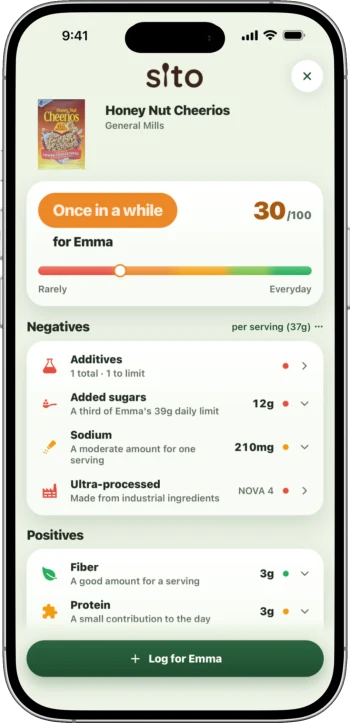
Sito is our app. Scan a barcode and it names the additives on the label. Each one gets its class from the same public table of 253 additives you can read at /additives. Tap one to see its class and the references behind it. A clean row gets an explanation too. "We have not heard of it" and "we looked, and it is clean" are different answers.
The score out of 100 weights nutrition at 50, additives at 33 and processing at 17. Under 6, the score is stricter: an additive our table flags for children moves up one class. The child's age never leaves the phone. Sometimes one serving is a quarter or more of your child's own daily limit for a nutrient. Then the sentence under the score says so.
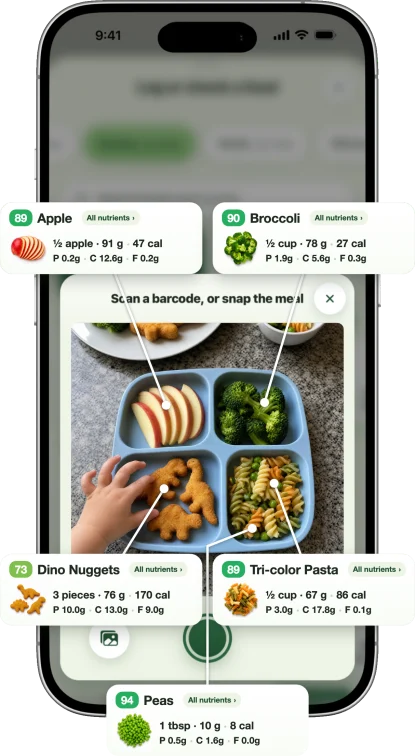
Then log the scan into your child's day. Each child has a profile, and a partner can log from their own phone. The method is public at /score.
Look up the E numbers on your own shelf
Scan a packaged food and Sito names the additives in it, then scores the product out of 100 for your child's age.
What is an E number?
The law defines a food additive as "any substance not normally consumed as a food in itself and not normally used as a characteristic ingredient of food … the intentional addition of which to food for a technological purpose" (Regulation 1333/2008, Article 3).
On a label, each additive appears by "Its functional class (e.g. Colour, Preservative) • Followed by either its specific name or E-number" (European Commission factsheet, February 2026). So "Colour: E129" and "Colour: Allura red" mean the same thing. Some are ordinary substances: the FSA names ascorbic acid, which is vitamin C, and citric acid.
Who decides an E number is safe?
In the EU, "The European Commission and EU Member States decide on the approval of food additives"; EFSA "provides scientific advice to support the authorisation process" (EFSA). Only additives "for which the proposed uses were considered safe are on the EU list", the European Commission says.
The FSA puts the UK test this way: "A food additive is only approved if; it has been tested and proved to be safe for its intended use; there is a justifiable technological need to use it; and its use does not mislead the consumer".
Why a US pack says Red 40 and never E129
The US has its own rules and names. Color additives there "require pre-market review and approval by the FDA" (FDA). On the label, "certified color additives must be declared by their listed names or appropriate abbreviations (for example, FD&C Red No. 40 or Red 40)" (FDA).
The FDA notes that "Other countries allow the use of FD&C Red No. 3 under a different name, such as in Canada and Europe under the name erythrosine" (FDA). Our table lists both names on one page, so Red 40 and E129 land together.
The six colors with a legal warning about children
Annex V of the regulation requires this wording on food and drink that contains any of six colors: "'name or E number of the colour(s)': may have an adverse effect on activity and attention in children" (Regulation 1333/2008, Annex V). The six are:
- Tartrazine (E 102)
- Quinoline yellow (E 104)
- Sunset yellow (E 110)
- Carmoisine (E 122)
- Ponceau 4R (E 124)
- Allura red (E 129)
The FSA explains why. Its research "found that consuming certain artificial food colours could cause increased hyperactivity in some children". So "Food and drink containing any of these six colours must carry a warning on the packaging".
The label is a precaution, not a finding about your child. In our table all six are Moderate risk, all six child flagged. The FSA adds: "It's important to remember that hyperactivity can also be caused by other things. So being careful about what a child eats may help manage hyperactive behaviour but it may not stop it".
Most E numbers are not a warning
Our table has 253 rows and 597 citations, most from EFSA and the FDA. By class: no risk identified 137, high 49, low 35, moderate 32. "No risk identified" means a clean current EFSA and FDA status, written out with its citations. An unfamiliar additive is never treated as a bad one.
Clean rows a parent meets most days include E322 lecithins, E300 ascorbic acid, E330 citric acid, E500 sodium carbonates and E551 silicon dioxide.
The class sets the points that come off the additive part of the score: high 30, moderate 15, low 6, no risk identified 0.
A few that do have a finding behind them
- E171 titanium dioxide. EFSA's panel "concluded that titanium dioxide can no longer be considered safe as a food additive" (EFSA, 6 May 2021). Our class: High.
- E127 erythrosine, Red 3 in the US. The FDA is withdrawing it: "On January 15, 2025, the FDA issued an order to revoke these authorizations". Food makers have until January 15, 2027 to reformulate. The FDA adds: "there is no evidence showing FD&C Red No. 3 causes cancer in humans" (FDA). Our class: High, child flagged.
- E211 sodium benzoate. EFSA's 2016 review found the group daily limit "exceeded in the brand-loyal scenario in particular for toddlers and children consuming on a regular basis flavoured drinks". Our class: High, child flagged.
- E951 aspartame. IARC placed it in Group 2B in 2023; EFSA's daily limit is 40 mg per kg of body weight. Our class: Moderate. The FSA says "Only people who are diagnosed at birth with phenylketonuria need to avoid foods containing certain sweeteners, i.e. aspartame and aspartame-acesulfame salt".
- E422 glycerol in slush drinks. UK industry guidance says these drinks "Should not be consumed by children under seven years of age" (FSA). The FSA calls this best practice, not a legal requirement.
Does the UK still use E numbers?
Yes. England and Wales run on "assimilated Regulation (EU) 1333/2008" and Northern Ireland on the EU regulation itself (FSA, June 2026). Same numbers, same list.
One color differs. "As of 7 February 2022, titanium dioxide (TiO2 - E171) is no longer permitted for use as a food additive in the manufacturing of food products in Northern Ireland". The FSA's approved list still carries E171, marked "not permitted for use in Northern Ireland".
How to look up an E number in under a minute
- Open /additives. Every row is searchable and individually linkable, and the whole file is downloadable.
- Type the number or the name. Addresses like /additives/e129 redirect to the named page.
- In the store, scan the pack with Sito instead. Tap a flagged additive and the card says it plainly: "It is legally sold today and nothing here says this product is unsafe".
What to do if you think a color affects your child
The American Academy of Pediatrics says "More research is needed to better understand how artificial food colors (AFCs) may or may not impact a child's behavior" (HealthyChildren.org). Children "have more exposure than adults based on their size and dietary intake".
For a child with attention deficit hyperactivity disorder, the AAP says "until we know more, it may be helpful to eliminate AFCs from their diet if they seem to worsen symptoms". Nothing stronger than that. An app cannot diagnose, so read the label, and "If you're concerned about food additives, talk with your pediatrician".
FAQ
Is E129 the same as Red 40?
Our table keeps E129 and Red 40 on one page. On the EU and UK list the name is Allura red (Annex V), and a US label carries the FDA's own listed name instead, "FD&C Red No. 40 or Red 40". Look up either one at /additives/red-40; /additives/e129 goes straight there.
Are E numbers banned in the US?
No. The US approves additives under its own rules, and color additives "require pre-market review and approval by the FDA". US packs use names rather than E numbers. One color is being withdrawn: the FDA revoked Red 3 on January 15, 2025 (FDA).
How do I check an E number on a pack?
Search it at /additives, or scan the barcode with Sito. The app carries the same 253 row table, names the additives on the label, and shows the class and references when you tap one. The score out of 100 then puts the whole label in one number for your child's age.
Sources
- Regulation (EC) No 1333/2008, Article 3, legislation.gov.uk: https://www.legislation.gov.uk/eur/2008/1333/article/3
- Regulation (EC) No 1333/2008, Annex V, legislation.gov.uk: https://www.legislation.gov.uk/eur/2008/1333/annex/V
- Food Standards Agency, Food additives, GOV.UK, 2018: https://www.gov.uk/government/publications/food-additives/food-additives
- Food Standards Agency, Approved additives and E numbers, GOV.UK, June 2026: https://www.gov.uk/government/publications/approved-additives-and-e-numbers/approved-additives-and-e-numbers
- EFSA, Food additives topic page: https://www.efsa.europa.eu/en/topics/topic/food-additives
- EFSA, Titanium dioxide: E171 no longer considered safe when used as a food additive, 6 May 2021: https://www.efsa.europa.eu/en/news/titanium-dioxide-e171-no-longer-considered-safe-when-used-food-additive
- European Commission, Food additives: https://food.ec.europa.eu/food-safety/food-improvement-agents/additives_en
- European Commission factsheet, Food additives in the EU: Safe use and clear labelling, February 2026: campaign-26_factsheet_food-additives.pdf
- FDA, Understanding how FDA regulates color additives: https://www.fda.gov/food/color-additives-information-consumers/understanding-how-fda-regulates-color-additives
- FDA, FD&C Red No. 3: https://www.fda.gov/industry/color-additives/fdc-red-no-3
- American Academy of Pediatrics, HealthyChildren.org, Are Food Additives Safe for Kids?, updated 9 September 2025: https://www.healthychildren.org/English/healthy-living/nutrition/Pages/Food-Additives.aspx
- Sito additive table, 253 rows with citations: sito.kids/additives; scoring method: sito.kids/score