
Carrageenan is the thickener the food industry lists as E407. In our table it is high risk: it takes 30 of the 33 additive points off a product's score for a child.
- High risk. 30 of the 33 additive points come off a product that carries it.
- Flagged for young children. Set only where EFSA’s own exposure assessment shows toddlers or children exceeding or approaching the ADI, or where a regulator used explicitly child-specific language. For a child under 6 it moves one class up.
- 4 citations from EFSA, IARC, each one below.
What Carrageenan does to a score
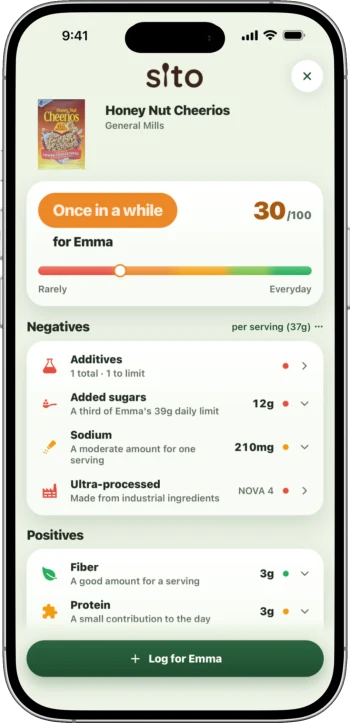
A packaged food starts with 33 points for what is in its ingredient list. Carrageenan takes 30 of the 33 additive points off a product's score, and a child under 6 sees it one class higher again. Scan the pack in Sito and the score you get is the one for your own child's age, with this additive named in the reasons. How we score has the whole method.
What the sources found
Every classification in our table comes from the citations below, and nothing else. They are quoted as the source wrote them.
-
EFSA
10.2903/j.efsa.2018.5238
Re-evaluation of carrageenan (E 407) and processed Eucheuma seaweed (E 407a): the existing group ADI of 75 mg/kg bw per day was made TEMPORARY because of uncertainties in chemistry, exposure and toxicology, with the database to be improved within 5 years. -
EFSA
PMC7009739 (full text of 10.2903/j.efsa.2018.5238)
Verbatim: 'in the refined brand-loyal exposure assessment scenario the exposure estimates exceeded, in some cases by up to approximately 10-fold, the temporary existing ADI at the high level (95th percentile) for all population groups and at the mean for all population groups except for infants and the elderly' - refined brand-loyal exposure up to 758.6 mg/kg bw per day for toddlers (12-35 months). -
EFSA
PMC7009739 (same opinion, infant section)
Panel: 'it remains inadvisable to use carrageenan in infant formulae that are fed from birth, including those in the category of foods for special medical purposes'; unresolved question of absorption by the immature gut of very young infants. -
IARC
Monographs Vol. 31 (1983); Supplement 7 (1987) - carrageenan
Degraded carrageenan classified Group 2B (possibly carcinogenic to humans; colorectal tumours induced in rats); native/undegraded carrageenan classified Group 3 (not classifiable).
Why this class
IARC Group 1 or 2A with a dietary exposure route; or EFSA has withdrawn or negated a safety conclusion; or EFSA’s own exposure assessment finds a child age group exceeding the ADI at mean intake; or the substance is banned or formally being phased out for food use by the EU, by the US FDA, or under a US state law.
Our confidence in this row's classification is high. Medium or low does not mean the evidence is weak; it means something about the row is still being pinned down, usually a regulatory status confirmed from one source rather than two.
See what is in your own cupboard
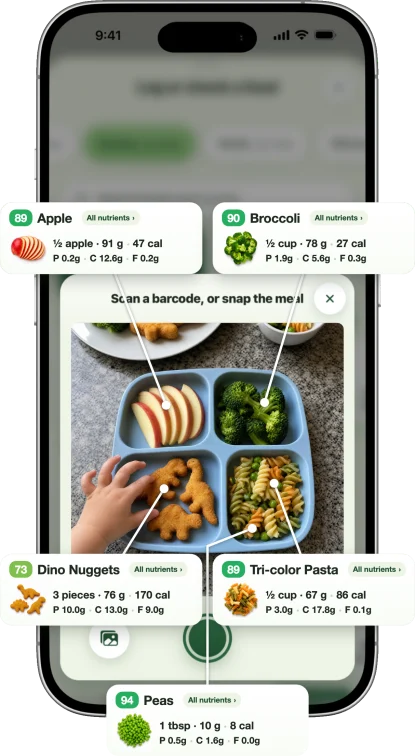
Scan a packaged food and Sito names the additives in it, then scores the product out of 100 for your child's age.
Other thickeners in the table
- Dextrin (E1400), no risk identified
- Modified starch (E14xx), no risk identified
- Acetylated distarch adipate (E1422), no risk identified
- Hydroxypropyl distarch phosphate (E1442), no risk identified
- CMC (E466), low risk
- Konjac (E425), moderate risk