
Most newborns feed 8 to 12 times a day (CDC). By 6 months a baby on formula takes about 6 to 8 ounces at 4 or 5 feeds (AAP), and solids can start with one meal a day (WIC). From 12 months a child eats 3 meals a day (NHS), and you can switch from formula to whole cow's milk (CDC). The chart below covers the first year, with a source for every number, and you can print it.
- Most newborns feed 8 to 12 times a day and formula starts at 1 to 2 ounces a feed (CDC), reaching 6 to 8 ounces, 4 or 5 times a day, by 6 months (AAP).
- Solids start around 6 months, not before 4: one small meal at first, about 3 meals by 9 to 12 months, and milk stays the main food.
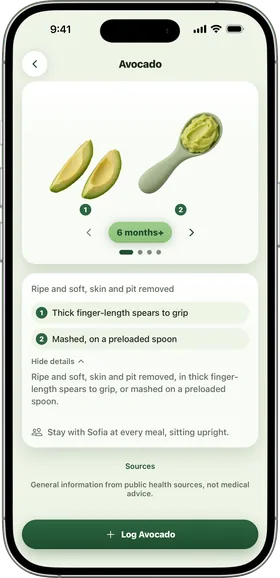
- Sito is our app: from 4 months, Starting Solids shows how to serve 583 foods at your baby's age and logs every taste.
Starting Solids in Sito, from 4 months
Sito changes with your baby's age. Under 4 months, add weight and length after each checkup to see where your baby sits on WHO's growth chart. At 4 months Starting Solids opens. Before the first taste it asks "Ready for solids?" and shows the NHS's three signs.
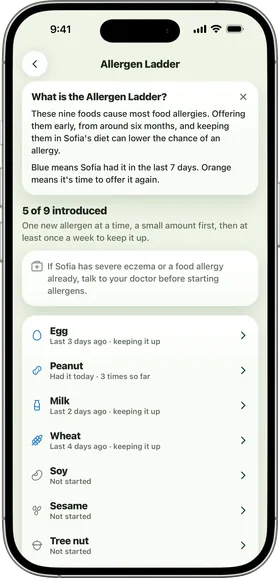
From there, Sito shows how to serve each of 583 foods at your baby's age: strips or mashed at 6 months, pieces about 1 cm at 9, chopped family food at 12. The Allergen Ladder takes 9 common allergens one at a time, with a check-in after each. The other parent joins with a code and logs tastes from their own phone. A PDF for the doctor, made on your phone, shows growth at every age and the foods tried since 4 months.
Log your baby's first foods
From 4 months, Starting Solids shows how to serve 583 foods at your baby's age and keeps how every taste went.
Baby feeding chart by month
These amounts are ranges from the AAP, CDC, WIC, WHO and NHS, not goals. Where sources differ, we show both and name each.
Baby Feeding Chart, Birth to 12 Months
| Age | Breast milk | Formula | Solid meals | How food is served |
|---|---|---|---|---|
| First week | On demand, 8 to 12 feeds a day (CDC, WIC); AAP says 10 to 12 | 1 to 2 oz a feed (CDC); no more than about 1 to 2 oz (AAP); WIC says 2 to 3 oz | None | Not yet |
| 2 to 4 weeks | Every 2 to 4 hours (CDC) | Building to 3 to 4 oz a feed (AAP), every 3 to 4 hours (AAP, CDC) | None | Not yet |
| 1 to 2 months | Every 2 to 4 hours (CDC) | At least 3 to 4 oz, about every 3 to 4 hours (AAP) | None | Not yet |
| 2 to 4 months | Every 2 to 4 hours; may have a longer sleep of 4 to 5 hours (CDC) | No amount per feed given; follow your baby's cues; day gaps occasionally up to 4 or 5 hours; no more than about 32 oz a day (AAP) | None | Not yet |
| 4 to 6 months | On demand (AAP) | By 6 months, 6 to 8 oz at 4 or 5 feeds (AAP) | Not before 4 months; about 6 months (CDC) | Watch for the three signs of readiness (NHS) |
| 6 months | On demand (WIC) | 6 to 8 oz at 4 or 5 feeds (AAP); about 24 to 32 oz a day (WIC) | 1 to start (WIC); WHO says 2 to 3 | Soft finger length strips, or mashed on a preloaded spoon (Sito table) |
| 7 to 8 months | Around 4 milk feeds (NHS) | About 24 to 32 oz a day (WIC); NHS says around 600 ml | 2 to 3 (WHO); moving toward 3 (NHS) | As at 6 months (Sito table); slightly coarser at about 8 months (AAP) |
| 9 to 11 months | About 3 milk feeds from 10 months (NHS) | Roughly 24 oz a day (AAP, WIC); NHS says about 400 ml from 10 months | 3 to 4 (WHO); 3 from 10 months (NHS) | Soft pieces about 1 cm to pinch, or mashed with lumps (Sito table) |
| 12 months | Can go on (WHO) | Not needed; whole cow's milk, about 16 oz a day (NHS, CDC, AAP) | 3 meals; may also need 2 snacks (NHS) | Chopped family food (Sito table) |
Every baby is different: follow your baby's hunger and fullness cues. Before 12 months: no honey, no juice and no cow's milk (CDC, AAP); the NHS allows cow's milk in cooking from around 6 months. Stay with your baby at every meal, sitting up (CDC). Questions about how much your baby eats or grows? Ask your pediatrician. Each number names its source: AAP (HealthyChildren.org), CDC, USDA WIC, WHO, NHS; food shapes from Sito's first-foods table. From 4 months, Sito shows how to serve each food at your baby's age. sito.kids/blog/baby-feeding-schedule-by-month, October 2026. General information, not medical advice: your baby's doctor has the final word.
Every baby is different, and babies generally stop eating when full (CDC). The NHS gives milk in ml: 600 ml is about 20 oz and 400 ml about 13.5 oz (our conversion).
How much should a newborn eat?
A breastfed newborn nurses about every 2 hours, 10 to 12 times in 24 hours (AAP); the CDC says 8 to 12 times (CDC). A bottle fed newborn may take only half an ounce a feed for the first day or two, then usually 1 to 2 ounces (AAP). Formula feeds come every 2 to 3 hours at first (CDC).
Follow your baby, not the clock. If your baby was born early or has a medical condition, the feeding schedule your pediatrician sets comes first (AAP). Babies on breast milk alone, or on under 32 ounces of formula a day, need extra vitamin D from shortly after birth, which vitamin D drops can give (CDC). The NHS advises a vitamin D supplement from birth for breastfed babies and babies on less than 500 ml of formula a day (NHS; see our vitamin D guide).
How many ounces should a baby drink by age?
The chart gives formula amounts by age. Between 2 and 6 months the AAP and CDC give no amount per feed. Follow your baby's cues, with no more than about 32 ounces a day (AAP). From 8 to 12 months, the AAP and WIC give roughly 24 ounces a day (AAP, WIC). If your baby consistently seems to want more or less than this, talk with your pediatrician (AAP).
When do babies start solid food?
Around 6 months, and not before 4 months (CDC). The AAP advises breast milk alone for about 6 months (AAP). Look for three signs together: your baby sits steady, picks food up and brings it to the mouth, and swallows it (NHS). Chewing fists, waking more at night or wanting extra milk can be mistaken for signs. If your baby was born early, ask your doctor when to start (NHS).
Start with half a spoonful or less, and give milk before and after the first tastes. If your baby cries or turns away, do not make them eat (AAP). The CDC starts with smooth foods (CDC); the NHS says some babies start with finger foods (NHS); our table offers both. Our baby led weaning guide and the Starting Solids food pages show how each food is served.
Baby feeding schedule by month, 6 to 12 months
6 months
Milk is still the main food (CDC). WIC starts with one meal a day (WIC), and the NHS says babies do not need 3 meals at first (NHS). A first serving is half a spoonful (AAP) or 1 or 2 tablespoons (CDC). Include foods that provide iron and zinc, such as baby food made with meat or iron-fortified cereals (AAP); our iron rich foods for babies list has more. You can offer a little water, 4 to 8 ounces a day, in a cup (AAP). Our table serves soft finger length strips, or mashed food on a preloaded spoon. There is no evidence that waiting past 4 to 6 months to give soft foods such as egg, dairy, soy, peanut products or fish prevents food allergy (AAP). If your baby has severe eczema or an egg allergy, ask the doctor before peanut (CDC); our guide to introducing allergens walks through it. A sample day is in our 6 month old feeding schedule.
7 and 8 months
Work toward 3 meals and around 4 milk feeds, about 600 ml of formula a day (NHS). By 7 or 8 months a baby can eat foods from different food groups, smooth at first and then lumpier (CDC). The AAP suggests slightly coarser foods at about 8 months (AAP). The full plan is in our 7 and 8 month old feeding schedule.
9 to 11 months
From about 10 months, 3 meals and about 3 milk feeds, about 400 ml of formula a day (NHS). WHO gives 3 to 4 meals (WHO). Pieces about 1 cm for pinching sit inside the AAP's half inch limit (AAP). Your baby sits up to eat, not in the car or stroller, with you watching the whole time (CDC). A baby who cannot breathe, gasps or wheezes, cannot cry or make a sound, grabs at the throat, turns bluish, or goes limp or unconscious needs help right away (AAP). Take a CPR and first aid course (AAP).
12 months
Three meals a day, and your child may also need 2 healthy snacks; formula is no longer needed (NHS). You can switch gradually to plain whole cow's milk, about 16 ounces a day (CDC, AAP). No honey before 12 months (CDC); our table waits until 2, since honey is an added sugar. At 12 months the full Sito app opens on its own. For plate sizes, see portion sizes by age.
Signs your baby is hungry, full or overfed
Under 6 months, a hungry baby brings hands to the mouth, turns to the breast or bottle and licks the lips. A full baby closes the mouth, turns away and relaxes the hands (CDC). From 6 months, a hungry baby reaches and opens the mouth; a full one pushes food away or turns the head. Your baby does not need to finish (CDC).
Bottle fed babies may keep sucking after they are full. An overfed baby can have stomach pains, gas, spit up or vomit. Offer less; you can always give more (AAP). If your baby wants to eat all the time, even when full, talk with your pediatrician (AAP).
Is my baby eating enough?
Your pediatrician plots your baby's weight on a growth chart at checkups; progress on it is one way to tell whether your baby gets enough food (AAP). A newborn's diapers are a good sign of whether they get enough. A newborn should have 2 to 3 wet diapers a day in the first few days, and at least 5 to 6 after the first 4 to 5 days (AAP). The NHS counts around 6 wet nappies a day from a few days after birth (NHS). After solids start, if stools stay loose, watery or full of mucus, talk with the doctor (AAP). If your baby is slow to gain weight, do not wait too long between feeds, even if it means waking the baby (AAP). Worried about how much your baby eats? Ask your doctor or nurse (CDC).
Where the AAP, CDC, WHO and NHS differ
| Question | AAP | CDC and WIC | WHO | NHS |
|---|---|---|---|---|
| Solids at 6 months | Half a spoonful or less | 1 or 2 tablespoons (CDC); one meal a day (WIC) | Small amounts; 2 to 3 meals a day at 6 to 8 months | A few pieces or teaspoons |
| Snacks before 1 | 2 in the 8 to 12 month sample day | WIC builds to 2 to 3 | 3 to 4 meals from 9 months, with 1 to 2 snacks as required | Not needed; offer extra milk instead |
| Juice under 1 | None | None | Limit | Not needed; if given, 1 part to 10 parts water, at meals |
| Whole nuts | On the choking list; keep high-risk foods away until 4 or older | On the choking list | Only in a safe form | Not under 5 |
If the advice differs, your pediatrician knows your baby.
Frequently asked questions
How many ounces should a baby drink?
The AAP gives no more than about 1 to 2 ounces a feed in the first week and at least 3 to 4 ounces by the end of the first month. By 6 months it is 6 to 8 ounces at 4 or 5 feeds, with no more than about 32 ounces a day (AAP). From 8 months, roughly 24 ounces a day (AAP). Breastfed newborns feed 8 to 12 times a day (CDC); the AAP says 10 to 12 (AAP).
When can babies go 4 hours between feedings?
The AAP says to wake a baby on formula who sleeps longer than 4 to 5 hours in the first few weeks and misses feeds (AAP). WIC says to wake a newborn who sleeps longer than 4 hours (WIC). The CDC says a breastfed baby may have a longer sleep of 4 to 5 hours in the first weeks and months (CDC). Between 2 and 4 months most babies on formula no longer need a night feed, and day gaps occasionally reach 4 or 5 hours (AAP). A big feed does not mean a longer gap (NHS). If your baby has trouble gaining weight, do not wait too long between feeds (AAP).
What are the signs of overfeeding a baby?
An overfed baby can have stomach pains, gas, spit up or vomit (AAP). Offer less; you can always give more. A baby who wants to eat all the time, even when full, is a question for your pediatrician (AAP).
How many months to start feeding a baby?
About 6 months, and not before 4 months (CDC). Wait for three signs together: your baby sits steady, brings food to the mouth, and swallows (NHS).
Is there an app to log my baby's first foods?
Yes. Sito is our app. From 4 months, Starting Solids shows how to serve 583 foods at your baby's age and logs each taste with how much, the texture and how it went. The Allergen Ladder takes 9 common allergens one at a time, with a check-in after each. At 12 months the full app opens on its own.
Sources
- AAP HealthyChildren, Amount and Schedule of Baby Formula Feedings
- AAP HealthyChildren, How Often and How Much Should Your Baby Eat?
- AAP HealthyChildren, When Can Babies Start Solid Foods? Readiness & Feeding Tips
- AAP HealthyChildren, Recommended Drinks for Children Age 5 & Younger
- AAP HealthyChildren, Choking Prevention for Babies & Children: What Every Parent Needs to Know
- CDC, How Much and How Often to Feed Infant Formula
- CDC, How Much and How Often to Breastfeed
- CDC, Signs Your Child Is Hungry or Full
- CDC, When, What, and How to Introduce Solid Foods
- CDC, How Much and How Often To Feed
- CDC, Choking Hazards
- CDC, Foods and Drinks to Avoid or Limit
- USDA Food and Nutrition Service, Infant Nutrition and Feeding: A Guide for Use in the WIC Program (2019, PDF)
- WHO, Infant and young child feeding (fact sheet)
- WHO, Guideline for complementary feeding of infants and young children 6-23 months of age (2023)
- NHS, Formula milk: common questions
- NHS, Your baby's first solid foods
- NHS, Baby and toddler meal ideas
- NHS, Foods to avoid giving babies and young children
- NHS, Drinks and cups for babies and young children