
Citric acid is the acidity regulator the food industry lists as E330. In our table it is no risk identified: it takes no points off a product's score.
- The key finding, from EFSA: Panel notes citrate's established role as a citric-acid-cycle intermediate and confirms JECFA's (1974) 'ADI not specified' for citric acid and citrates (EFSA Journal 2016;14(11):4599, Safety of trimagnesium dicitrate anhydrous as a food additive)
- No child flag. The class, and the points it costs, are the same for a child of any age.
- Where you meet it. It turns up in 1,105 of the 10,000 packaged foods scanned most on Open Food Facts, most often in cookies, soft drinks and sauces. Nine in ten of those foods are sold in Europe (counted 26 Sep 2026).
- 2 citations from EFSA and EU law, each one below.
What Citric acid does to a score
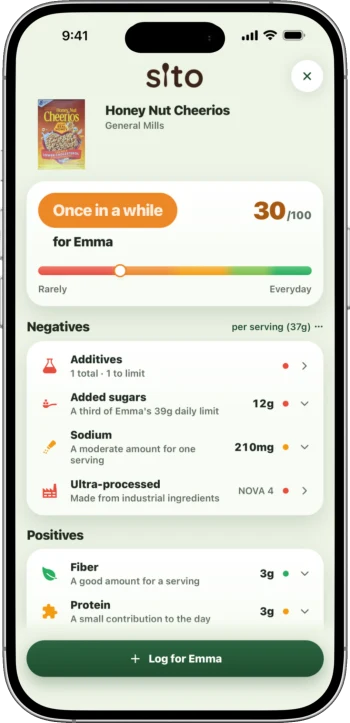
A packaged food's additive subscore starts at 100 and loses points for each additive on the label; that subscore is a third of the final score. Citric acid takes no points off a product's score. Scan the pack in Sito and the score you get is the one for your own child's age, with this additive named in the reasons. How we score has the whole method.
See what is in your own cupboard
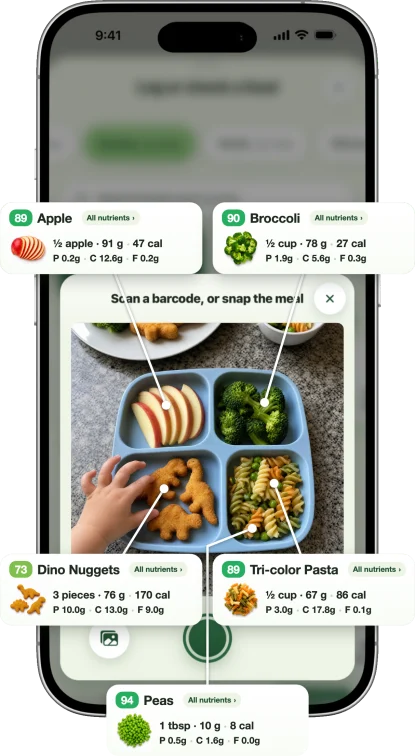
Scan a packaged food and Sito names the additives in it, then scores the product out of 100 for your child's age.
What the sources found
Every classification in our table comes from the citations below, and nothing else. Each finding is our one-line summary of what the source concluded, with the source and reference beside it.
-
EFSA
Journal 2016;14(11):4599 — Safety of trimagnesium dicitrate anhydrous as a food additive
Panel notes citrate's established role as a citric-acid-cycle intermediate and confirms JECFA's (1974) 'ADI not specified' for citric acid and citrates. -
EU law
Regulation (EC) No 1333/2008 Annex II (EU Union list), EUR-Lex ELI: reg/2008/1333
E 330 authorised in the EU as a Group I additive at quantum satis across most food categories; no restriction tied to children.
Why this class
Clean current EFSA and FDA status. These rows exist so that an unfamiliar additive is never treated as a bad one: a missing row costs a product nothing, and a clean row says so with citations.
Our confidence in this row's classification is high. Medium or low does not mean the evidence is weak; it means something about the row is still being pinned down, usually a regulatory status confirmed from one source rather than two.
Questions parents ask
Is Citric acid (E330) safe for kids?
No risk identified. No regulator finding we score, so a product keeps its full additive subscore in Sito. The current status is clean: Panel notes citrate's established role as a citric-acid-cycle intermediate and confirms JECFA's (1974) 'ADI not specified' for citric acid and citrates (EFSA Journal 2016;14(11):4599, Safety of trimagnesium dicitrate anhydrous as a food additive).
What is E330?
E330 is the E number for Citric acid, an acidity regulator. Open Food Facts tags it en:e330.
Next to it on the label
The E numbers either side of E330 in our table, then the closest acidity regulators by number.
- Potassium lactate (E326), no risk identified
- Calcium lactate (E327), no risk identified
- Sodium citrates (E331), no risk identified
- Potassium citrates (E332), no risk identified
- Calcium citrates (E333), no risk identified
- L(+)-tartaric acid (E334), no risk identified