
Allergens can start once solids start. ASCIA puts that "usually around 6 months of age and not before 4 months of age," once your baby shows signs of being ready.
- Start allergens when solids start, around 6 months and never before 4, one at a time.
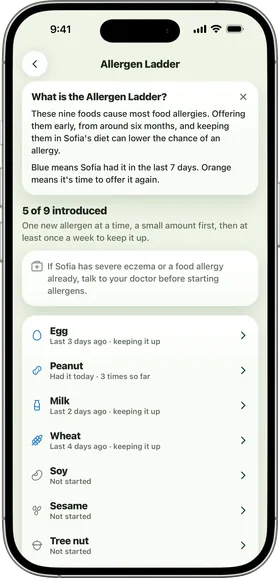
- Begin with a small taste. Once it goes well, offer it at least once a week. Sito's Allergen Ladder shows which one is due.
- Most reactions show within minutes, up to 2 hours. Trouble breathing, a swollen tongue or throat, or pale and floppy: call 911 (999 UK, 000 AU).
Track every allergen and how it went
Sito is our app. Its Allergen Ladder covers the nine common allergens. The plan: one new allergen at a time, a small amount first, then at least once a week to keep it up.
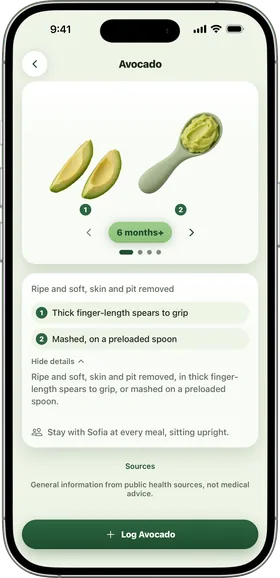
- A first taste in plain words. Each allergen's page names an amount, such as "A quarter of a teaspoon of well-cooked whole egg, mashed into food." The same quarter teaspoon for all nine is our app's choice.
- A check-in after each taste. Sito asks "How did it go?" With notifications on, one reminder comes two hours later if you have not answered.
- What is due this week. Orange means "offer it again this week."
- Help if something happened. The form opens with the emergency signs. That allergen pauses, with a note to talk to your doctor before the next taste.
- A report for the doctor. A PDF of the nine allergens and any reactions, made on your phone.
The ladder sits on the home screen from 4 to 11 months and stays open until age 2. See what Sito does for babies.
Take the 9 allergens one at a time
Add your baby and the Allergen Ladder opens with Starting Solids at 4 months. Free to download, free to try.
When to start introducing allergens to your baby
Start when solids start. The NHS says from around 6 months, one at a time, so you can spot any reaction. The AAP names peanuts, eggs, dairy and sesame as allergens to offer from around 6 months. It adds: "Delaying the introduction of these foods may actually raise the risk" (AAP HealthyChildren).
New to solids? See how much a 6 month old eats and our baby feeding schedule by month.
Which allergens to introduce: the nine
ASCIA names nine common allergy causing foods: cow's milk, egg, peanut, tree nuts, wheat, soy, sesame, fish and shellfish. It says to offer them "in the first year of life (by 12 months of age)," starting with foods your family eats.
Allergen introduction schedule: a plan you can follow
| Step | What to do | Who says so |
|---|---|---|
| 1. Start solids | Around 6 months, never before 4, when your baby is ready | ASCIA, NHS, AAP |
| 2. Eczema or an allergy already? | Talk to your doctor first. Groups differ on which babies (see below) | NHS, AAP, NIAID |
| 3. Egg and peanut early | Soon after solids start: well-cooked egg, smooth peanut butter thinned, no whole nuts | ASCIA, AAP |
| 4. One new allergen at a time | One per meal. Gaps differ: at least a day, or 3 to 5 days (see FAQ) | ASCIA, AAP, CDC |
| 5. Small first taste | About 1/4 teaspoon of egg or peanut in a food your baby already eats, then 1/2, then up to a normal serving | ASCIA |
| 6. Watch | Stay with your baby. Most reactions show within minutes, up to 2 hours | ASCIA, NHS |
| 7. Keep it up | Once it goes well, at least once a week | ASCIA |
| 8. If there is a reaction | Stop that food, get medical advice, keep going with the others. Emergency: call 911, 999 (UK) or 000 (AU) | ASCIA, AAP, NHS |
How to introduce peanut to baby
ASCIA suggests smooth peanut butter or paste, or finely ground peanut, "not whole nuts or pieces," soon after solids start.
- First time: "a small amount (1/4 teaspoon)" mixed into a food your baby already eats.
- Next time, with no reaction: increase "from 1/4 teaspoon to 1/2 teaspoon."
- After that: keep "doubling the amount up to what is considered a normal serve for their age."
The AAP suggests thinning a small amount of peanut butter in cereal, pureed fruit or yogurt. Once it goes well, the AAP's example portion is 2 teaspoons of peanut butter.
The AAP calls whole peanuts and tree nuts choking hazards for babies and young children. Avoid whole peanuts until a child can chew them well, usually at least 4 years and up. "Always stay with your baby when they're eating in case they start to choke," says the NHS.
How to introduce egg to baby
ASCIA suggests "well cooked whole egg (such as mashed hard-boiled)" soon after solids start. The amounts match peanut, starting at 1/4 teaspoon. Once egg goes well, the AAP's example portion is about 1/3 of a well-cooked egg.
If your baby has eczema or a food allergy already
The groups differ here.
- ASCIA: its advice "is relevant for all babies, including those with eczema and/or food allergy."
- NHS: with a diagnosed food allergy or eczema, or a family history, "Talk to your GP or health visitor first."
- AAP: "If your baby has eczema or a family history of allergies, check with your pediatrician first." For severe eczema (needing prescription creams often) or egg allergy, "testing for peanut allergy is recommended" (AAP HealthyChildren).
- NIAID (2017): with severe eczema, egg allergy or both, peanut "as early as 4 to 6 months," after checking with your provider, who "may choose to perform an allergy blood test" or refer you. Mild to moderate eczema: "around 6 months." Neither: "freely introduce" (NIAID).
- US and Canadian allergy societies (2021): peanut and egg around 6 months, not before 4. "Screening before introduction is not required, but may be preferred by some families" (JACI In Practice 2021).
None of them advise putting allergens off. Sito's ladder says to talk to your doctor first if your baby has severe eczema or a food allergy. If you are not sure which applies, ask your baby's doctor.
Signs of an allergic reaction in a baby
"Most allergic reactions are mild," says the NHS. They usually show within a few minutes of a new food, but it may take up to 2 hours. The NHS lists these signs:
- swollen lips or face
- red, itchy, watery eyes
- wheezing and coughing
- a red, itchy rash, or eczema that gets worse
- being sick, tummy pain, diarrhea or constipation
- sneezing, or a runny or blocked nose
ASCIA adds hives or welts, noisy breathing, a swollen tongue, being pale and floppy, and becoming very unsettled. "Eye rubbing, repetitively sticking tongue out, excessive crying, arching of the back and decreased muscle tone" may be signs in babies, says the AAP.
A mild rash around the mouth (redness or contact hives) with no other signs "is not usually an allergic reaction," ASCIA says. It says to offer the food again.
What to do if your baby has a reaction
Call 911 now (999 in the UK, 000 in Australia) if your baby has difficult or noisy breathing, a swollen tongue or throat, or is pale and floppy. These are signs of anaphylaxis on the ASCIA action plan. A child who is "limp, floppy or not responding like they normally do" is also a reason to call, says the NHS. The ASCIA plan says to hold young children flat, not upright.
The plan warns that milder signs may not always come first, and that anaphylaxis can occur without skin symptoms.
For milder signs, ASCIA says to "stop feeding your baby that food and seek medical advice." Before trying that food again, get specialist medical advice. If one food causes a reaction, other common allergy causing foods "should still be introduced," says ASCIA.
Delayed reactions
Some reactions are slow and show up "sometimes days later" (AAP). With cow's milk allergy, symptoms "can take up to 3 days" (NHS).
One slow type, FPIES, "can be mistaken for a stomach bug" (AAP). Its most common symptom is "repeated vomiting, usually one to four hours after eating the trigger food," says ASCIA. For diarrhea, rash or vomiting after a new food, the AAP's general advice is to "stop using the new food and consult with your child's pediatrician."
Frequently asked questions
How long should I wait between new allergens?
The groups differ. ASCIA says "only introduce one new food at the same meal." One AAP page says "wait at least a day." The AAP's Starting Solid Foods page and the CDC say 3 to 5 days. Ask your baby's doctor which gap fits your baby.
Do I need an allergen introduction kit?
ASCIA recommends "actual food." It says starter packs "can be unnecessary and costly if common allergy causing foods are regularly included in family meals" (ASCIA).
Can an app tell me if my baby is allergic?
No app can diagnose an allergy. Sito is a guide, not medical advice. It keeps a record of each taste and how it went, in a PDF you can share with your doctor. After a reaction, we ask before adding it to your child's allergies: "Decide this with your doctor." Once added, Sito warns about it in foods and scans. See our food allergy app for kids guide.
Sources
- ASCIA, How to Introduce Solid Foods (2026)
- ASCIA Action Plan for Allergic Reactions (2026)
- ASCIA, FPIES (2026)
- ASCIA, Food Allergen Starter Packs FAQ (2026)
- NHS, Food allergies in babies and young children
- NHS, Your baby's first solid foods
- NHS, Anaphylaxis
- AAP HealthyChildren, Starting Solid Foods
- AAP, When to Introduce Egg, Peanut Butter and Other Allergens
- AAP HealthyChildren, Food Allergies in Children
- AAP HealthyChildren, Peanut Allergy: Latest Prevention Guidelines
- CDC, When, What, and How to Introduce Solid Foods
- NIAID, Peanut Allergy Prevention, Summary for Parents (2017)
- Fleischer et al., JACI In Practice 2021