
Consumer Reports tested 21 popular kids' snacks and flagged 14 of them for at least one contaminant. The lines it drew were its own screening levels, built on California and EPA benchmarks, not legal limits (Consumer Reports). Here is what was found, what the FDA says, and what you can check on a pack.
TL;DR
- Consumer Reports tested 21 kids' snacks and flagged 14 on at least one contaminant; seven were below its level of concern on every test.
- Those benchmarks are conservative screening levels CR chose, not legal limits, and the FDA sets no maximum for acrylamide in food.
- The part of a pack you can act on is the label, and Sito scores it for your child's own age.
How Sito reads the label for your child
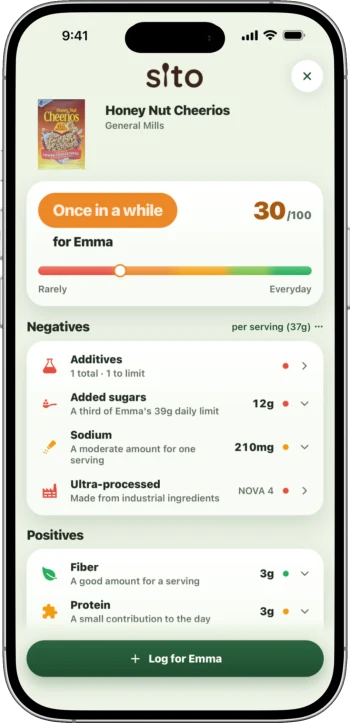
Sito is our app. Scan a snack and we give it a score from 0 to 100, calculated only from what is printed on its label. The score is read for your child's own age, and it is stricter under 6. An additive our risk table flags for children moves up one class there, which takes points off. See how the score works.
Half of the score is nutrition, a third is additives, and the rest is processing. That third comes from our public additive table: 253 additives with 597 citations, 76 of them flagged for children. When one serving carries a quarter or more of your child's own daily added-sugar limit, the card says so in your child's name. Then log it into their day.
Check the snacks in your own cupboard
Scan a packaged snack and Sito names the additives in it, then scores the product out of 100 for your child's age.

What Consumer Reports tested, and what it found
CR evaluated 21 popular kids' snacks for process contaminants, phthalates and heavy metals. It published the report on August 26, 2026 and updated it on September 9. The news wave came later.
The reassuring half gets cut from most retellings. Seven products had every contaminant below CR's level of concern. None of the products had concerning levels of arsenic or lead, and mercury was not detectable in any of them (Consumer Reports).
Acrylamide was found in 13 of the 14 products tested for it. Ten of the 21 had measurable phthalates, and only three exceeded CR's level of concern.
Which snacks were flagged, and which were not
CR's chart sorts the 21 snacks into serving advice. Its strictest line, "serve very rarely (at most twice a month)", went to four products.
| CR's serving line | Products (CR's findings) |
|---|---|
| Serve very rarely (at most twice a month) | Annie's Organic Cheddar Bunnies; Lay's Classic Potato Chips; Snyder's of Hanover Mini Pretzels; Nature Valley Crunchy Granola Bars Oats 'n Honey |
| Contaminants of concern: none. One per day is fine | Pirate's Booty Aged White Cheddar Rice & Corn Puffs; Dannon Danimals Pouches Strawberry; Frigo Cheese Heads Whole Milk String Cheese; Stonyfield Organic Yogurt Tubes Strawberry; Annie's Organic Fruit Snacks Berry Patch; GoGo SqueeZ Fruitz Applesauce Pouch; Welch's Fruit Snacks Mixed Fruit |
Nature Valley Crunchy Granola Bars Oats 'n Honey had the highest acrylamide reading per serving: 10.1 micrograms in a 42 gram serving of two bars. That number is measured against CR's own threshold, not a legal one.
CR also says its serving limits are "based on CR's testing for contaminants only, and do not reflect a product's nutritional value". A fruit snack can clear every contaminant test and still be mostly sugar. That part the label tells you.
What acrylamide is, and where it comes from
Acrylamide can form in some foods during high temperature cooking, such as frying, roasting and baking. It does not come from packaging or the environment (FDA).
The FDA says acrylamide caused cancer in animals exposed to very high doses. In people, the European Food Safety Authority calls the evidence "limited and inconclusive". It adds that children are the most exposed age group by body weight (EFSA).
Organic does not change this. The FDA says acrylamide levels in cooked organic foods should be similar to levels in cooked non-organic foods.
What phthalates are, and how they get into food
Phthalates are not allowed to be added to food directly. The FDA currently allows nine of them in food contact uses, mostly as plasticizers (FDA). From there, small amounts can migrate into what we eat.
So they never appear on an ingredient list. The American Academy of Pediatrics explains that indirect additives from processing or packaging "are not listed on the ingredient labels", including chemicals from plastic, glues, dyes, paper and coatings (AAP).
Heat speeds it up. The AAP notes that heat can cause plastics to leak BPA and phthalates into food. Both the AAP and CR suggest glass over plastic, and never heating food in plastic.
Is any of this against the law?
No. The FDA's guidance for industry on acrylamide says plainly that it "does not identify any specific maximum recommended level or action level". Guidance documents are not legally enforceable (FDA guidance).
So what did the flagged snacks exceed? CR's own line. It worked out a hazard quotient: the exposure in one serving divided by a protective exposure limit from the EPA or California's OEHHA. CR calls that quotient its "level of concern". Its model child weighs 23.1 kg (about 51 pounds) and eats the manufacturer's recommended daily servings.
For acrylamide, the benchmark is California's Proposition 65 No Significant Risk Level of 0.2 micrograms per day (OEHHA). That is a warning threshold for product labels in one state. It is a conservative screening level, not a federal limit or a violation.
In 2022 the FDA revoked authorization for 23 of 28 phthalates, because industry had stopped using them. The same day it denied a petition to revoke the food contact uses of all 28 on safety grounds (FDA update). Nine remain allowed.
The Consumer Brands Association pushed back on the report, saying many of the substances occur naturally or form during preparation. CR replied that its scientists do not dispute that baking and flash frying form them.
One epidemiologist's read
The epidemiologist Gideon Meyerowitz-Katz read the same results and found them "pretty reassuring" (Slate). The main contaminant CR found was acrylamide, which he calls by far the least worrying thing to find in food.
His summary: very high doses are linked to cancers in animal studies, but acrylamide is generally not thought to be harmful at the amounts found in food. Eating these snacks regularly, he writes, "will likely not even affect" a child's health.
Michael Glazier, the pediatrician CR quotes, lands close by: "Small, occasional exposures are probably both unavoidable and inconsequential."
What you can do this week
Nothing here needs a pantry clear out. Dani Lebovitz, the pediatric dietitian CR quotes, puts it simply: "A completely contaminant-free pantry doesn't exist."
- Rotate. Her advice is to swap between a few snacks across the week instead of relying on the same one every day. That lowers repeated exposure while keeping foods your child loves (Consumer Reports).
- Add whole foods. CR's examples: apple slices with nut or seed butter, carrots or cucumber with hummus, blueberries with yogurt.
- Cook lighter. Toasting bread to light brown rather than dark brown lowers acrylamide. Soaking raw potato slices in water for 15 to 30 minutes before frying or roasting does too (FDA).
- Read the label. CR's advice is to look for fiber and protein, and relatively low added sugar and sodium.
That step has a catch. The % Daily Value on a pack is an adult's day: 50 grams of added sugar on a 2,000 calorie diet (FDA). The sodium Daily Value is less than 2,300 mg, and the FDA says limits for children under 14 are lower (FDA). A four year old's day is much smaller.
That is where Sito helps. The score reads the label against your child's own limits, not an adult's. The added-sugar cap is 10 percent of that child's energy, and zero under 24 months. The kids' calorie calculator shows the size of that day.
An app cannot diagnose anything. If you are worried about a specific exposure, or a symptom you are trying to explain, talk to your pediatrician.
FAQ
Which snacks did Consumer Reports flag?
CR flagged 14 of 21 snacks on at least one contaminant. Four got its "serve very rarely" line: Annie's Organic Cheddar Bunnies, Lay's Classic Potato Chips, Snyder's of Hanover Mini Pretzels, and Nature Valley Crunchy Granola Bars Oats 'n Honey. Three exceeded its phthalate level of concern: Annie's Cheddar Bunnies, Slim Jim Mild Snack Size Sticks, and Clif Zbar Chocolate Chip. Seven had no contaminant of concern.
Is acrylamide in snacks against the law in the US?
No. The FDA's guidance sets no maximum or action level for acrylamide, and guidance is not legally enforceable. CR measured against California's Proposition 65 level of 0.2 micrograms per day and EPA exposure limits. Those are protective screening levels, not federal limits.
Are organic snacks lower in acrylamide?
The FDA says no. Acrylamide forms during high heat cooking, so cooked organic foods should have levels similar to non-organic ones. Annie's Organic Cheddar Bunnies was one of the four snacks on CR's strictest line.
How do phthalates get into a snack if they are not an ingredient?
They migrate from food contact materials. The FDA allows nine phthalates in food contact applications such as packaging, and the AAP notes these indirect additives never appear on ingredient labels. Heat makes plastics release more, so the AAP and CR both suggest glass over plastic and never heating food in plastic.
What can I actually check on the pack?
The label. CR suggests fiber, protein, and relatively low added sugar and sodium. The pack's % Daily Value is for an adult on 2,000 calories, and the FDA says children's sodium limits are lower. Sito reads the same label and gives a 0 to 100 score for your child's own age, with nutrition as half of it. When one serving is a quarter or more of your child's own added-sugar limit, the card tells you in their name.
Sources
- Consumer Reports, "We Found Harmful Contaminants in Most of the Kids' Snacks We Tested, but Some Better Options, Too", Lisa Valente MS RD, published August 26, 2026, updated September 9, 2026. consumerreports.org
- Consumer Reports, "Contaminants in Kids' Snacks" Test Methodology, August 2026. consumerreports.org (PDF)
- FDA, Acrylamide Questions and Answers, current 03/05/2024. fda.gov
- FDA, Guidance for Industry: Acrylamide in Foods, March 2016. fda.gov
- FDA, Acrylamide and Diet, Food Storage, and Food Preparation. fda.gov
- FDA, Phthalates in Food Packaging and Food Contact Applications. fda.gov
- FDA, Constituent Update on Phthalates, October 29, 2024. fda.gov
- FDA, Added Sugars on the Nutrition Facts Label. fda.gov
- FDA, Sodium in Your Diet. fda.gov
- OEHHA, Proposition 65 Initial Statement of Reasons, Acrylamide, September 24, 2021. oehha.ca.gov
- EFSA, Acrylamide in food is a public health concern, June 4, 2015. efsa.europa.eu
- AAP HealthyChildren, Are Food Additives Safe for Kids?, updated September 9, 2025. healthychildren.org
- Gideon Meyerowitz-Katz, "There's a Scary-Sounding New Report on Kids' Snack Foods. What Should Parents Make of It?", Slate, September 14, 2026. slate.com