Quinoline Yellow is the color the food industry lists as E104. In our table it is moderate risk: it takes 15 points off the additive subscore, a third of a product's score (about 5 of the 100).
- The key finding, from EFSA: ADI reduced from 10 to 0.5 mg/kg bw/day; at maximum usage levels refined intake estimates were generally well above the new ADI for both children and adults (10.2903/j.efsa.2009.1329)
- Flagged for young children. Set only where EFSA’s own exposure assessment shows toddlers or children exceeding or approaching the ADI, or where a regulator used explicitly child-specific language. For a child under 6 it moves up one class, to high risk.
- Where you meet it. It turns up in 3 of the 10,000 packaged foods scanned most on Open Food Facts, most often in soft drinks. Nine in ten of those foods are sold in Europe (counted 26 Sep 2026).
- 3 citations from EFSA and EU law, each one below.
What Quinoline Yellow does to a score
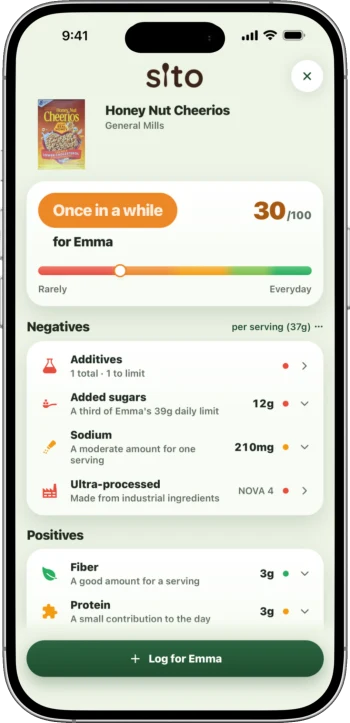
A packaged food's additive subscore starts at 100 and loses points for each additive on the label; that subscore is a third of the final score. Quinoline Yellow takes 15 points off the additive subscore, a third of a product's score (about 5 of the 100), and a child under 6 sees it one class higher again. Scan the pack in Sito and the score you get is the one for your own child's age, with this additive named in the reasons. How we score has the whole method.
See what is in your own cupboard
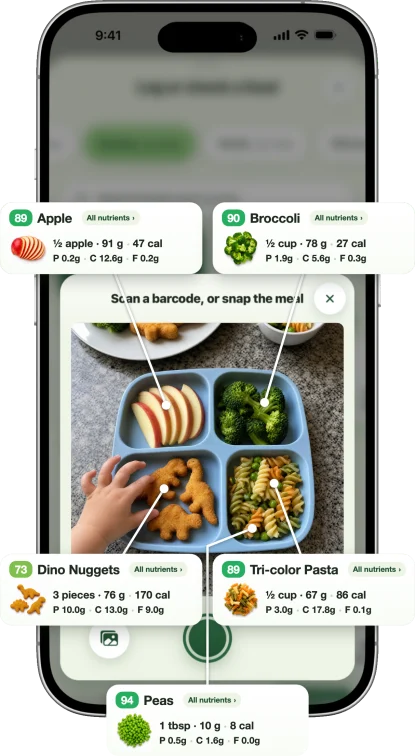
Scan a packaged food and Sito names the additives in it, then scores the product out of 100 for your child's age.
What the sources found
Every classification in our table comes from the citations below, and nothing else. Each finding is our one-line summary of what the source concluded, with the source and reference beside it.
-
EFSA
10.2903/j.efsa.2009.1329
ADI reduced from 10 to 0.5 mg/kg bw/day; at maximum usage levels refined intake estimates were generally well above the new ADI for both children and adults. -
EFSA
10.2903/j.efsa.2015.4070
After the 2013 reduction of maximum permitted levels, mean and high-level exposure estimates were below the ADI for all population groups in all three scenarios. -
EU law
Regulation (EC) No 1333/2008, Annex V
Mandatory child activity/attention warning label.
Why this class
IARC Group 2B; or an EFSA re-evaluation that flagged genotoxicity data gaps, found safety could not be assessed on the available data, or cut the ADI citing child exposure; or an EU harmonised classification of the substance as a reproductive or developmental hazard; or an EU withdrawal of one authorised food use while others remain; or an OEHHA/Proposition 65 listing; or membership of the Southampton-six colourants.
Our confidence in this row's classification is high. Medium or low does not mean the evidence is weak; it means something about the row is still being pinned down, usually a regulatory status confirmed from one source rather than two.
Questions parents ask
Is Quinoline Yellow (E104) safe for kids?
Moderate risk. In Sito it takes 15 points off the additive subscore, a third of a product's score (about 5 of the 100). It is flagged for young children, so for a child under 6 it moves up one class, to high risk: 30 points off the additive subscore. The finding we rely on: ADI reduced from 10 to 0.5 mg/kg bw/day; at maximum usage levels refined intake estimates were generally well above the new ADI for both children and adults (EFSA, 10.2903/j.efsa.2009.1329).
What is E104?
E104 is the E number for Quinoline Yellow, a color. Open Food Facts tags it en:e104.
Next to it on the label
The E numbers either side of E104 in our table, then the closest colors by number.
- Curcumin (E100), low risk, flagged for young children
- Riboflavin (E101), no risk identified
- Yellow 5 (E102), moderate risk, flagged for young children
- Yellow 6 (E110), moderate risk, flagged for young children
- Cochineal / carmine (E120), low risk
- Azorubine / carmoisine (E122), moderate risk, flagged for young children
Read next
- The full table: E104 and 252 other additives, 597 citations
- How a moderate risk additive costs a food 15 of its 100 additive points
- What an E number like E104 means, and who approves it
- Our study of 3,000 products: the flagged additive parents meet most is not a dye
- Red 40, also flagged for young children: what the rules say