
Sito is our app for children's nutrition. It tracks your child's iron and calcium from every meal you log and sets a goal for their age from the first birthday. For US children, those goals are the daily amounts the NIH lists. You enter a birthday once. From then on you see today's iron and calcium next to the goal, a 7-day average, and a saved report every Sunday.
- Sito tracks your child's iron and calcium from every logged meal, against the daily amounts for their age.
- Setup pre-selects iron and calcium from 12 months, and your picks come first on the home screen, with a 7-day average and a Weekly Report every Sunday.
- If your doctor gave you a different number, type it in and we use yours.
An app to track your child's iron and calcium intake
One setup screen asks: "What should we watch closest?" For every child from 12 months, Iron and Calcium are already selected and labeled "From [name]'s age". Fiber joins them up to age 12, and Protein from 13. If your worry is "Is my child getting enough nutrients?", Protein joins the list.
Your picks set the order, not the access. Sito tracks 18 nutrients for every child, and your picks come first, everywhere. You can change them in the profile at any time.
On the home screen, four nutrient tiles sit under calories, picks first. The iron tile shows today's milligrams next to the goal, for example a goal of 7 to 40 mg for a 2 year old in the US. A bar and a word, such as "A bit low" or "In the zone", tell you where the day stands. A day with nothing logged says "Not logged yet".
A switch flips between Today and the last 7 days. The caption reads "Average of 5 logged days in the last 7". For children under 2, a note says toddler appetites swing a lot day to day and points you to that average.
Tap any meal or food to see what it added. Under "What it adds", iron and calcium appear as a share of your child's whole day, for example the day's iron moving from 22% to 34%. Once the goal is met, it reads "Enough iron for the day". Inside a meal, "Per food" lists each food. Tap one to see what it brought.
Every Sunday a Weekly Report is saved for you. The Iron and Calcium rows show the week's daily average against the goal range, with arrows against last week. Your picks carry a "Priority" pill. "This week's focus" names one thing to work on, with a why and a how.
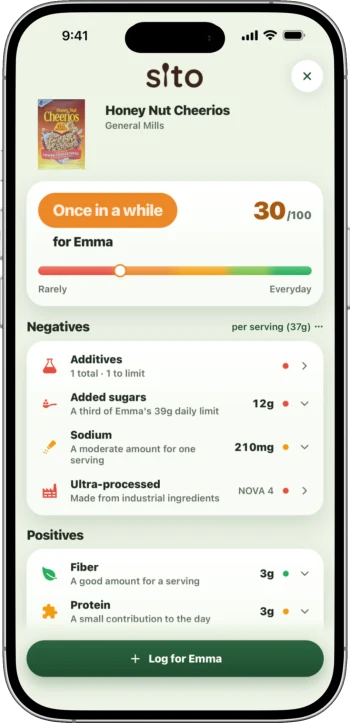
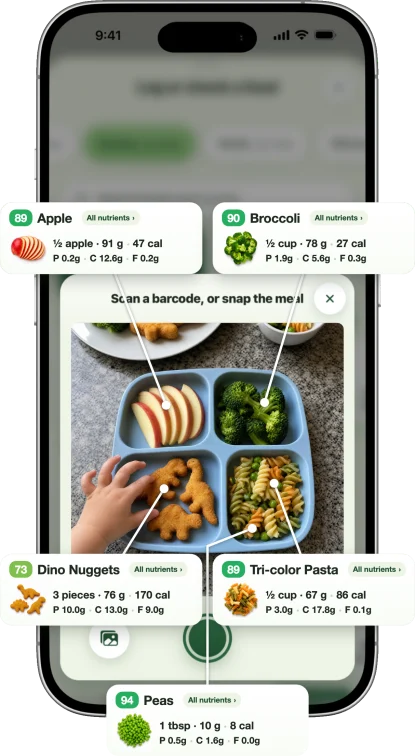
You log by photo, barcode, typing or search. A scanned product gets a score out of 100 for your child's age and a "Log for [name]" button.
Every kid gets their own numbers. A partner logs from their own phone and sees the same meals and totals. If a doctor or dietitian gave you a number, enter it in the goals screen and we use yours instead.
Track your child's iron and calcium
Log meals by photo, barcode or search and see the day's iron and calcium against the amounts for your child's age.
How much iron and calcium does a child need?
The numbers change with age and, for teen iron, with sex. They do not change with height or weight. These are the National Academies values reported by the NIH Office of Dietary Supplements.
| Age | Iron RDA | Iron upper limit | Calcium RDA | Calcium upper limit |
|---|---|---|---|---|
| 7 to 12 months | 11 mg | 40 mg | 260 mg (AI) | 1,500 mg |
| 1 to 3 years | 7 mg | 40 mg | 700 mg | 2,500 mg |
| 4 to 8 years | 10 mg | 40 mg | 1,000 mg | 2,500 mg |
| 9 to 13 years | 8 mg | 40 mg | 1,300 mg | 3,000 mg |
| 14 to 18 years | 11 mg boys, 15 mg girls | 45 mg | 1,300 mg | 3,000 mg |
From age 1, Sito uses these same numbers for US children. The RDA is the floor of the goal range and the upper limit is the ceiling. The upper limit is the most a day should have, not a target.
Adult numbers differ. A woman aged 19 to 50 needs 18 mg of iron a day, more than double a toddler's 7 mg (NIH). So a tracker has to know your child's age. More on why adult trackers miss children in tracking macros for kids.
Why a food label's %DV is not your child's number
The %DV on a Nutrition Facts label compares a food with a Daily Value set for adults and children age 4 and older. For iron that is 18 mg (NIH). For calcium it is 1,300 mg (NIH).
A 2 year old needs 7 mg of iron and 700 mg of calcium. A cereal fortified to "100% DV" holds 18 mg of iron per serving, more than double that 7 mg. An 8-ounce plain low-fat yogurt has 415 mg of calcium, about a third of the label's 1,300 mg. For a 5 year old with a 1,000 mg goal, the same yogurt is over 40% of the day.
Sito does that math for you. Every food is shown as a share of your child's own goal, not the adult label.
Why iron and calcium are the two to watch
The NIH lists infants, young children and teenage girls among the groups at risk of getting too little iron. For calcium, 49% of children age 4 to 18 got less than the estimated average requirement from foods and supplements, in 2007 to 2010 national data (NIH).
The 2020-2025 Dietary Guidelines named calcium a nutrient of public health concern, along with potassium, fiber and vitamin D (ODPHP). The current edition says teens need more energy, protein, calcium and iron, especially girls, because of periods (Dietary Guidelines 2025-2030).
Two groups need a closer look. Children with lactose intolerance, a milk allergy or a dairy-free diet run a higher risk of too little calcium (NIH). Vegetarian children need 1.8 times as much iron, because plant iron is absorbed less easily (NIH).
Milk: plenty of calcium, almost no iron
Milk is a strong calcium source. A cup of whole milk has 276 mg, 8 ounces of plain low-fat yogurt has 415 mg, and a cup of calcium-fortified soymilk has 299 mg (NIH). Iron is a different story. In the NIH food table, a cup of milk has 0 mg of iron.
The AAP advises no cow's milk before 12 months. After the first birthday, keep it to no more than 24 ounces a day. Milk can fill a child up and leave less room for iron-rich foods.
Sito tracks both from the same meals, so you can see when calcium reads "In the zone" while iron sits at "A bit low". For foods that lift the iron tile, see iron-rich foods for picky eaters.
What helps the body use them
- Iron comes in two forms. Heme iron is in animal foods, and the body absorbs it more easily. Non-heme iron is in plants and fortified foods (CDC).
- Pair non-heme iron with foods high in vitamin C to help absorption (CDC).
- Calcium might reduce iron absorption. In a typical Western diet, though, this has little effect on most people's iron status (NIH).
- Vitamin D is required for calcium to be absorbed in the gut (NIH). More in vitamin D for kids.
- Absorption varies by food. About 27% of the calcium in milk is absorbed, and only about 5% from spinach (NIH).
When to talk to your pediatrician
An app shows what your child ate, but an app cannot diagnose. A blood test is your pediatrician's call.
The AAP suggests iron screening starting at about 9 to 12 months for babies mostly on breast milk, or 15 to 18 months for babies mostly on formula. Teens with periods should be screened within a year of their first period, and no later than age 14.
The AAP adds that symptoms should prompt screening and treatment before low iron turns into anemia. The signs to watch for, and what a pediatrician does about them, are in our guide to iron deficiency in children. Supplement questions belong to the same visit; see does my child need a multivitamin.
FAQ
How much iron does a 2 year old need?
7 mg a day, the RDA for ages 1 to 3. The upper limit is 40 mg (NIH). For a US child that age, Sito sets the same goal: 7 to 40 mg.
How much calcium does a 5 year old need?
1,000 mg a day, the RDA for ages 4 to 8. The upper limit is 2,500 mg (NIH).
Can I serve milk with an iron-rich meal?
Usually, yes. Calcium might reduce iron absorption, but the NIH says that in a typical Western diet this has little effect on most people's iron status. After the first birthday, the AAP advises no more than 24 ounces of milk a day, so milk does not crowd out iron-rich foods.
Can I track two children in Sito?
Yes. Every kid gets their own numbers, set from their own age. A partner logs from their own phone and sees the same meals and totals.
Sources
- NIH Office of Dietary Supplements, Iron, Health Professional Fact Sheet (updated September 4, 2025). ods.od.nih.gov
- NIH Office of Dietary Supplements, Calcium, Health Professional Fact Sheet (updated June 22, 2026). ods.od.nih.gov
- American Academy of Pediatrics, HealthyChildren.org, Iron Deficiency and Anemia in Babies, Children and Teens (updated June 22, 2026). healthychildren.org
- CDC, Infant and Toddler Nutrition, Iron (reviewed April 14, 2026). cdc.gov
- ODPHP, New resources identify where to find key nutrients (August 16, 2024). odphp.health.gov
- Dietary Guidelines for Americans 2025-2030, p. 7. cdn.realfood.gov
- Sito, Where our food data comes from. sito.kids/data