
Children need 7 mg of iron a day at ages 1 to 3, 10 mg at 4 to 8, and 8 mg at 9 to 13, the same for boys and girls (NIH Office of Dietary Supplements).
- Daily iron: 7 mg (1 to 3), 10 mg (4 to 8), 8 mg (9 to 13), 11 mg boys and 15 mg girls (14 to 18).
- Meat, poultry and fish carry the best-absorbed iron; fortified cereals and beans are the other big sources.
- Pair plant iron with vitamin C foods, keep milk within AAP limits, and keep offering foods without pressure.
Tracking iron with Sito
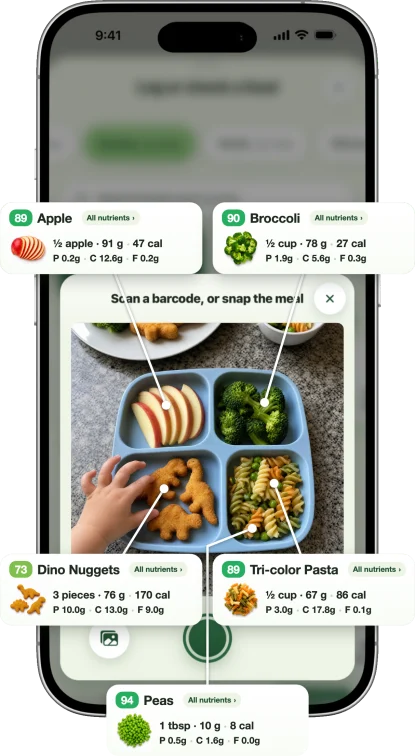
Sito adds up the iron in what your child ate today, logged by photo, barcode, search or a few words, and shows it next to the target for their age. For US children from age 1, it uses the National Academies' numbers below. The target comes from age (and sex from 14), not from height or weight.
- If some foods have no iron data, the total is marked "≥" (at least) instead of guessing.
- You can pin iron as a focus nutrient.
- Until age 4, it shows how to serve each of 583 foods, iron-rich ones included, at your toddler's age.
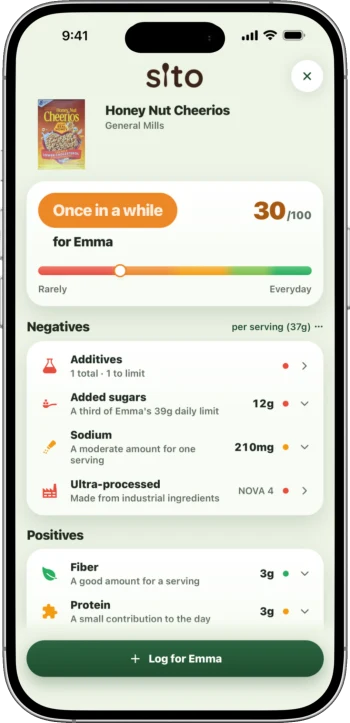
- Our product score rates packaged foods from their label; iron is not part of it.
More: is my toddler getting enough nutrients? and how a tracker for kids works.
See today's iron at a glance
Log meals by photo, barcode or search and Sito adds up the day's iron against the target for your child's age.
How much iron does my child need?
| Age | Iron per day |
|---|---|
| 7 to 12 months | 11 mg |
| 1 to 3 years | 7 mg |
| 4 to 8 years | 10 mg |
| 9 to 13 years | 8 mg |
| 14 to 18 years | 11 mg boys, 15 mg girls |
These are the Recommended Dietary Allowances set by the National Academies (NIH ODS). In the UK, the reference is 6.9 mg at age 1 and at 2 to 3, 6.1 mg at 4 to 6 and 8.7 mg at 7 to 10 (Public Health England).
Iron in child-sized portions
Toddler portions follow the AAP's serving sizes for toddlers where one exists (vegetables for a 2-year-old) and USDA household measures otherwise. The other portion is for older kids, not a recommendation. Numbers are iron in the food, not iron absorbed; fortification varies, so check cereal labels.
| Food | Toddler portion | Another portion | Notes |
|---|---|---|---|
| Fortified infant oat cereal, dry (stirred into oatmeal or yogurt) | 1/4 cup: 7.8 mg | 2 tbsp: 4.1 mg | |
| Instant oatmeal, fortified, cooked | 1/4 cup: 3.5 mg | 1 cup: 13.9 mg | |
| Regular oats, not fortified, cooked | 1/4 cup: 0.5 mg | 1 cup: 2.1 mg | |
| White beans, canned | 2 tbsp: 1.0 mg | 1/2 cup: 3.9 mg | Under 4: mash |
| Ground beef 85% lean, cooked | 1 oz: 0.8 mg | 3 oz: 2.5 mg | Under 4: tender pieces no larger than 1/2 inch |
| Tofu, firm | 1 oz: 0.8 mg | 1/2 cup: 3.4 mg | Under 4: pieces no larger than 1/2 inch |
| Lentils, cooked | 2 tbsp: 0.8 mg | 1/2 cup: 3.3 mg | |
| Hummus | 2 tbsp: 0.8 mg | 1/4 cup: 1.6 mg | |
| Spinach, cooked | 2 tbsp: 0.8 mg | 1/2 cup: 3.2 mg | Poorly absorbed |
| Chickpeas, cooked | 2 tbsp: 0.6 mg | 1/2 cup: 2.4 mg | Under 4: mash |
| Tuna, light, canned in water | 1 oz: 0.5 mg | 3 oz: 1.4 mg | Under 4: pieces no larger than 1/2 inch, no bones |
| Potato, baked with skin | 1/4 medium: 0.5 mg | 1 medium: 1.9 mg | |
| Egg, scrambled | 1/2 egg: 0.4 mg | 1 egg: 0.8 mg | |
| Chicken thigh, roasted | 1 oz: 0.3 mg | 3 oz: 1.0 mg | Under 4: tender pieces no larger than 1/2 inch, no bones |
| Whole milk | 1/2 cup: 0.0 mg | 24 fl oz: 0.2 mg |
More foods: bread, pasta, fish, nut butters, seeds, dried fruit
| Food | Toddler portion | Another portion | Notes |
|---|---|---|---|
| Sunflower seed butter | 1 tbsp: 0.7 mg | 2 tbsp: 1.3 mg | Under 4: spread thin, never a spoonful |
| Pumpkin seeds, roasted | 1 tbsp ground: 0.6 mg | 1 oz whole: 2.3 mg | Under 4: ground only, never whole or chopped |
| Black beans, cooked | 2 tbsp: 0.5 mg | 1/2 cup: 1.8 mg | Under 4: mash |
| Enriched pasta, cooked | 1/4 cup: 0.4 mg | 1 cup: 1.5 mg | |
| Dried apricots | 4 halves: 0.4 mg | 1/4 cup: 0.9 mg | Under 4: CDC lists uncooked dried fruit as a choking hazard |
| Peanut butter, smooth | 1 tbsp: 0.3 mg | 2 tbsp: 0.6 mg | Under 4: spread thin, never a spoonful |
| Green peas, cooked | 2 tbsp: 0.3 mg | 1/2 cup: 1.2 mg | |
| Raisins | Mini box (14 g): 0.3 mg | 1/4 cup: 0.6 mg | Under 4: CDC lists uncooked dried fruit as a choking hazard |
| Whole-wheat bread | 1/4 slice: 0.2 mg | 1 slice: 0.8 mg | Under 4: no seeds or whole kernels |
| Salmon, farmed, cooked | 1 oz: 0.1 mg | 3 oz: 0.3 mg | Under 4: pieces no larger than 1/2 inch, no bones |
Source: USDA FoodData Central (SR Legacy). Three things stand out:
- Fortified cereals carry the most per spoonful. Plain oats have a fraction of the iron.
- Meat varies a lot. A toddler ounce of beef has about 2.6 times the iron of chicken thigh and more than 8 times that of salmon.
- Milk has almost none.
What does 7 mg look like in a toddler's day?
An illustration, not a meal plan, using the portions above:
- 1/4 cup fortified oatmeal: 3.5 mg
- 1 oz ground beef: 0.8 mg
- 2 tbsp lentils: 0.8 mg
- 2 tbsp hummus: 0.8 mg
- 2 tbsp cooked spinach: 0.8 mg
- 1/2 egg: 0.4 mg
- 1/4 slice whole-wheat bread: 0.2 mg
That adds up to about 7.3 mg, right at the 7 mg target. Swap the fortified oatmeal for plain oats and the day drops to about 4.3 mg. About half the day came from one bowl.
How to help the iron count
Heme and non-heme iron
Meat, seafood and poultry contain both heme and non-heme iron; plants and iron-fortified foods contain only non-heme iron (NIH ODS). The body absorbs heme iron more easily (CDC). Grain foods still count: NIH says about half of US dietary iron comes from bread, cereal and other grain products.
Pair plant iron with vitamin C
The CDC says pairing non-heme iron sources with foods high in vitamin C can help absorption: citrus such as oranges, broccoli or cabbage, berries, papaya, tomatoes and sweet potatoes. But NIH says a typical Western diet dampens the effect of foods that help or hinder absorption, so they have little effect on most people's iron status.
Phytate, spinach and calcium
Phytate in grains and beans can reduce absorption, and spinach's iron is poorly absorbed. Calcium might reduce absorption too, though NIH says that effect has not been definitively established.
Iron-rich foods for kids past the toddler years
The foods do not change after age three; the amount does. A 4 to 8 year old needs 10 mg of iron a day and a 9 to 13 year old 8 mg, against 7 mg for a 1 to 3 year old (NIH ODS). The right-hand column in the chart above is the older-child portion: a cup of fortified instant oatmeal carries about 13.9 mg, half a cup of white beans about 3.9 mg, and an ounce of ground beef about 0.8 mg.
So a 5 year old reaches 10 mg the same way a toddler reaches 7: one fortified bowl does most of the work, and meat, beans or lentils close the gap. A teenage girl is the exception in the table, at 15 mg a day, and that is worth watching once periods start (NIH ODS).
How much milk is too much?
The AAP says no cow's milk before 12 months, and after the first birthday no more than 24 ounces a day. Milk is low in iron and can make children feel full, which can mean they eat fewer iron-rich foods (AAP, HealthyChildren).
| Age | Suggested cow's milk |
|---|---|
| 12 to 24 months | 16 oz (2 cups) a day |
| 2 to 5 years | 16 to 24 oz (2 to 3 cups) a day |
Source: HealthyChildren, recommended drinks.
Drinking at least a quart (32 ounces) a day and not being hungry at meals are signs of milk dependency, which the AAP says can lead to iron-deficiency anemia. Its steps (AAP):
- Cut back over a week to no more than 16 ounces (about 500 mL) a day.
- Offer milk only with meals, after some solid food.
- Offer only water between meals, no milk.
Picky eaters and iron foods
Favoring a couple of foods is normal and often fades by about age 5 (CDC). The AAP notes that low iron isn't only about eating: "growth cycles play a big role too."
- You offer, they decide. Pressure or punishment can make kids actively dislike foods, and the AAP advises against bribing with treats (AAP).
- Expect many tries. A young child may need 8 to 10 exposures before trying a new food (CDC). If they refuse, wait a week and offer it again.
- Keep meals on a schedule with fewer snacks, so your child comes hungry.
- Cook one family meal with at least one food your child likes.
- Build food bridges. Once a food is accepted, offer others with a similar color, flavor and texture (the AAP's example: pumpkin pie, then mashed sweet potatoes, then mashed carrots).
- Mix new with familiar. Stir lentils into a sauce they like, or serve broccoli with grated cheese. Toddlers tend to enjoy any food involving a dip, so try hummus.
- Offer meat or deboned fish at least 2 times a week.
More ideas: when your toddler refuses vegetables and toddler fiber needs.
Serve iron foods safely under 4
The AAP advises keeping high-risk foods from children until age 4 or older, depending on development (HealthyChildren). For iron foods, that means:
- Spread peanut butter and other nut or seed butters thinly, never in chunks or spoonfuls.
- No whole or chopped nuts and seeds; breads without seeds or whole kernels.
- Mash whole beans. Cut meat into small, tender pieces no larger than half an inch, and remove bones from meat and fish.
- The CDC lists uncooked dried fruit, such as raisins, as a choking hazard, along with uncut berries and cherry or grape tomatoes (CDC).
- Supervise meals.
When to talk to the doctor
The CDC suggests asking about iron at your child's next checkup. The AAP recommends screening starting at about 9 to 12 months for babies who mostly have breast milk and at 15 to 18 months for babies who mostly have formula; the CDC says a doctor or nurse will likely test for anemia at around 12 months. Teens with periods should be screened within a year of their first period, and no later than 14.
- If milk reliance doesn't change within a month of the steps above, call your pediatrician.
- If you see signs of low iron in a teen, the AAP says to contact their doctor right away.
- If your child is diagnosed, follow the doctor's instructions fully, and keep any iron supplement out of children's reach.
Signs of low iron and what testing involves are in our guide to iron deficiency in children.
FAQ
Is spinach a good source of iron for kids?
It has iron, but it is poorly absorbed. Half a cup of boiled spinach has about 3 mg, and NIH says spinach has low iron bioavailability because it contains absorption inhibitors such as polyphenols.
Do teens need more iron?
Yes. At 14 to 18, boys need 11 mg and girls 15 mg a day. The AAP adds that female athletes and performers may need up to 25 mg a day.
Sources
- NIH Office of Dietary Supplements, Iron fact sheet for health professionals
- CDC, Iron (infant and toddler nutrition)
- CDC, Picky eaters
- CDC, Choking hazards
- AAP HealthyChildren, Anemia and your child
- AAP HealthyChildren, Pump up the diet with iron
- AAP HealthyChildren, Picky eaters
- AAP HealthyChildren, Your toddler only wants milk
- AAP HealthyChildren, Recommended drinks for children age 5 and younger
- AAP HealthyChildren, Serving sizes for toddlers
- AAP HealthyChildren, Choking prevention
- Public Health England, Government Dietary Recommendations (2016)
- USDA FoodData Central (SR Legacy), food iron values