
Children ages 1 to 18 need 600 IU of vitamin D a day, which is 15 mcg. Babies under 12 months need 400 IU (10 mcg). In the US, fortified foods such as milk and cereal supply most of it (NIH Office of Dietary Supplements).
- Babies under 12 months need 400 IU (10 mcg) of vitamin D a day; ages 1 to 18 need 600 IU (15 mcg).
- Two cups of milk, fortified cereal and an egg give a toddler 364 IU; an ounce of salmon brings it to 554 IU.
- Breastfed babies need 400 IU a day from their first days, and older kids may need a supplement: ask your pediatrician. Sito checks the milk, yogurt and cereal you buy.
Check the milk, yogurt and cereal you buy with Sito
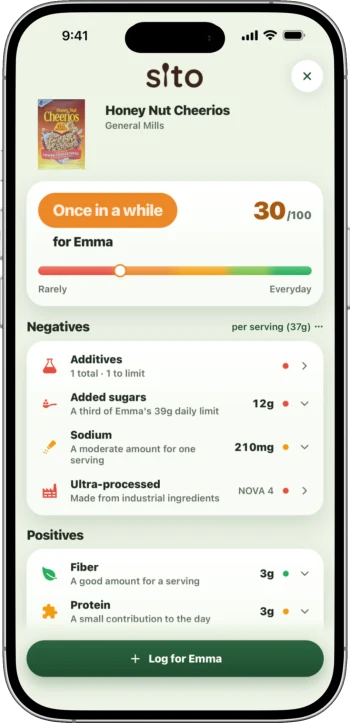
Sito is our app. In the dairy and cereal aisles, scan the carton, cup or box. Sito scores it out of 100 for your child's age, and the score is stricter under 6. If one serving uses a quarter or more of your child's daily added-sugar limit, the card says so by name. That matters because flavored milks carry added sugar, and the AAP says children 5 and under should skip them (HealthyChildren.org).
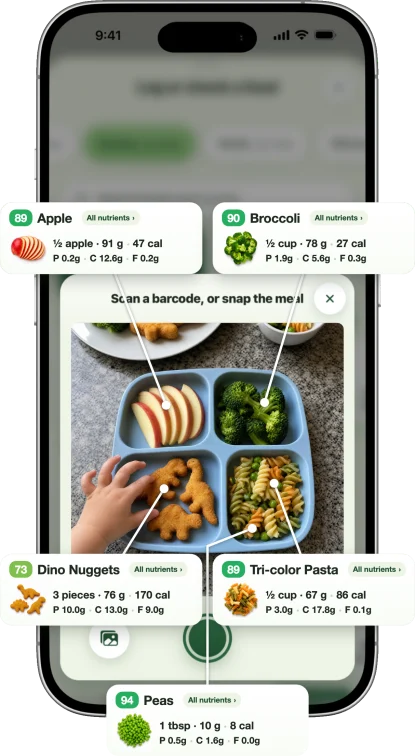
One tap logs the product into your child's day. There, the day's calcium shows against the National Academies target for their age: 700 mg at 1 to 3, 1,000 mg at 4 to 8 and 1,300 mg at 9 to 18. Vitamin D is needed to absorb that calcium in the gut (NIH ODS, Calcium). The Weekly Report averages it every Sunday. Each child has their own profile, and a partner can log from their own phone.
Check the milk and cereal you buy
Scan a barcode and see a score out of 100 for your child's age, then log it and see the day's calcium against their goal.
How much vitamin D does my child need?
The daily amounts below come from the NIH Office of Dietary Supplements. One mcg of vitamin D equals 40 IU. The upper limit is the most a child can take each day that is unlikely to cause harm, so treat it as a ceiling, not a goal.
| Age | Daily need | Upper limit |
|---|---|---|
| 0 to 6 months | 400 IU (10 mcg) | 1,000 IU (25 mcg) |
| 7 to 12 months | 400 IU (10 mcg) | 1,500 IU (38 mcg) |
| 1 to 3 years | 600 IU (15 mcg) | 2,500 IU (63 mcg) |
| 4 to 8 years | 600 IU (15 mcg) | 3,000 IU (75 mcg) |
| 9 to 18 years | 600 IU (15 mcg) | 4,000 IU (100 mcg) |
Can my child get enough vitamin D from food?
Partly, and fortified foods do most of the work. The NIH says getting enough from natural, unfortified food alone "is difficult" (NIH ODS). The AAP says "most children will not get enough of this vitamin through diet alone" (HealthyChildren.org).
Here is what real days add up to, using the NIH amounts per serving. Brands vary, so check your own labels.
- Toddler, 1 to 2: 2 cups fortified milk (240 IU) + fortified cereal (80 IU) + one egg (44 IU) = 364 IU, about 60% of the day.
- Same toddler, plus fish: add 1 oz of salmon, a third of a 3 oz serving (190 IU) = 554 IU.
- Age 2 to 5: 3 cups milk (360 IU) + cereal (80 IU) + egg (44 IU) = 484 IU.
- Older child: 1 cup milk (120 IU) + 3 oz salmon (570 IU) = 690 IU.
A low number on paper is not the same as a deficiency. US kids ages 2 to 19 average about 196 IU a day from food and drinks, yet the NIH says evidence suggests most people have enough vitamin D in their blood (NIH ODS).
Which foods have vitamin D?
Per serving, from the NIH ODS table:
| Food | Serving | Vitamin D |
|---|---|---|
| Sockeye salmon | 3 oz | 570 IU |
| White mushrooms, UV exposed | 1/2 cup | 366 IU |
| Fortified 2% milk | 1 cup | 120 IU |
| Fortified soy, almond or oat milk | 1 cup | 100 to 144 IU |
| Cereal fortified at 10% DV | 1 serving | 80 IU |
| Egg | 1 large | 44 IU (in the yolk) |
| Light canned tuna | 3 oz | 40 IU |
| Cheddar cheese | 1.5 oz | 17 IU |
Almost all US milk is fortified with about 120 IU per cup, while cheese and ice cream usually are not (NIH ODS).
Yogurt varies a lot. A fortified vanilla yogurt lists 47 IU per 100 g, about 80 IU in a 6 oz cup by our math. Plain whole-milk yogurt lists 2 IU per 100 g (USDA FoodData Central: fortified vanilla, plain whole milk). Check the label.
Cow's milk is not recommended before 12 months (CDC). The AAP adds that, other than soy milk, plant-based milks are not recommended in place of dairy milk for children (HealthyChildren.org).
How do I read vitamin D on a food label?
Since the FDA's 2016 label update, vitamin D must appear on the Nutrition Facts label (FDA). You will see the amount in mcg and a percent Daily Value. The FDA calls 5% DV or less low and 20% or more high (FDA).
One catch: on most labels the Daily Value is 20 mcg, set for adults and children 4 and up. Your child's 15 mcg is 75% of that. So a cup of milk that reads 15% DV gives your child about a fifth of their day (NIH ODS).
Is sunshine enough?
Because UV rays can cause skin cancer, the American Academy of Dermatology "does not recommend getting vitamin D from sun exposure" (AAD). The AAP notes that sunscreen "does not allow the body to make much vitamin D," which is why milk and formula are fortified (HealthyChildren.org). The AAP also advises keeping babies under 6 months out of direct sunlight (NIH ODS).
Does my child need a vitamin D supplement?
It depends on age and on what your child eats.
- Breastfed or partly breastfed babies: the AAP says they "should be supplemented with 400 IU a day of vitamin D beginning in the first few days of life" (HealthyChildren.org). Breast milk usually does not carry all the vitamin D a baby needs (CDC). Ask your pediatrician about vitamin D drops.
- Formula-fed babies: infant formula is fortified with vitamin D (CDC). Babies on formula alone may not need drops, depending on how much they drink. Ask your pediatrician (HealthyChildren.org).
- Children and teens: if a child "is not consuming enough vitamin D in his or her diet, a supplement may be needed." Teens who get under 600 IU from food "should receive a supplement containing that amount" (HealthyChildren.org). Ask your pediatrician first.
- Higher risk: low vitamin D is more common with a milk allergy, lactose intolerance, a vegan diet, little time in the sun, or trouble absorbing fat, as in cystic fibrosis, celiac disease or Crohn's disease (NIH ODS). Children on certain medicines or with chronic diseases "may need higher doses of vitamin D," the AAP says, so consult your pediatrician (HealthyChildren.org).
Keep any vitamin D supplement out of your child's reach (HealthyChildren.org).
Can a child get too much vitamin D?
Yes, but almost never from food. The NIH says toxicity "is almost always a result of excessive intakes of vitamin D through supplements." Too much raises blood calcium, which can cause nausea, vomiting, muscle weakness, excessive thirst and kidney stones (NIH ODS). If your child swallows vitamins, call Poison Control; the number is in our guide Does my child need a multivitamin?
Signs of low vitamin D or rickets
Signs of rickets include bowed legs, and wide wrists in a baby who crawls but does not walk yet. Severe cases can bring swelling at the ends of the ribs, and blood calcium can drop low enough to cause seizures. Breastfed babies who do not get extra vitamin D are at highest risk (HealthyChildren.org).
A physician diagnoses rickets with an exam, x-rays and blood tests, and may check a "25 hydroxy" vitamin D level (HealthyChildren.org). The Endocrine Society does not recommend routine testing in healthy people, and results can read falsely low or high (NIH ODS). An app cannot diagnose a deficiency. If you are worried, the blood test is your pediatrician's call.
When to call the pediatrician
- Your breastfed baby is not on vitamin D drops yet, or you are unsure whether your formula-fed baby needs them.
- Your child has a milk allergy, lactose intolerance or eats a vegan diet.
- Your child has cystic fibrosis, celiac disease or Crohn's disease, or takes certain medicines.
- You notice bowed legs, wide wrists, or your child has a seizure.
- You have questions about a vitamin D blood test.
- Before starting any supplement.
FAQ
How much vitamin D does a toddler need?
600 IU (15 mcg) a day from age 1 through 18. Babies under 12 months need 400 IU (10 mcg) (NIH ODS).
Is milk enough vitamin D for my child?
On its own, no. A cup of fortified milk has about 120 IU (NIH ODS), so milk alone would take 5 cups to reach 600 IU. The AAP suggests 2 cups a day at 12 to 24 months and 2 to 3 cups at ages 2 to 5 (HealthyChildren.org). Milk is a base, and fortified cereal, eggs and fish add to it. If the total still looks short, ask your pediatrician.
Can kids get too much vitamin D?
Yes, almost always from supplements rather than food. Stay within the upper limit for your child's age, 2,500 IU at 1 to 3 and 3,000 IU at 4 to 8 (NIH ODS), and keep supplements out of reach (HealthyChildren.org).
Which app helps me check the milk and cereal I buy?
Sito. Scan the carton or box to see a score out of 100 for your child's age, stricter under 6. If one serving uses a quarter or more of their daily added-sugar limit, the card says so. One tap logs it into their day, where calcium shows against the National Academies target for their age. Read how the score works on our score page, or see our guide to tracking iron and calcium for kids.
Sources
- NIH Office of Dietary Supplements, Vitamin D: Fact Sheet for Health Professionals
- NIH Office of Dietary Supplements, Calcium: Fact Sheet for Health Professionals
- American Academy of Pediatrics, HealthyChildren.org: Vitamin D for Babies, Children and Adolescents
- HealthyChildren.org: Vitamin D and Iron Supplements for Babies
- HealthyChildren.org: Vitamin D Deficiency and Rickets
- HealthyChildren.org: Recommended Drinks for Children Age 5 and Younger
- CDC, Infant and Toddler Nutrition: Vitamin D
- FDA: What's on the Nutrition Facts Label
- FDA: Daily Value on the Nutrition and Supplement Facts Labels
- American Academy of Dermatology: Vitamin D stats and facts
- USDA FoodData Central, fortified vanilla yogurt and plain whole-milk yogurt