
If your toddler ate three bites of dinner tonight, that meal tells you very little. After the first birthday, growth slows and appetite drops sharply (AAP). Eating becomes erratic from one day to the next. The honest check is the week, and the best sign is steady growth (NHS). Here is what really runs short in US toddlers, the daily amounts for ages 1 to 3, and when to call the pediatrician.
- Judge a toddler's eating over a week, not a meal: appetite drops after age 1 and swings day to day.
- In US data, most toddlers under 2 got too little vitamin D and fiber from their diet, and iron needs watching; ages 1 to 3 need 7 mg iron, 700 mg calcium, 600 IU vitamin D and 19 g fiber a day.
- Steady growth is the best sign; call the doctor if your child does not gain weight as expected, loses appetite, is tired a lot or looks pale.
How Sito helps with this question
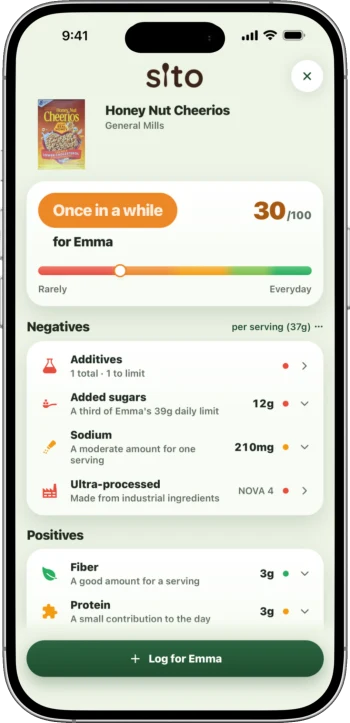
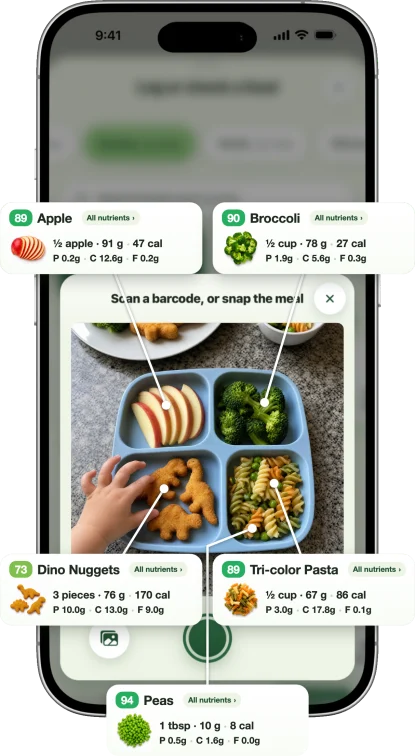
We built Sito for this worry. Log meals by photo, barcode, a few words or search. In the US, Sito shows a 1 to 3 year old's iron, calcium, vitamin D, zinc and fiber against the National Academies' daily amounts, for today or as a 7-day average. Under age 2 it points you to the average, because one day says little. Until age 4, it also shows how to serve each of 583 foods at your toddler's age. A weekly report arrives every Sunday. Take any questions to your pediatrician.
See the week, not the meal
Log meals by photo, barcode or search and see the day's iron, calcium and fiber against the goal for your child's age, averaged over the days you logged.
How do I know if my toddler is eating enough?
Start with growth, not plates. "A child who is growing well is getting enough to eat," says the AAP. The NHS says it the same way: if your child is active, gaining weight and seems well, they are getting enough.
Then widen the lens. After age 1, the AAP describes eating that is "erratic and unpredictable from one day to the next." If you offer a range of wholesome foods, it balances out over several days. Encourage, but do not pressure or force. The CDC says a child may go a couple of days without eating much and should still get what they need over a week. Expect skipped meals now and then (KidsHealth).
A food group missed for a few days is nothing to worry about. Missed for a long time, it could mean too few nutrients (AAP).
If the worry will not settle, log a few ordinary days and read the average. Our food diary guide keeps it light.
Which nutrients do toddlers most often miss?
The US data points to a short list. A national study looked at toddlers aged 12 to 23 months in 2009 to 2012. From food and drinks, most fell below the average requirement for vitamin E (82 percent) and vitamin D (74 percent). Fewer than 1 percent met the adequate intake for fiber and potassium (Am J Clin Nutr, 2016).
Iron is the other one to watch. From 2003 to 2010, at least 15 percent of toddlers had iron deficiency (AAP). It is not only picky eating; growth cycles play a big role too (AAP). After 12 months, toddlers are at risk for iron deficiency. They no longer drink iron-fortified formula, may not eat iron-fortified infant cereal, or may not eat enough iron-rich foods to make up the difference (KidsHealth). See our iron-rich foods for picky eaters.
Vitamin D is the odd one out. Very few foods naturally contain it (NIH ODS), so a food log will often show it low. More on that below.
How much does a toddler need each day?
These are the US daily amounts for ages 1 to 3.
| Nutrient | Daily amount, ages 1 to 3 | Source |
|---|---|---|
| Iron | 7 mg | NIH ODS |
| Calcium | 700 mg | NIH ODS |
| Vitamin D | 15 mcg (600 IU) | NIH ODS |
| Zinc | 3 mg | NIH ODS |
| Fiber | 19 g (Adequate Intake) | NASEM |
| Potassium | 2,000 mg (Adequate Intake) | NASEM |
A review for family doctors gives another fiber rule: at least the child's age plus 5 grams a day (AFP). Our toddler fiber guide lists easy foods that add up.
What does a toddler's day of food look like?
The AAP sketches a day for a 2 year old this way:
- 2 to 2½ cups of dairy
- 2 to 3 servings of grains
- 1 cup of fruit
- 1 cup of vegetables
- 1½ to 2 ounces of protein
- 3 teaspoons of fats and oils
The same page asks parents to focus on overall growth and the whole week. Our portion sizes by age page shows what those servings look like on a toddler's plate.
Can milk get in the way?
Yes, when there is too much of it. Milk is low in iron and can make children feel full (AAP). The limits differ a little by source:
- AAP anemia page: no more than 24 ounces a day after age 1 (AAP).
- AAP milk page: no more than 16 to 24 ounces a day after the first birthday (AAP).
- KidsHealth: about 16 ounces (2 cups) from 12 to 24 months, then 16 to 24 ounces (2 to 3 cups) after age 2 (KidsHealth).
Within those limits milk still helps: almost all US milk is fortified with about 120 IU of vitamin D per cup (NIH ODS).
What signs should I watch for?
At first, children with iron-deficiency anemia may have no symptoms at all (KidsHealth). When signs do show, the AAP lists:
- Pale, yellowish or ashy skin
- Faded cheeks, lips, nail beds and eyelids
- Low or irritable mood
- Mild muscle weakness
- Feeling tired or needing naps more often
- Craving ice, dirt or paper
Constipation can come from a diet low in water and fiber (KidsHealth). On the growth chart, a change from the percentile line your child usually follows can signal a problem, though it does not always (KidsHealth).
None of these signs proves a deficiency on its own. Doctors usually diagnose iron-deficiency anemia with questions, an exam and blood tests (KidsHealth). More in our guide to iron deficiency in children.
When should I call the pediatrician?
On its poor weight gain page, KidsHealth says to call your doctor if your child:
- develops new symptoms like vomiting, diarrhea or fever
- does not begin to gain weight as expected
- loses appetite
- is tired a lot or lacks energy for everyday activities
- misses developmental milestones
Go to the ER if your child is vomiting over and over, is not drinking at all, or shows signs of dehydration (KidsHealth). If constipation lasts two to three weeks, talk to your doctor (KidsHealth). The iron signs above should prompt screening before low iron turns into anemia (AAP). The AAP says iron screening should start at about 9 to 12 months for mostly breastfed babies and 15 to 18 months for mostly formula-fed babies.
You do not need a symptom to ask. Picky eating is usually a normal stage, and the AAP says to talk with your pediatrician if you are concerned about your child's diet. Well visits are a good time, and if needed the pediatrician can refer you to a pediatric registered dietitian (Henry Ford Health). If weight is the worry, see toddler not gaining weight.
Does my toddler need a vitamin?
Usually not. A multivitamin is usually unnecessary in healthy toddlers who eat a balanced diet and are growing normally (AFP). Vitamin D is different. Two dairy servings meet calcium but give less than half the vitamin D a toddler needs, so doctors often recommend a supplement (KidsHealth). Your doctor will say whether your child needs one. Never give a vitamin or mineral supplement without discussing it with your doctor first (KidsHealth).
Frequently asked questions
My toddler barely ate today. Is that OK?
Usually, yes. Toddler eating is erratic from one day to the next and balances out over several days when a range of wholesome foods is on offer (AAP). If your child is active, gaining weight and seems well, they are eating enough (NHS).
Is my toddler getting enough vitamin D?
A food log will often say no, because very few foods naturally contain vitamin D (NIH ODS). Two dairy servings give less than half of what a toddler needs, so doctors often recommend a supplement (KidsHealth). A blood test is one way to know if your child gets enough (NIH ODS), so ask your pediatrician.
Can an app tell if my child has a deficiency?
No. Doctors usually diagnose iron-deficiency anemia with questions, an exam and blood tests (KidsHealth). Sito shows how a week of food compares with the daily amounts. Take what you notice to your pediatrician.
Sources
- Am J Clin Nutr (2016): Usual nutrient intakes of US infants and toddlers, NHANES 2009 to 2012
- AAP: Iron deficiency anemia, updated guidance
- AAP: Iron deficiency and anemia in babies, children and teens
- AAP: Feeding and nutrition, your one year old
- AAP: Making sure your child is eating enough
- AAP: Sample one-day menu for a two year old
- AAP: Your toddler only wants milk
- AAP: Picky eaters
- KidsHealth: Nutrition guide for toddlers
- KidsHealth: Iron-deficiency anemia
- KidsHealth: Growth charts
- KidsHealth: Constipation
- KidsHealth: Poor weight gain (failure to thrive)
- CDC: How much and how often to feed
- NHS: Fussy eaters
- American Family Physician (2018): Nutrition in toddlers
- NIH ODS: Iron fact sheet
- NIH ODS: Calcium fact sheet
- NIH ODS: Vitamin D fact sheet
- NIH ODS: Zinc fact sheet
- NASEM Dietary Reference Intakes: Fiber
- NASEM Dietary Reference Intakes: Potassium
- Henry Ford Health: Is my toddler getting enough nutrition?