
- Formula starts at about 1 to 2 ounces a feed, every 2 to 3 hours, 8 to 12 times a day (CDC), and reaches 6 to 8 ounces at 4 or 5 feeds by 6 months (AAP).
- By weight, the AAP's average is about 2½ ounces a day per pound, usually no more than about 32 ounces a day; your baby's cues come first.
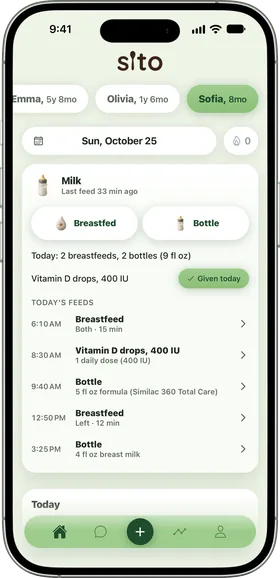
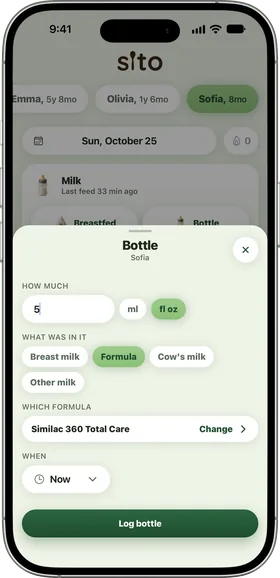
- Log every bottle in Sito, the app we build: how much, what was in it, and your formula picked by name.
Formula feeding chart by age
These are ranges, not goals. Where a source gives only one unit, the other is our conversion (about 30 ml an ounce).
| Age | Per feed | Feeds a day | About how much a day |
|---|---|---|---|
| First days | CDC: 1 to 2 oz (30 to 60 ml) every 2 to 3 hours, more if hungry. AAP: maybe ½ oz for a day or two, then 1 to 2 oz. WIC: 2 to 3 oz (60 to 90 ml) | 8 to 12 (CDC, WIC); at least 8 (AAP) | None given by AAP, CDC, NHS or WIC; follow your baby's cues |
| First week | No more than about 1 to 2 oz (30 to 60 ml) (AAP) | As above | As above |
| Rest of month 1 | Gradually up to 3 to 4 oz (90 to 120 ml) (AAP) | About every 3 to 4 hours (CDC, AAP) | 150 to 200 ml per kg from the end of week 1 (NHS Wales) |
| 1 month | At least 3 to 4 oz (120 ml) (AAP) | About every 3 to 4 hours (AAP) | By weight (below) |
| 2 to 4 months | None given by AAP, CDC, NHS or WIC; follow your baby's cues | Most no longer need a night feed; day gaps occasionally up to 4 or 5 hours (AAP) | Usually no more than about 32 oz (960 ml) (AAP) |
| 6 months | 6 to 8 oz (180 to 240 ml) (AAP) | 4 or 5 (AAP) | 32 oz (960 ml) by 6 months (WIC); usually no more than about 32 oz (AAP) |
| 6 to 12 months, with solids | AAP sample day, 8 to 12 months: 4 to 6 oz (120 to 180 ml) at meals and a snack, 6 to 8 oz before bed | Formula or solids about 5 to 6 times (CDC); NHS: around 4 milk feeds from about 7 months, about 3 from 10 | About 24 to 32 oz at 6 to 8 months, about 24 oz at 8 to 12 (WIC); roughly 24 oz (720 ml) at 8 to 12 (AAP). NHS: around 600 ml (about 20 oz) from 7 months, about 400 ml (about 13.5 oz) from 10 |
| 12 months | Formula not needed (NHS); switch gradually to whole cow's milk (CDC) | n/a | 16 oz (2 cups) of whole milk a day, 12 to 24 months (AAP) |
Print the chart (one page, PDF).
Vitamin D: a baby on less than 32 ounces of formula a day needs extra vitamin D from shortly after birth, such as drops (CDC). The NHS says no vitamin D supplement above 500 ml (about a pint) of formula a day (NHS).
Log every bottle in Sito
From birth to 11 months, a Milk card sits on Sito's home screen. A breastfeed is one tap. A bottle takes how much, in ml or fl oz, what was in it and your formula, picked by name from our list. The card shows today's feeds and how much the bottles held, such as "Today: 2 breastfeeds, 3 bottles (12 fl oz)". Vitamin D drops are marked as given in one tap a day. The report for your doctor, in ten languages, lists feeds, bottles and vitamin days. The other parent logs from their own phone. More on our baby page.
Log every bottle, with your formula by name
A Milk card from birth: a breastfeed in one tap, a bottle with how much and what was in it. Free to download, with a free trial.
- Vitamin D drops marked as given in one tap a day.
- A report for your doctor with feeds, bottles and vitamin days.
How much formula by weight
The AAP's average is about 2½ ounces (75 ml) of formula a day for every pound (453 g) of body weight, usually no more than about 32 ounces (960 ml) a day (AAP). NHS Wales says most babies need around 150 to 200 ml per kilo a day from the end of the first week until 6 months, and this varies from baby to baby (NHS Wales). For a 10 pound (4.5 kg) baby, that is about 25 ounces (750 ml) a day by the AAP and 675 to 900 ml (23 to 30 ounces) by NHS Wales (our arithmetic). Both are averages: let your baby tell you when they have had enough (AAP).
Hunger and fullness cues
Crying is often a late sign of hunger (CDC). From birth to 5 months, earlier signs are hands to the mouth, turning toward the bottle, puckering, smacking or licking lips, and clenched hands. A full baby closes the mouth, turns the head away and relaxes the hands.
Babies tend to feed little and often, so they may not finish their bottle (NHS). Never force a baby to finish it (WIC). Bottle fed babies may be more likely to overfeed, so it is better to offer less, since you can always give more (AAP).
Is my baby getting enough formula?
In the first few days a baby should have 2 to 3 wet diapers each day, and at least 5 to 6 a day after the first 4 to 5 days (AAP). The NHS says around 6 wet nappies a day from a few days after birth (NHS). Your baby's progress on the growth chart at checkups is one way to tell whether they are getting enough food (AAP). If your baby is having trouble gaining weight, don't wait too long between feedings, even if it means waking your baby (AAP).
When to call the pediatrician
For babies born prematurely or with certain medical conditions, scheduled feedings advised by your pediatrician are best (AAP). Talk with your pediatrician if your baby consistently seems to want more or less than the average by weight (AAP), wants to eat all the time even when full, or has trouble gaining weight (AAP), and with any question about growth or amounts (CDC).
- Signs of dehydration: fewer than six wet diapers a day, a dry mouth, fewer tears when crying, or a sunken soft spot. Notify the pediatrician immediately (AAP). The NHS says fewer wet nappies, few or no tears, a sunken soft spot or drowsiness need an urgent GP appointment or NHS 111. With signs of dehydration, call 999 or go to A&E (in the US, 911 or the emergency room) for blue, grey, pale or blotchy skin, lips or tongue, skin that feels cold, difficulty breathing, or a baby sleepier than normal or difficult to wake (NHS).
- Vomiting: always contact your pediatrician if your baby vomits forcefully after every feeding or if there is ever blood in the vomit (AAP). Dark green vomit: contact the health care provider immediately; after vomiting or diarrhea, contact them for lack of interest in feeding (WIC).
- Sleepiness or lack of hunger: a health care provider should assess your baby (WIC).
How to make a bottle safely
Use the amount of water on the formula container, measuring the water first, then the powder (CDC). Do not add extra powder or extra water (NHS). Too little water may make your baby's kidneys work too hard (CDC); too much can lead to water intoxication and seizures (AAP). Do not make or feed homemade formula (FDA).
Tap water mixed per the label is safe most of the time; if you are unsure, ask your local health department (CDC). For a baby under 2 months, born before 37 weeks or with a weakened immune system, the CDC says to boil the water, wait about five minutes, mix, then cool the formula before feeding. The FDA says to ask your pediatrician about extra precautions under 3 months (FDA). The NHS makes up feeds one at a time, with freshly boiled water still at 70°C or hotter (NHS). Cool the bottle before feeding and test a few drops on the inside of your wrist: it should feel warm, not hot (CDC, NHS).
Use made-up formula within 2 hours, and within 1 hour once feeding begins. If you will not start it within 2 hours, refrigerate it right away and use it within 24 hours. Throw out leftovers after a feed, and never use a microwave (CDC). Never leave your baby alone with a propped-up bottle (NHS).
Formula from 6 months, with solids
As your baby eats more solids, they need less formula (CDC). From 7 months the NHS gives lower day totals than WIC and the AAP; the chart shows each (NHS, WIC, AAP). For the plate, see how much a 6 month old eats, the 7 and 8 month schedule, our first-year schedule and Starting Solids.
At 12 months: whole milk and toddler formula
At 12 months you can switch gradually from formula to plain, unsweetened, pasteurized whole cow's milk (CDC). The AAP gives 16 ounces (2 cups) of whole milk a day at 12 to 24 months, and calls toddler milks unnecessary (AAP). Another AAP page allows whole or 2% milk with a balanced diet of solid foods, 2 cups (about 16 ounces) a day or less (AAP). The NHS says formula and toddler milks are not needed from 12 months, and allows pasteurised whole or semi-skimmed cows' milk (NHS). From 12 months, a bottle of cow's milk logged in Sito counts in the day's nutrient totals.
Frequently asked questions
How much formula should a baby drink by age?
In the first days, the CDC says to start with 1 to 2 ounces every 2 to 3 hours. By the end of the first month, at least 3 to 4 ounces a feed; by 6 months, 6 to 8 ounces at 4 or 5 feeds (AAP). From 8 to 12 months, roughly 24 ounces a day (AAP, WIC). The NHS gives around 600 ml a day from about 7 months and about 400 ml from about 10 months.
How many ounces does a newborn need?
A newborn's belly is tiny. The CDC says to start with 1 to 2 ounces every 2 to 3 hours, more if your baby shows hunger, and most newborns feed 8 to 12 times in 24 hours. The AAP says a baby might take only half an ounce a feed for the first day or two. WIC gives 2 to 3 ounces a feed.
What is the most formula a baby should have in a day?
The AAP says a baby should usually drink no more than an average of about 32 ounces (960 ml) of formula in 24 hours. If your baby consistently wants more or less, discuss it with your pediatrician.
How can I tell if my baby is getting enough formula?
Count wet diapers: at least 5 to 6 a day after the first 4 to 5 days (AAP), or around 6 a day from a few days after birth (NHS). Your baby's progress on the growth chart at checkups is one way to tell (AAP). The AAP's dehydration page lists fewer than six wet diapers a day, a dry mouth, fewer tears or a sunken soft spot as signs to notify the pediatrician immediately.
When do babies switch from formula to milk?
At 12 months, gradually, to plain whole cow's milk (CDC), about 16 ounces a day at 12 to 24 months (AAP). The AAP says toddler milks are unnecessary, and the NHS says formula milks are not needed from 12 months.
Is there an app to log my baby's bottles and formula?
Yes. Sito, the app we build, has a Milk card from birth: a breastfeed in one tap, a bottle with how much and what was in it, your formula picked by name, and vitamin D drops marked as given. The other parent logs from their own phone, and the doctor report lists feeds, bottles and vitamin days.
Sources
- AAP HealthyChildren, Amount and Schedule of Baby Formula Feedings
- AAP HealthyChildren, How Often and How Much Should Your Baby Eat?
- AAP HealthyChildren, How to Safely Prepare Baby Formula With Water
- AAP HealthyChildren, Dehydration
- AAP HealthyChildren, Why Babies Spit Up
- AAP HealthyChildren, Why Formula Instead of Cow's Milk?
- AAP HealthyChildren, Recommended Drinks for Children Age 5 & Younger
- CDC, How Much and How Often to Feed Infant Formula
- CDC, Signs Your Child Is Hungry or Full
- CDC, Infant Formula Preparation and Storage
- FDA, Infant Formula: Safety Do's and Don'ts
- USDA Food and Nutrition Service, Infant Nutrition and Feeding: A Guide for Use in the WIC Program (2019, PDF)
- NHS, Formula milk: common questions
- NHS, How to make up baby formula
- NHS, Bottle feeding advice
- NHS, Your baby's first solid foods
- NHS, Vitamins for children
- NHS, Dehydration
- NHS 111 Wales, Infant formula: common questions