At 7 and 8 months, breast milk or formula is still your baby's main source of nutrition (CDC), and solids move toward 3 meals a day (NHS). This is the 7 to 8 month step of our baby feeding chart by month, after the 6 month old feeding schedule.
- Milk still leads: breastfed babies feed on demand. For formula, USDA WIC says about 24 to 32 oz a day at 6 to 8 months, and the NHS around 600 mL at 7 to 9 months.
- Offer 2 to 3 meals a day (WHO), moving toward 3 from about 7 months (NHS).
- Sito shows how to serve 583 foods at your baby's age and logs every taste.
Track first foods with Sito
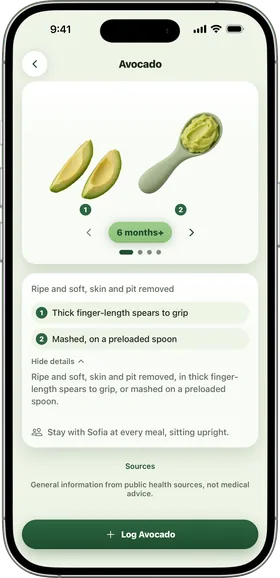
Sito is our app. From 4 to 11 months, its home screen is Starting Solids, which shows how to serve each of 583 foods at your baby's age.
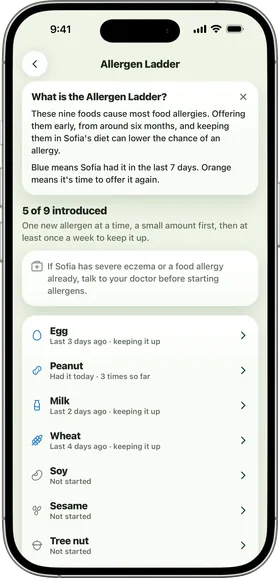
Logging a taste asks how much, the texture and how it went. The Allergen Ladder takes 9 common allergens one at a time, then at least once a week, with a "How did it go?" check after each allergen taste. A recorded reaction pauses that allergen, with a note to talk to your doctor before the next taste.
The doctor report, a PDF in six languages, lists the allergens and every food tried. See how Sito works for babies.
See how to serve each food at 7 and 8 months
Add your baby and Starting Solids shows how to serve 583 foods at their age, logs every taste and runs the Allergen Ladder for 9 allergens. Free to download, free to try.
7 month old feeding schedule
At 7 months: about 4 milk feeds (NHS) and 2 to 3 meals (WHO). This is our example day, clock times included, not a rule. Watch your baby, not the clock (USDA WIC).
- 7 am: Milk on waking.
- 8 am: Breakfast: iron-fortified cereal on a preloaded spoon, half a ripe banana to hold, sips of water.
- Noon: Lunch: a strip of chicken, sweet potato wedges or mash, then milk.
- 5 pm: Dinner, the third meal, once your baby is ready for it, then milk.
- 7 pm: Milk before bed.
8 month old feeding schedule
Our second example day is built on the AAP sample menu for 8 to 12 months: 3 meals and 2 snacks, with breast milk or formula 5 times. The NHS says babies under 12 months do not need snacks and to offer an extra milk feed instead. The clock times are ours, not a rule, and your baby decides how much (CDC).
- 7 am: Breakfast: cereal, or an egg mashed or scrambled and cooked solid; mashed fruit; breast milk or formula.
- 10 am: Snack: milk, with cooked vegetables.
- Noon: Lunch: yogurt, or mashed beans or meat; yellow or orange vegetables; milk.
- 3 pm: Snack: yogurt or mashed soft fruit, with water.
- 5:30 pm: Dinner: poultry, meat or tofu; green vegetables; soft pasta or potato; fruit; milk.
- 7 pm: Breast milk, formula or water; after milk, water or brushing teeth.
How much should a 7 or 8 month old eat?
Breastfed babies feed on demand (USDA WIC). For formula, the sources differ:
- USDA WIC: about 24 to 32 oz a day at 6 to 8 months, then about 24 oz from 8 to 12 months.
- NHS, 7 to 9 months: around 600 mL a day (about 20 oz, our conversion).
- AAP: usually no more than an average of about 32 oz (960 mL) in 24 hours.
Solids in a typical day, by food group (USDA WIC):
| Food group | 6 to 8 months | 8 to 12 months |
|---|---|---|
| Grains | 1 to 2 oz | 2 to 4 oz |
| Vegetables | 2 to 4 oz | 4 to 6 oz |
| Fruit | 2 to 4 oz | 4 to 6 oz |
| Protein foods | 1 to 2 oz | 2 to 4 oz |
Serving sizes vary (USDA WIC). Reaching for food, opening the mouth and getting excited are signs of hunger, while pushing food away, closing the mouth and turning the head are signs of fullness (CDC). If your baby cries or turns away, do not make them eat (AAP).
How often should I feed my 7 month old?
Two to three meals a day at 6 to 8 months (WHO). From about 7 months, your baby gradually moves toward 3 meals plus around 4 milk feeds (NHS). For healthy full-term babies, the AAP says to look to the baby rather than the clock. Premature babies and babies with certain medical conditions follow the schedule their pediatrician advises.
Should an 8 month old still be eating purees?
Purées still appear in the AAP's 8 to 12 month menu, but the sources say to add coarser food now. At about 8 months, the AAP suggests foods slightly coarser than strained purées. The NHS says to offer more mashed, lumpy and finger foods, and to move on from purées as soon as your baby can manage them. ESPGHAN says babies should be eating lumpy foods by 8 to 10 months at the latest, and lumps that start after about 9 to 10 months are linked with a higher risk of feeding difficulties. With new textures, your baby might cough, gag or spit up (CDC).
Finger foods for 7 and 8 month olds
Babies this age use a mitten-like or raking grip; the pincer grasp comes at about nine months (AAP). The sources differ on shape. The NHS says a finger food should be big enough to hold in a fist with a bit sticking out. The AAP says soft, easy to swallow and cut into small pieces, no larger than one-half inch. Sito's table uses the NHS shape until 9 months, then soft pieces about 1 cm:
| Food | At 7 and 8 months |
|---|---|
| Banana | Half a ripe banana, fully peeled, to hold in a fist, or mashed on a preloaded spoon. |
| Sweet potato | Roasted or steamed until soft, in finger-length wedges, or mashed onto a preloaded spoon. |
| Eggs | Cooked firm all through: an omelet strip to hold, or hard-boiled egg mashed smooth with water, breast milk or formula. Cook egg until the white and yolk are both solid, never runny. |
Avocado, broccoli, pasta and the rest are in our starting solids guide. Stay with your baby for every bite, seated upright in a high chair, not in the car or stroller (CDC). Self-feeding carries no more risk of choking than a spoon, and gagging is not choking (NHS).
Allergens, iron and water
Allergens. Give one new food at a time and wait at least a day (AAP); the AAP's solids page and USDA WIC say 3 to 5 days. If diarrhea, a rash or vomiting follows, stop the new food and consult your pediatrician. With severe eczema or a past allergic reaction to a food, talk to the pediatrician before starting allergens. ASCIA says to give the common allergens by 12 months, one new one at a meal, then, once tolerated, at least once a week. See our guide to introducing allergens to your baby.
Iron. The recommended amount is 11 mg a day from 7 months to 1 year (National Academies, via MedlinePlus). Meat, fish, fortified cereals, dark green vegetables, beans and lentils all help (NHS); pair plant iron with vitamin C foods (CDC). See our iron-rich foods for babies.
Water. From about 6 months, 4 to 8 oz a day in an open, sippy or strawed cup (AAP), as sips with meals (NHS). No juice under 12 months (AAP), no honey under 1 and no whole nuts under 5 (NHS).
When to call your pediatrician
- Your baby is not eating solid foods by seven months: discuss it with your doctor, child health nurse or dietitian (ASCIA).
- Your baby wants to eat all the time, even when full (AAP), or you are worried about how much or how little your baby eats (CDC, AAP): talk with your pediatrician. The growth chart at checkups is one way to tell if your baby gets enough food (AAP).
- Stools that are extremely loose, watery or full of mucus: offer fewer solids and go slower, and if it continues, talk with the doctor (AAP).
- Difficult or noisy breathing, a swollen tongue, throat swelling or tightness, or a baby who is pale and floppy: call an ambulance (911 in the US, 999 in the UK, 000 in Australia) and hold your baby flat, not upright (ASCIA action plan).
- A baby who can't breathe, is gasping, can't cry or make noise, turns bluish, looks panicked or goes limp may be choking and needs help right away (AAP). The AAP recommends a certified CPR and first aid course.
An app cannot diagnose. Your pediatrician knows your baby.
Frequently asked questions about feeding a 7 and 8 month old
How often should you feed an 8 month old?
Two to three meals a day (WHO). Breast milk or formula 3 to 4 times a day (MedlinePlus) or around 4 (NHS); the AAP sample menu offers it 5 times. The NHS says no snacks are needed before 1; the AAP menu has two.
Will my baby drink less milk as they eat more solids?
They may. As your baby eats more solid food, they may want less milk at each feed or drop a milk feed, and a breastfed baby adapts their feeds to how much food they have (NHS). Breast milk or formula is still the main source of nutrition from 6 to 12 months (CDC).
Can a 7 month old have scrambled eggs?
Yes. Babies can have eggs from around 6 months, cooked until the white and yolk are both solid (NHS). The AAP lists scrambled eggs as a finger food. Sito serves egg at 7 and 8 months as an omelet strip, or hard-boiled and mashed smooth.
How many ounces should a 7 or 8 month old drink?
Breastfed babies feed on demand (USDA WIC). For formula at 6 to 8 months, USDA WIC says about 24 to 32 oz a day and MedlinePlus about 6 to 8 oz per feeding; from 8 months, USDA WIC and the AAP both say about 24 oz. The NHS says around 600 mL (about 20 oz) at 7 to 9 months. The AAP says usually no more than an average of about 32 oz in 24 hours.
Is there an app to track my baby's first foods?
Yes, Sito. From 4 months, Starting Solids shows how to serve 583 foods at your baby's age, logs each taste with its texture and how it went, and runs the Allergen Ladder for 9 allergens, with a doctor report in six languages.
Sources
- WHO, Infant and young child feeding
- NHS, Your baby's first solid foods
- NHS, Baby and toddler meal ideas
- NHS, Foods to avoid giving babies and young children
- USDA WIC, Guidelines for Feeding Healthy Infants
- AAP, Sample Menu for a Baby 8 to 12 Months Old
- AAP, Amount and Schedule of Baby Formula Feedings
- AAP, How Often and How Much Should Your Baby Eat?
- AAP, When Can Babies Start Solid Foods?
- AAP, When to Introduce Egg, Peanut Butter and Other Common Food Allergens to a Baby
- AAP, Recommended Drinks for Children Age 5 and Younger
- AAP, Movement Milestones: Babies 4 to 7 Months
- AAP, Choking Prevention for Babies and Children
- CDC, How Much and How Often To Feed
- CDC, Signs Your Child is Hungry or Full
- CDC, Tastes and Textures
- CDC, Iron
- CDC, Choking Hazards
- ESPGHAN, Complementary Feeding: A Position Paper (2017)
- ASCIA, How to Introduce Solid Foods to Babies for Allergy Prevention
- ASCIA, Action Plan for Allergic Reactions (2026)
- MedlinePlus, Feeding patterns and diet: children 6 months to 2 years
- MedlinePlus, Iron in diet