- Milk is the main food. A formula-fed baby may take 6 to 8 ounces at each of 4 or 5 feedings a day (AAP); a breastfed baby feeds on demand.
- Solids start with one feeding a day (USDA WIC) and small amounts: a teaspoon or two for the AAP, 1 or 2 tablespoons for the CDC.
- Sito opens Starting Solids at 4 months: how to serve 583 foods at your baby's age, and a log of every taste.
Keeping track of first foods with Sito
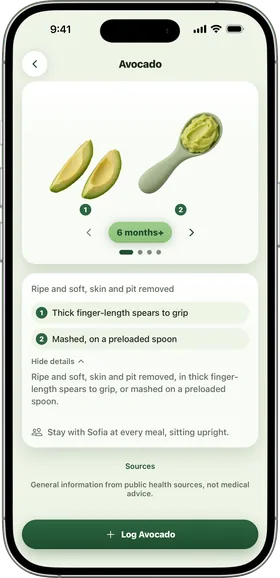
Sito is our app. From 4 months, its home is Starting Solids: the signs of readiness, how to serve each of 583 foods at your baby's age, and a quick log of every taste with how much, the texture and how it went.
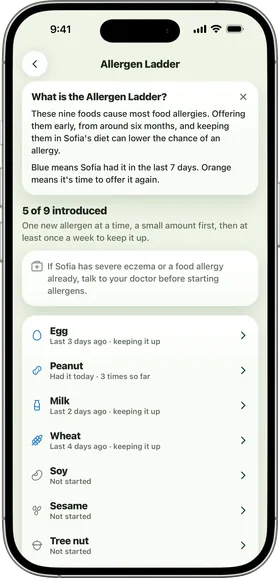
The Allergen Ladder takes 9 common allergens one at a time, with a check-in after each. When your pediatrician asks, the report on your phone shows growth, allergens and the foods tried.
Every first food, served right
Add your baby and Starting Solids opens at 4 months: how to serve 583 foods at their age, and how every taste went. Free to download, free to try.
For the whole first year, see our baby feeding chart by month.
6 month old feeding schedule with solids: a sample day
Our example, not a rule; it leaves out night feeds. Feed when your baby shows hunger, not by the clock (AAP, USDA WIC).
Start of the month
| Time | What |
|---|---|
| 7 am | Milk feed |
| 10:30 am | Milk feed and the day's one meal: a teaspoon or two of one new food |
| 2 pm | Milk feed |
| 5:30 pm | Milk feed |
| 7:30 pm | Milk feed before bed |
End of the month
| Time | What |
|---|---|
| 7 am | Milk feed |
| 8 am | Breakfast: a few spoonfuls, or a soft strip to hold |
| 11 am | Milk feed |
| 2:30 pm | Milk feed |
| 5 pm | Dinner with the family: a second small meal |
| 6 pm | Milk feed |
| 7:30 pm | Milk feed before bed, if your baby wants it |
Milk or food first? The sources differ. For the first tries, the AAP suggests a little milk, then very small half-spoonfuls of food, then more milk (AAP). The NHS says to offer food before the usual milk feed, but not to wait until your baby is too hungry (NHS). The CDC says to try breastfeeding first if your baby seems less interested in it after solids start (CDC).
How much should a 6 month old eat?
How much formula or breast milk
By 6 months, a formula-fed baby may take 6 to 8 ounces at each of 4 or 5 feedings in 24 hours (AAP). A baby should usually drink no more than an average of about 32 ounces (960 mL) of formula in 24 hours (AAP). USDA WIC says formula-fed babies take in about 24 to 32 ounces a day at 6 to 8 months, with the amount set for each baby, and that milk may decrease as foods increase (USDA WIC).
Breastfed babies feed on demand (USDA WIC, CDC). Milk stays the main source of nutrition from 6 to 12 months (CDC).
How much solid food
The AAP says to start with half a spoonful or less and increase gradually, with "just a teaspoonful or two to start" (AAP). The CDC says to start small: "Give 1 or 2 tablespoons of food" (CDC). USDA WIC says to start with about half an ounce to 1 ounce (USDA WIC). Our math: 1 tablespoon is 3 teaspoons, 15 mL or half a fluid ounce, so the AAP starts smallest. The NHS says do not worry about how much they eat (NHS).
How often should a 6 month old eat solids?
USDA WIC says to start with one feeding and gradually increase to about three a day (USDA WIC). The NHS says babies do not need 3 meals a day at first (NHS). The WHO gives 2 to 3 meals a day for infants 6 to 8 months (WHO).
What can a 6 month old eat?
The NHS says 3 signs together, from around 6 months, show your baby is ready: sitting and holding their head steady, picking food up and putting it in their mouth by themselves, and swallowing it rather than spitting it out (NHS).
Iron first
Include foods that provide iron and zinc, such as baby food made with meat or iron-fortified cereals (AAP). Breastfed babies can also benefit from iron supplements starting around 6 months; ask your pediatrician (AAP). More in our guide to iron-rich foods for babies.
One new food at a time
The AAP, CDC and USDA WIC give 3 to 5 days between new single-ingredient foods (AAP, CDC, USDA WIC). The AAP's allergen page says to wait at least a day (AAP). The NHS says foods with allergens, such as peanuts, eggs, gluten and fish, can be introduced from around 6 months, one at a time and in small amounts so you can spot any reaction (NHS). If your baby has severe eczema or an egg allergy, talk with your child's doctor or nurse about when and how to safely introduce foods with peanuts (CDC). More in our guide to introducing allergens to baby.
Ten first foods and how we serve them
Most are a piece to hold, or mashed. Babies this age use a mitten- or claw-like grip; the pincer grasp comes at about 9 months (AAP). The NHS says finger food should be big enough to hold in the fist with a bit sticking out. It says there is no more risk of choking when babies feed themselves than when fed with a spoon, and to always stay with your baby while they eat (NHS).
The AAP advises differently: first foods soft or pureed, finger foods soft and cut into small pieces, and no chunks of meat or cheese under 1 year (AAP). Its choking page says pieces no larger than one-half inch, with children sitting down to eat and an adult supervising (AAP).
Ten first foods and how we serve them at 6 to 8 months
| Food | How we serve it at 6 to 8 months |
|---|---|
| Avocado | Ripe and soft, skin and pit removed, in thick finger-length spears to grip, or mashed on a preloaded spoon. |
| Banana | Half a ripe banana, fully peeled, to hold in a fist, or mashed on a preloaded spoon. |
| Sweet potato | Roasted or steamed until soft, in finger-length wedges, or mashed onto a preloaded spoon. |
| Oats | Cooked into a thick, soft porridge and offered on a preloaded spoon for the baby to grab. |
| Egg | Cooked firm all through: an omelet strip to hold, or hard-boiled egg mashed smooth with water, breast milk or formula. Allergen; iron-rich; never runny |
| Chicken | Moist slow-cooked thigh or breast in a long flat strip about 7 cm by 3 cm to gnaw, or shredded fine and mixed into mash. Iron-rich; cook to 165°F (74°C); no bones, skin or gristle |
| Steak | Cooked through, fat trimmed, in one strip about 7 cm long and 3 cm wide to gnaw and suck, or minced fine into mash. Iron-rich; cook to 145°F (63°C), rest 3 minutes |
| Yogurt | Plain, full-fat and unsweetened, on a preloaded spoon your baby can grab. Allergen (milk); pasteurized, no added sugar |
| Peanut | Smooth unsalted peanut butter thinned with warm water, or finely ground peanuts, stirred into porridge or mashed fruit. Allergen; never by the spoonful; whole or chopped peanuts wait until 5 |
| Broccoli | Steamed until soft enough to squash, as a whole floret held by its stalk, or mashed. |
The NHS says to avoid hard foods such as whole nuts, raw carrot and raw apple, and to add no salt or sugar (NHS). Do not put baby cereal in a bottle, because your baby could choke, unless your child's doctor recommends it for reflux (AAP). More foods are in our starting solids guide; Sito has all 583.
Let your baby decide how much
Hungry looks like reaching for food, opening the mouth and getting excited. Full looks like pushing food away, closing the mouth and turning the head. Let your child decide how much they want (CDC). It may take 10 tries or more for your baby to get used to new foods (NHS). If your baby cries or turns away when you feed them, do not make them eat (AAP).
Water, juice and milk at 6 months
Healthy babies do not need extra water (AAP). Around 6 months you can offer a little water in a cup, 4 to 8 ounces a day (AAP), and the NHS suggests sips with meals (NHS). No juice under 12 months (AAP). On cow's milk the sources differ: the AAP says not to give it until your baby is over 12 months old (AAP), and the NHS allows it in cooking or mixed with food from around 6 months, but not as a main drink until 1 (NHS).
When to call your pediatrician
Talk with your pediatrician if:
- Your baby consistently seems to want more or less formula than the amounts above (AAP), or seems to want to eat all the time, even when full (AAP).
- Stools are extremely loose, watery or full of mucus: offer less solid food and go more slowly, and if it continues, talk with your child's doctor (AAP).
- You have concerns about how much or how little your baby eats (AAP), or questions about growth or how much breast milk they get (CDC).
- Your baby was born early or has certain medical conditions: scheduled feedings advised by your pediatrician are best (AAP).
If you see signs of an allergic reaction, stop feeding that food and get medical advice. Reactions usually show within minutes to two hours (ASCIA). Call 911 (999 in the UK, 000 in Australia) for difficult or noisy breathing, a swollen tongue or throat, or a baby who is pale, limp, floppy or not responding as usual (NHS, NHS, ASCIA). An app cannot diagnose; your pediatrician can.
Next: our 7 and 8 month old feeding schedule.
Frequently asked questions about feeding a 6 month old
How many ounces should a 6 month old drink?
A formula-fed baby may take 6 to 8 ounces at each of 4 or 5 feedings in 24 hours (AAP). USDA WIC says formula-fed babies take in about 24 to 32 ounces a day at 6 to 8 months, with the amount set for each baby (USDA WIC). A baby should usually drink no more than an average of about 32 ounces (960 mL) of formula in 24 hours (AAP). A breastfed baby feeds on demand (USDA WIC).
Is 4 oz enough for a 6 month old?
By 6 months, the AAP says a formula-fed baby may take 6 to 8 ounces at each feeding (AAP). But babies probably will regulate their intake from day to day (AAP). The growth chart is one way to tell whether your baby is getting enough food (AAP). If your baby consistently seems to want less, discuss it with your pediatrician (AAP). A breastfed baby feeds on demand, when they show hunger (CDC).
How long can a 6 month old go between feedings?
The AAP gives 4 or 5 formula feeds in 24 hours (AAP). The CDC says most 6 to 12 month olds need infant formula or solid foods about 5 to 6 times in 24 hours (CDC). From 2 to 4 months on, a formula-fed baby may go longer between daytime feeds, occasionally up to 4 or 5 hours (AAP). A breastfed baby feeds on demand (CDC).
Can I give my baby juice at 6 months?
No. Babies younger than 12 months should not be given juice (AAP). Our juice page starts it at 12 months. Around 6 months you can offer a little water instead, 4 to 8 ounces a day (AAP).
Is there an app to keep track of my baby's first foods?
Yes. In Sito, Starting Solids opens at 4 months with how to serve 583 foods at your baby's age and a quick log of every taste. The Allergen Ladder takes 9 allergens one at a time, with a check-in after each, and the report for your pediatrician is made on your phone.
Sources
- AAP, How Often and How Much Should Your Baby Eat?
- AAP, Amount and Schedule of Baby Formula Feedings
- AAP, When Can Babies Start Solid Foods? Readiness and Feeding Tips
- AAP, Recommended Drinks for Children Age 5 and Younger
- AAP, Iron Deficiency and Anemia in Babies, Children and Teens
- AAP, When to Introduce Egg, Peanut Butter and Other Common Food Allergens to a Baby
- AAP, Choking Prevention for Babies and Children
- AAP, Movement Milestones: Babies 4 to 7 Months
- CDC, How Much and How Often To Feed
- CDC, How Much and How Often to Feed Infant Formula
- CDC, How Much and How Often to Breastfeed
- CDC, Signs Your Child Is Hungry or Full
- CDC, When, What, and How to Introduce Solid Foods
- USDA WIC, Guidelines for Feeding Healthy Infants
- WHO, Infant and Young Child Feeding
- NHS, Your Baby's First Solid Foods
- NHS, Food Allergies in Babies and Young Children
- NHS, Anaphylaxis
- ASCIA, How to Introduce Solid Foods to Babies for Allergy Prevention