
Butylated hydroxytoluene (BHT) is the antioxidant the food industry lists as E321. In our table it is low risk: it takes 6 of the 33 additive points off a product's score for a child.
- Low risk. 6 of the 33 additive points come off a product that carries it.
- Flagged for young children. Set only where EFSA’s own exposure assessment shows toddlers or children exceeding or approaching the ADI, or where a regulator used explicitly child-specific language. For a child under 6 it moves one class up.
- 5 citations from FDA, EFSA, IARC, Peer-reviewed, Law, each one below.
What BHT does to a score
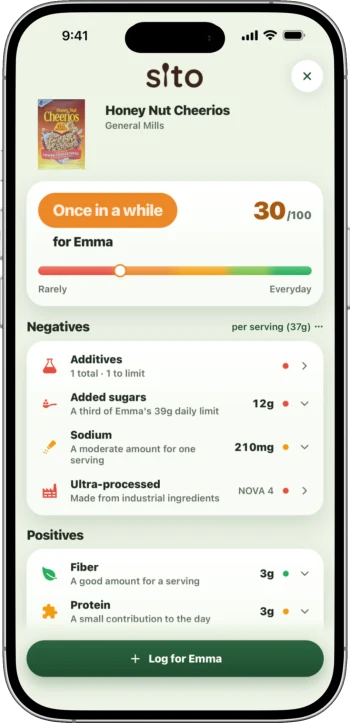
A packaged food starts with 33 points for what is in its ingredient list. BHT takes 6 of the 33 additive points off a product's score, and a child under 6 sees it one class higher again. Scan the pack in Sito and the score you get is the one for your own child's age, with this additive named in the reasons. How we score has the whole method.
What the sources found
Every classification in our table comes from the citations below, and nothing else. They are quoted as the source wrote them.
-
FDA
news release 'FDA finalizes food chemical safety post-market assessment program, launches reassessment of BHT and ADA' (program finalized 2026-05-12)
FDA finalised its post-market chemical assessment programme on 2026-05-12 and selected butylated hydroxytoluene as one of the first two chemicals to reassess (with azodicarbonamide, E 927a). Not a ban, a phase-out or a safety finding, and it does not change this classification: BHT is currently under FDA post-market reassessment, so its US status is under active review rather than settled; this citation records that review. -
EFSA
10.2903/j.efsa.2012.2588 (EFSA Journal 2012;10(3):2588)
ADI 0.25 mg/kg bw/day (NOAEL 25 mg/kg, UF 100); not of concern for genotoxicity. 'For exposure of children to BHT from its use as food additive ... it is also unlikely that this ADI is exceeded at the mean, but is exceeded for some European countries (Finland, The Netherlands) at the 95th percentile', while adults are unlikely to exceed it at mean or P95. -
IARC
classification list — Butylated hydroxytoluene (BHT), CAS 128-37-0, Group 3 (Vol. 40, Suppl. 7, 1987)
Not classifiable as to carcinogenicity to humans. -
Peer-reviewed
Liu & Mabury, Environ Int 2019; doi:10.1016/j.envint.2019.04.028; and Koch et al., Int J Hyg Environ Health 2020; doi:10.1016/j.ijheh.2020.113541
Human biomonitoring detects BHT and its metabolites in urine at population scale, confirming widespread internal exposure alongside dietary intake. -
Law
TX SB 25, 89th Texas Legislature (2025)
BHT is among the 44 ingredients that would trigger a warning label from 2027-01-01; enforcement preliminarily enjoined 2026-02-11 (First Amendment). Not a ban.
Why this class
A credible adverse or precautionary signal that stops short of every Moderate and High criterion: peer-reviewed adverse findings not yet reflected in regulatory status, an exposure exceedance confined to high-percentile or single-event estimates, or a precautionary regulatory step short of those criteria — a reduced ADI, a data limitation noted without an adverse conclusion, a narrowed or conditioned authorisation, or a child-focused assessment or school-food law that covers the additive as part of a class.
Our confidence in this row's classification is high. Medium or low does not mean the evidence is weak; it means something about the row is still being pinned down, usually a regulatory status confirmed from one source rather than two.
See what is in your own cupboard
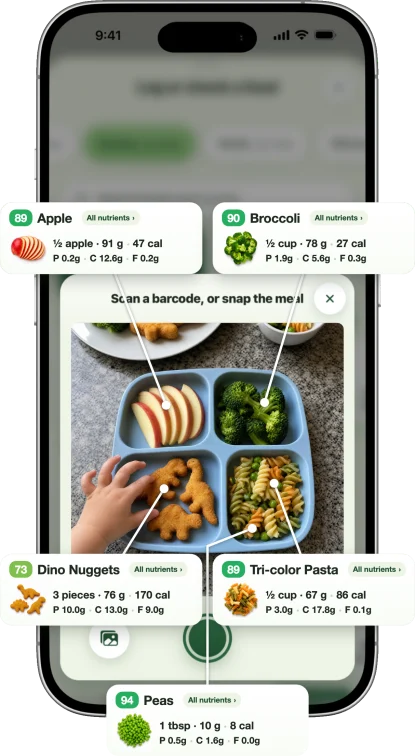
Scan a packaged food and Sito names the additives in it, then scores the product out of 100 for your child's age.
Other antioxidants in the table
- Erythorbic acid (E315), no risk identified
- Sodium erythorbate (E316), no risk identified
- Calcium disodium EDTA (E385), no risk identified
- Extracts of rosemary (E392), no risk identified
- Propyl gallate (E310), low risk
- TBHQ (E319), low risk