
Butylated hydroxyanisole (BHA) is the antioxidant the food industry lists as E320. In our table it is high risk: it takes 30 of the 33 additive points off a product's score for a child.
- High risk. 30 of the 33 additive points come off a product that carries it.
- No child flag. Nothing below is written about children specifically, so the class is the same at every age.
- 4 citations from IARC, OEHHA, Law, EFSA, each one below.
What BHA does to a score
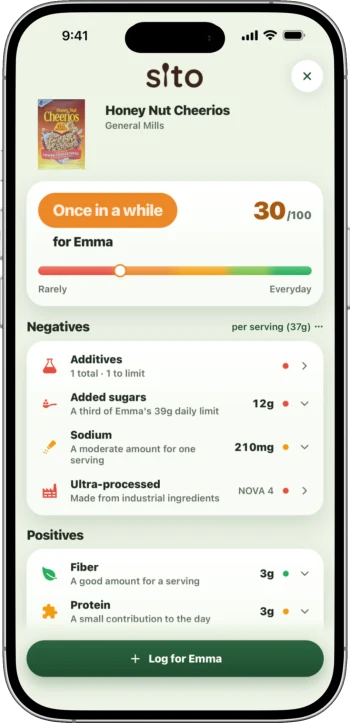
A packaged food starts with 33 points for what is in its ingredient list. BHA takes 30 of the 33 additive points off a product's score. Scan the pack in Sito and the score you get is the one for your own child's age, with this additive named in the reasons. How we score has the whole method.
What the sources found
Every classification in our table comes from the citations below, and nothing else. They are quoted as the source wrote them.
-
IARC
classification list — Butylated hydroxyanisole (BHA), CAS 25013-16-5, Group 2B (Vol. 40, Suppl. 7, 1987)
Possibly carcinogenic to humans, from oral rodent forestomach studies — dietary route. -
OEHHA
Proposition 65 list — butylated hydroxyanisole, CAS 25013-16-5, listed 1990-01-01 (cancer)
Listed under Prop 65 as known to the State of California to cause cancer since 1990-01-01. -
Law
West Virginia HB 2354 (signed 2025-03-24); TX SB 25, 89th Leg. (2025)
WV prohibits BHA in food sold in the state — school nutrition programs from 2025-08-01 (in force), all food from 2028-01-01 (preliminarily enjoined Dec 2025). TX SB 25 names BHA among 44 ingredients triggering a warning label from 2027-01-01 (enforcement enjoined 2026-02-11). -
EFSA
10.2903/j.efsa.2011.2392 and 10.2903/j.efsa.2012.2759
ADI raised to 1.0 mg/kg bw/day (forestomach hyperplasia judged not relevant to humans; NOAEL 100 mg/kg from rat-pup growth/mortality/behaviour); additive-only exposure below the ADI, but combined food + food-contact-material exposure 'does exceed the ADI for most population groups'.
Why this class
IARC Group 1 or 2A with a dietary exposure route; or EFSA has withdrawn or negated a safety conclusion; or EFSA’s own exposure assessment finds a child age group exceeding the ADI at mean intake; or the substance is banned or formally being phased out for food use by the EU, by the US FDA, or under a US state law.
Our confidence in this row's classification is medium. Medium or low does not mean the evidence is weak; it means something about the row is still being pinned down, usually a regulatory status confirmed from one source rather than two.
See what is in your own cupboard
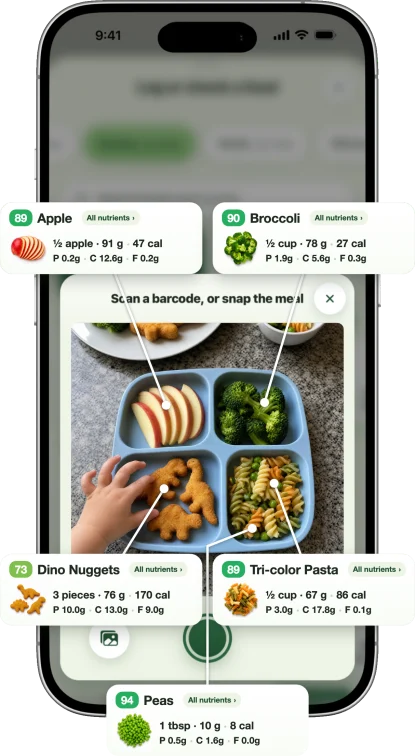
Scan a packaged food and Sito names the additives in it, then scores the product out of 100 for your child's age.
Other antioxidants in the table
- Extracts of rosemary (E392), no risk identified
- Propyl gallate (E310), low risk
- TBHQ (E319), low risk
- BHT (E321), low risk
- Octyl gallate (E311), high risk
- Dodecyl gallate (E312), high risk