
Boric acid is the preservative the food industry lists as E284. In our table it is moderate risk: it takes 15 of the 33 additive points off a product's score for a child.
- Moderate risk. 15 of the 33 additive points come off a product that carries it.
- Flagged for young children. Set only where EFSA’s own exposure assessment shows toddlers or children exceeding or approaching the ADI, or where a regulator used explicitly child-specific language. For a child under 6 it moves one class up.
- 5 citations from EFSA, Law, FDA, Open Food Facts, each one below.
What Boric acid does to a score
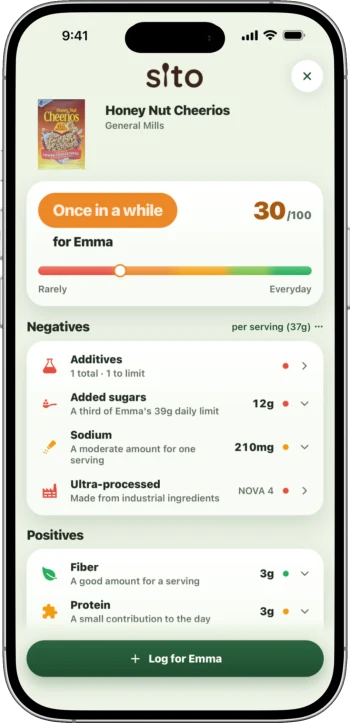
A packaged food starts with 33 points for what is in its ingredient list. Boric acid takes 15 of the 33 additive points off a product's score, and a child under 6 sees it one class higher again. Scan the pack in Sito and the score you get is the one for your own child's age, with this additive named in the reasons. How we score has the whole method.
What the sources found
Every classification in our table comes from the citations below, and nothing else. They are quoted as the source wrote them.
-
EFSA
10.2903/j.efsa.2013.3407 (EFSA Journal 2013;11(10):3407)
Group ADI 0.16 mg boron/kg bw/day established (NOAEL 9.6 mg boron/kg bw/day from a rat developmental study, uncertainty factor 60); male reproductive system adversely affected in rats, mice and dogs; boric acid and sodium tetraborate do not raise concern for genotoxicity. Exposure from the additive use at the highest mean: children 0.04 mg boron/kg bw/day. At the 95th percentile for consumers only: children 0.56 vs adolescents 0.37, adults 0.13, elderly 0.15 — children highest, 3.5x the ADI, the basis of the child flag. The Panel concluded regular exceedance of the ADI is unlikely given the caviar-only authorisation. -
Law
Commission Regulation (EC) No 790/2009 (1st ATP to CLP Regulation (EC) No 1272/2008), index 005-007-00-2 (boric acid) and 005-011-00-4 (disodium tetraborate); Commission Delegated Regulation (EU) 2021/849
Boric acid and disodium tetraborate carry the EU harmonised classification Repr. 1B, H360FD ('may damage fertility; may damage the unborn child'). Regulation (EU) 2021/849 deleted the boron-specific concentration limits, so the generic 0.3% limit for Repr. 1B applies since 2022-12-17. A hazard classification of the substance, not a food rule — CLP labelling does not apply to food sold to the final consumer — but it is the named regulatory reflection of the developmental hazard that keeps this row at mid rather than low. The same substances have been on the REACH Candidate List as SVHCs since 2010-06-18. -
Law
Regulation (EC) No 1333/2008 Annex II, food category 09.3 (fish roe): E 284 boric acid, maximum 4 000 mg/kg (expressed as boric acid), only sturgeons' eggs (caviar)
The single EU-authorised food use, in force: preservative in sturgeon caviar at up to 4,000 mg/kg expressed as boric acid. An authorisation, not a ban. -
FDA
eCFR search of 21 CFR — boric acid appears only in indirect/food-contact sections (§176.180, §178.2010, §178.3130, §175.105); no direct food-additive or GRAS listing
Not permitted as a direct food preservative in the US. -
Open Food Facts
additives taxonomy node en:e284
Cross-check: OFF maps E284 to the same 2013 EFSA re-evaluation; it records no exposure-exceedance flags, so this row's higher-concern-for-young-children flag comes from the EFSA table directly, not from OFF.
Why this class
IARC Group 2B; or an EFSA re-evaluation that flagged genotoxicity data gaps, found safety could not be assessed on the available data, or cut the ADI citing child exposure; or an EU harmonised classification of the substance as a reproductive or developmental hazard; or an EU withdrawal of one authorised food use while others remain; or an OEHHA/Proposition 65 listing; or membership of the Southampton-six colourants.
Our confidence in this row's classification is medium. Medium or low does not mean the evidence is weak; it means something about the row is still being pinned down, usually a regulatory status confirmed from one source rather than two.
See what is in your own cupboard
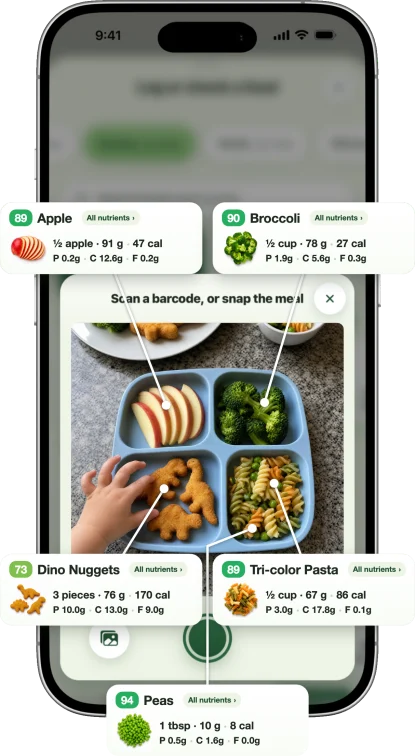
Scan a packaged food and Sito names the additives in it, then scores the product out of 100 for your child's age.
Other preservatives in the table
- Sodium methyl p-hydroxybenzoate (E219), low risk
- Propionic acid (E280), low risk
- Sodium propionate (E281), low risk
- Calcium propionate (E282), low risk
- Hexamethylene tetramine (E239), moderate risk
- borax (E285), moderate risk