
You searched for a weight loss app for kids. Pediatricians would point you somewhere else. In 2023 the American Academy of Pediatrics (AAP) published its first comprehensive guidance in 15 years on children and teens with obesity (AAP news release). One of its lead authors says children need support "within a treatment plan that involves the whole family."
- The AAP says the goal is better health, reached through family habits with your pediatrician, and that waiting does not help.
- BMI for age is a screening number your pediatrician reads over time. It is not a label for your child.
- The whole family shifts together: water and plain milk, less added sugar, meals together, sleep and screens. Sito helps with the food side: it tracks added sugar and scores drinks and snacks for your child's age.
How Sito helps your family with healthy habits
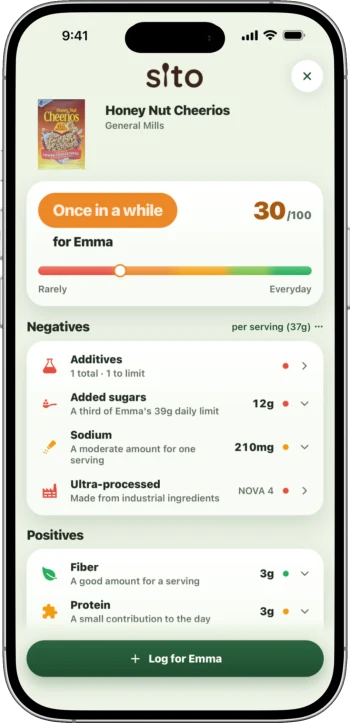
Sito is our app. It helps with the food and drink side of these habits. Pin added sugars, and your child's home screen shows the day's total against your child's own daily limit. Under age 2 it says "AAP: none before age 2."
Scan a drink or a snack and Sito gives it a score out of 100 for your child's age, stricter under 6. When one serving takes a quarter or more of your child's daily limit, the card names that limit and the share. Our public additive table sits behind every score.
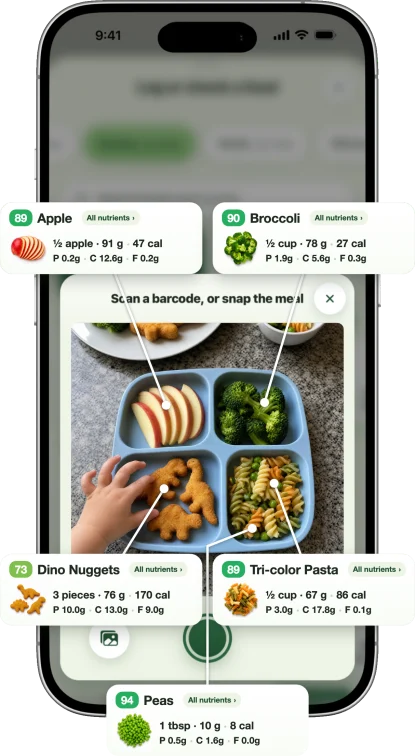
Log meals by photo, barcode, a short description or search. Each child has their own profile. Copy a meal to a sibling, and a partner joins with a 6-digit code and logs from their own phone.
Every Sunday we write a Weekly Report from the meals you logged, and past reports are saved, so you can open one at the checkup. If your doctor or dietitian gave you a number, enter it and we use yours instead of our estimate.
Build healthy habits as a family
Log meals by photo, barcode or search, scan drinks and snacks for your child's age, and keep a record to bring to the pediatrician.
Should a child use a weight loss app?
Not as a diet, and not without your pediatrician. For school-age children, the AAP says the child "is in the best position to decide how much to eat," and that "there is rarely a reason for you to count calories for your children" (AAP, Monitoring What Your Child Eats).
Any adolescent planning a weight-loss diet should first talk with a pediatrician (AAP, Fads and Diets). Some teenagers who try to lose weight may develop an eating disorder. The focus should be on a healthy lifestyle rather than on weight (AAP clinical report, 2016).
What works best is family based: the most effective treatments include 26 or more hours of face-to-face, family-based treatment over 3 to 12 months (AAP news release). These family healthy weight programs focus on health, not weight, and on the whole household. Ask your pediatrician about one (AAP, What is IHBLT?). An app cannot diagnose or treat, but Sito can keep a clear record of meals and drinks to open at those visits.
What the AAP 2023 guideline says about children's weight
It covers children age 2 and older. Its main points, as the AAP explains them:
- Do not wait. "There is no evidence that 'watchful waiting' or delayed treatment is appropriate for children with obesity," said one of the guideline's authors (AAP news release).
- The goal is better health. What "improved weight" means is decided for each child. The plan also aims for good self-esteem, being active, school, and time with family and friends (AAP, Treatment for Obesity).
- No blame. Expect your child and family to be treated "with respect, not blame or stigma." Genes, biology, environment, government policies and stress all play a part (AAP, Treatment for Obesity).
- The whole family. Children and teens are "especially aware of the harsh and unfair stigma" around weight, said a lead author, and the plan "involves the whole family" (AAP news release).
- Age matters. For family treatment programs, the most information is for children older than 6, and new studies in children 2 to 5 "look promising" (AAP, What is IHBLT?).
How doctors read BMI for age
Because children are growing, their BMI is compared with others of the same sex and age. The CDC uses these ranges (CDC, Child and Teen BMI Categories).
| BMI-for-age percentile | CDC category (ages 2 to 19) |
|---|---|
| Less than the 5th | Underweight |
| 5th to less than the 85th | Healthy weight |
| 85th to less than the 95th | Overweight |
| 95th or greater | Obesity |
| 120% of the 95th or greater, or 35 kg/m² or greater | Severe obesity |
These words describe where a BMI sits on a chart, and "these words do not describe your child" (AAP, BMI in Children).
BMI percentile is a screening tool, "not intended to be a sole diagnostic measure." The AAP recommends that your child's doctor check BMI at least once a year from age 2 (CDC, Screening for Child Obesity). Your pediatrician plots it on a growth chart to track growth trends over time. BMI is "only one piece of the puzzle": a shorter child with a muscular build may have a high BMI but little body fat. The AAP says the best way to know it is to have the pediatrician measure it and discuss the results with you (AAP, BMI in Children).
Family healthy habits the AAP and CDC name first
The AAP's 5-2-1-0 plan: 5 fruits and vegetables a day, 2 hours or less of screen time, 1 hour of physical activity, and the 0 stands for "limit sugar-sweetened drinks." Add breakfast every day, fiber, meals together as a family, enough sleep, and parents as role models (AAP, 5-2-1-0).
Drinks first
- Swap sugary drinks for water or plain milk (CDC, 6 Things Families Can Do).
- Ideally, one sweet drink or fewer per week, 100% juice included, and none for infants and toddlers (AAP, Helping Kids Build Healthy Active Lives).
- Aim for less than 25 grams of added sugar a day (about 6 teaspoons) from age 2, and none before 2. About half of the sugar children eat and drink comes from sweetened drinks (AAP, How to Reduce Added Sugar).
- If you serve juice, the AAP's limits are 4 ounces a day at ages 1 to 3, 4 to 6 ounces at 4 to 6, and 8 ounces at 7 to 18 (AAP on juice).
Meals together
Regular meal and snack times can support a healthy weight. Help children learn to follow their hunger and fullness cues. Family meals have been shown to support healthy weight, and children who eat while using screens risk "mindless and excess food intake" (AAP, Helping Kids Build Healthy Active Lives). Our guide to portion sizes by age shows a child-sized serving.
Move and sleep
Ages 6 to 17 should get at least 60 minutes of physical activity every day. Sleep matters too: 10 to 13 hours for preschoolers, 9 to 12 at ages 6 to 12, and 8 to 10 at ages 13 to 17. Too much screen time can lead to poor sleep and weight gain (CDC, 6 Things Families Can Do).
How to talk about weight at home
Talk about food, sleep and play, not weight. The AAP recommends more family meals and discouraging "weight talk" and "weight teasing" at home (AAP, eating disorders news).
Change what the household does, not what one child does, and be kind to yourself too. A BMI check is also a chance to talk with your pediatrician about eating, activity, screen time and sleep (CDC, Screening for Child Obesity). A simple food diary of what the family ate, kept without judgment, gives you something concrete to talk through.
When to call your pediatrician
- You are worried about your child's weight. Your pediatrician can assess health risks and may refer you to a family healthy weight program (CDC, 6 Things Families Can Do).
- Your child's BMI falls outside the 5th to 85th percentiles (AAP, BMI in Children).
- Your teen wants to start a weight-loss diet. Talk with the pediatrician first (AAP, Fads and Diets).
- Your child's eating patterns change. Anorexia often starts with a reasonable goal of living a healthier lifestyle. "Do not wait for your child to agree that they have a problem" (AAP, Anorexia and Bulimia).
FAQ
My teen wants a weight loss app. Is that safe?
Talk with your pediatrician first; the AAP asks this of any adolescent planning a weight-loss diet (AAP, Fads and Diets). Some teens who try to lose weight may develop an eating disorder, so keep the focus on a healthy lifestyle rather than on weight (AAP clinical report, 2016). If your pediatrician does advise treatment, the most effective kind is family based, with 26 or more hours of face-to-face support (AAP news release).
Should I count my child's calories?
For school-age children, the AAP says there is rarely a reason to, since most children control their intake quite well (AAP, Monitoring What Your Child Eats). The goal is better health (AAP, Treatment for Obesity), and your pediatrician can help you find the right plan for your family (AAP, What is IHBLT?). Start with drinks and added sugar instead.
What can I show my pediatrician from Sito?
Open Sito's Weekly Report. We write one every Sunday from the meals you logged, and past reports stay saved, so at the checkup you can open the last few and talk through what your child ate and drank. Everyone who logs for your child, including a partner on their own phone, adds to the same record.
An app cannot diagnose or treat. Talk with your pediatrician.
Sources
- AAP news release, first comprehensive guideline on obesity in children and adolescents, 2023
- AAP, Treatment for Obesity in Children and Teens, 2023
- AAP, What is IHBLT?, 2023
- CDC, Child and Teen BMI Categories, 2024
- CDC, Screening for Child Obesity, 2024
- AAP, BMI in Children, 2024
- AAP, 5-2-1-0 Healthy Active Living for Families, 2024
- AAP, Helping Kids Build Healthy Active Lives, 2026
- AAP, How to Reduce Added Sugar in Your Child's Diet, 2024
- AAP, fruit juice recommendations, 2017
- CDC, 6 Things Families Can Do, 2026
- AAP, Monitoring What Your Child Eats (ages 5 to 12), 2009
- AAP clinical report, Preventing Obesity and Eating Disorders in Adolescents, Pediatrics, 2016
- AAP, Identifying and Treating Eating Disorders, 2020
- AAP, Anorexia and Bulimia, 2025
- AAP, Fads and Diets, 2011