
A healthy snack for kids pairs two food groups, like fruit with cheese or vegetables with hummus (AAP). School-age kids usually eat one or two snacks a day (KidsHealth). On a packaged snack, check the added sugars, the sodium and the first ingredient. Whole nuts, whole grapes and popcorn wait until at least age 4.
- Pair two food groups, like apple and cheese; most school-age kids eat one or two snacks a day.
- On a pack, check added sugars, sodium and the first ingredient; the AAP says under 25 g of added sugar a day from age 2.
- Sito scans a snack, scores it out of 100 for your child's age, and logs it into their day.
Check a packaged snack against your child's own limits
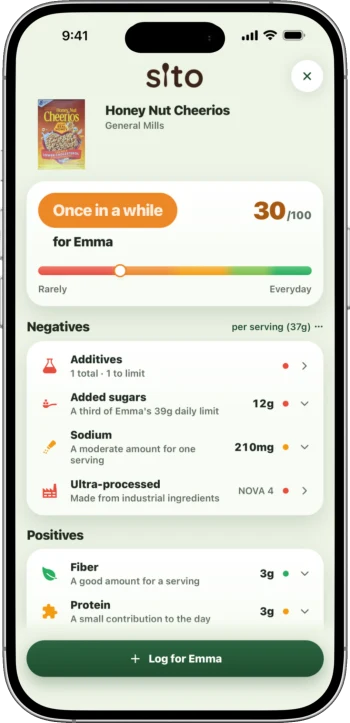
Sito is our app. Scan a packaged snack and it gets a score from 0 to 100, calculated from what is printed on its label (how we score a snack). The score is for your child's age, and it is stricter under 6.
Sito reads the pack against your child's own daily limits, not the pack's %DV. When one serving is at least a quarter of your child's limit for added sugars, sodium or saturated fat, the line under that row says so in your child's name.
- Each additive is named with its E number, backed by our public additive table of 253 additives and 597 citations.
- Tap "Log for" with your child's name to add the snack to their day. Sito tracks 18 nutrients across the day.
- Until age 4, Sito also shows how to serve each of 583 foods at your child's age, grapes and apples included.
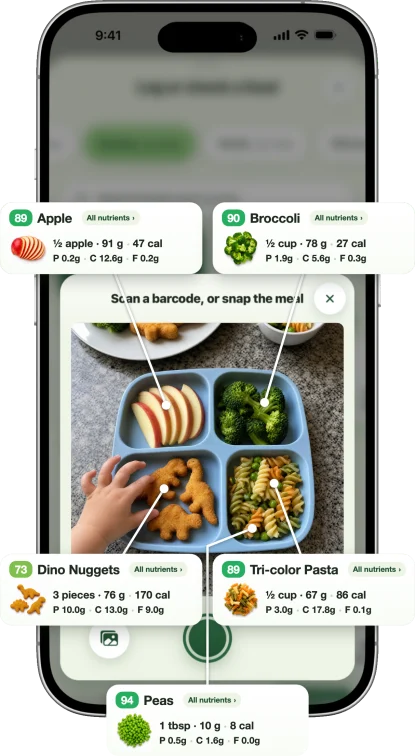
- For a homemade snack, the same camera takes a photo.
Check a packaged snack for your child's age
Scan a packaged snack and Sito scores it out of 100 for your child's own age and names the additives in it.
What makes a healthy snack for kids?
Most children eat at least one snack a day, so a snack is a good place to add fruit and vegetables (AAP). Pair them with dairy, protein or a whole grain, like grapes with cheese or celery with peanut butter.
Processed foods often have a lot of added sugar and salt, and the AAP says children may get hungry faster after them. Treats still have a place. KidsHealth calls them the exception rather than the rule, and says an occasional treat is fine.
How many snacks a day does a child need?
By age 2, a child should be eating three meals a day plus one or two snacks (AAP). School-age kids usually eat one or two, often mid-morning and after school (KidsHealth). For packaged snacks in the UK, the NHS says to "aim for 2 a day max" (NHS Healthier Families).
Offer snacks at set times, and let your child decide whether to eat and how much (AAP). Children who graze all day may not be hungry at mealtimes. Let four- and five-year-olds choose their own serving, on a smaller plate.
20 healthy snack ideas with portions for ages 3 to 5 and 6 to 12
These portions are the USDA's minimums for a snack in child care (USDA CACFP). They show what to offer, not an amount your child has to finish. For children under 4, see the choking fixes further down.
| Snack | Ages 3 to 5 | Ages 6 to 12 |
|---|---|---|
| Apple or pear slices | 1/2 cup | 3/4 cup |
| Berries or grapes | 1/2 cup | 3/4 cup |
| Veggie sticks with hummus | 1/2 cup veg | 3/4 cup veg |
| Plain yogurt with fruit | 1/4 cup yogurt | 1/2 cup yogurt |
| Cheese with fruit | 1/2 oz cheese | 1 oz cheese |
| Woven whole-wheat crackers | 3 crackers | 5 crackers |
| Whole-grain toast with nut or seed butter | 1/2 slice, 1 tbsp | 1 slice, 2 tbsp |
| Hard-boiled egg | 1/4 egg | 1/2 egg |
| Milk with a whole grain | 4 fl oz milk | 8 fl oz milk |
| Air-popped popcorn | 1 1/2 cups, from age 4 | 3 cups |
10 more ideas
| Snack | Ages 3 to 5 | Ages 6 to 12 |
|---|---|---|
| Banana | 1/2 cup | 3/4 cup |
| Canned fruit, no added sugars | 1/2 cup | 3/4 cup |
| Mandarin segments | 1/2 cup | 3/4 cup |
| Grape tomatoes | 1/2 cup | 3/4 cup |
| Snap peas with hummus | 1/2 cup | 3/4 cup |
| Cottage cheese with peaches | 2 tbsp | 1/4 cup |
| Low-sugar whole-grain cereal | 1/2 cup | 1 cup |
| Plain rice cakes | 1 1/2 | 3 |
| Oatmeal with shredded apple | 1/4 cup cooked | 1/2 cup cooked |
| Trail mix: cereal, nuts, raisins | Skip whole nuts | 1 oz nuts |
Protein amounts follow the USDA's protein guide and grains its grains chart. Keep dried fruit, like the raisins in trail mix, for mealtimes, because it can stick to teeth (NHS). For meals, see portion sizes by age.
Snacks for kindergarten and the lunchbox
Most schools offer a mid-morning snack (KidsHealth). If you pack one, pick two groups from the table, like cheese and fruit. For a nut-free class, swap nut butter for sunflower seed butter. The USDA counts 2 tablespoons of either as equal to 1 ounce of cooked lean meat (USDA).
A snack sold in US schools can qualify by being at least half whole grain, or by listing a whole grain, fruit, vegetable, dairy or protein food first. It must also carry no more than 200 mg of sodium per item (7 CFR 210.11). It is a school rule, but the first-ingredient check works at home too.
Healthy packaged snacks: added sugar, sodium and whole grain
Added sugar
The AAP says to aim for less than 25 grams (about 6 teaspoons) of added sugar a day from age 2, and none before 2 (AAP). The American Heart Association sets the same 25 g line (Vos et al., Circulation). The 2025 to 2030 Dietary Guidelines go further. They say to avoid added sugars from birth to age 4, and for ages 5 to 10, "No amount of added sugars is recommended" (DGA).
For snacks, the same guidelines set a ceiling of 5 g of added sugar per 3/4 ounce whole-grain equivalent for grain snacks like crackers, and 2.5 g per 2/3 cup equivalent for dairy snacks like yogurt. Added sugar hides in words with "sugar" or "syrup", words ending in "-ose", honey and fruit juice concentrate. Sugar in fruit and plain milk is not added.
The %DV on the pack is based on a 2,000-calorie day, with a Daily Value for added sugars of 50 g (FDA). So 10 g of added sugar shows 20% DV, which the FDA calls high. For a child, it works out to 40% of the AAP's 25 g.
Sodium
| Age | Keep sodium under |
|---|---|
| 1 to 3 years | 1,200 mg a day |
| 4 to 8 years | 1,500 mg a day |
| 9 to 13 years | 1,800 mg a day |
| 14 to 18 years | 2,300 mg a day |
These lines come from the National Academies, and the 2025 to 2030 guidelines use them too. Here is how three grain snacks compare, from USDA FoodData Central:
- 14 mini pretzels (22 g): about 273 mg, or about 18% of a 4 to 8 year old's limit.
- 5 whole-wheat crackers (22 g): about 176 mg, or about 41 mg low-salt.
- 3 cups of air-popped popcorn: about 2 mg, with about 4 g of fiber.
Whole grain does not mean low salt, so check both lines.
The first ingredient
Ingredients are listed by weight, most first (21 CFR 101.4), so look for a whole grain at the top. The Dietary Guidelines also say to limit foods with petroleum-based dyes and artificial preservatives. You can look up an additive in our additive table.
In the UK
Children aged 4 to 6 should have no more than 19 g of free sugars a day, and ages 7 to 10 no more than 24 g (Sugar: the facts). Salt should be no more than 3 g a day at 4 to 6, and 5 g at 7 to 10 (Salt in your diet). On the front of a pack, pick more green and amber traffic lights and fewer reds.
Our snack score reads the sugar and salt lines for you, and it is stricter for children under 6.
Snacks to change for children under 4
The AAP advises keeping high-risk foods from children until age 4 or older, depending on each child's development (AAP). Each one has a fix:
- Whole nuts: wait until 4, or 5 in the UK (NHS). Spread nut butter thinly, never by the spoonful.
- Grapes, grape tomatoes and berries: cut them lengthwise.
- Raw carrot sticks: steam them until soft.
- Raw apple chunks: slice them thinly.
- Cheese chunks or string cheese: cut into short strips.
- Popcorn: wait until age 4.
- Everything else: pieces no larger than half an inch.
Have your child sit down to eat, and stay with them. Get help right away if a child can't breathe, is gasping, can't talk or cry, turns bluish or goes limp. If you are worried about choking, eating or growth, talk to your pediatrician.
FAQ
How many snacks should a 5-year-old have a day?
Usually one or two, on top of three meals. The AAP says a child should be eating three meals plus one or two snacks by age 2, and KidsHealth says school-age kids usually eat one or two. In the UK, the NHS says to aim for no more than 2 packaged snacks a day. Offer them at set times and let your child decide how much to eat.
How much added sugar is too much in a kids' snack?
The AAP's line is less than 25 g of added sugar a day for children 2 and older, and none before 2. The 2025 to 2030 Dietary Guidelines say to avoid added sugars from birth to age 4, and that no amount is recommended for ages 5 to 10. For snacks, they set 5 g per 3/4 ounce whole-grain equivalent for grain snacks, and 2.5 g per 2/3 cup equivalent for dairy snacks. A snack with 10 g works out to 40% of the AAP's 25 g. Sito checks each serving against your child's own limit, and when it is a quarter or more, the card says so in your child's name.
Which snacks are choking hazards for kids under 4?
The AAP lists nuts and seeds, whole grapes, raw carrot sticks, raw apple chunks, popcorn, and chunks of cheese or string cheese, among others. Cut grapes lengthwise, steam carrots soft, slice apples thinly and cut string cheese into short strips. Wait until at least 4 for whole nuts and popcorn; the NHS says 5 for whole nuts.
Is popcorn a healthy snack for kids?
From age 4, it can be. Three cups of plain air-popped popcorn carry about 2 mg of sodium and about 4 g of fiber, based on USDA values. The USDA's child-care portion is 1 1/2 cups for ages 4 and 5, and 3 cups for ages 6 to 12. The AAP says to avoid popcorn until age 4. More on fiber in our guide to toddler fiber needs.
Sources
- AAP HealthyChildren, Choosing healthy snacks for kids
- AAP HealthyChildren, Building balanced snacks to feed to toddlers
- AAP HealthyChildren, Sample one-day menu for a 2-year-old
- AAP HealthyChildren, Feeding and nutrition tips for 4 and 5 year olds
- AAP HealthyChildren, How to reduce added sugar in your child's diet
- AAP HealthyChildren, Choking prevention
- Nemours KidsHealth, Snacks for school-age kids
- CDC, Good nutrition starts early
- USDA, CACFP snack meal pattern
- USDA, Serving meats and meat alternates in the CACFP
- USDA, Using ounce equivalents for grains in the CACFP (FNS-862)
- USDA and HHS, Dietary Guidelines for Americans 2025 to 2030
- Vos MB et al., Added sugars and cardiovascular disease risk in children, Circulation 2017
- FDA, Added sugars on the Nutrition Facts label
- FDA, How to understand and use the Nutrition Facts label
- National Academies, Dietary Reference Intakes for sodium and potassium (2019)
- eCFR, 7 CFR 210.11, Competitive food service and standards
- eCFR, 21 CFR 101.4, Food; designation of ingredients
- NHS Healthier Families, Healthier snacks for kids
- NHS, Sugar: the facts
- NHS, Salt in your diet
- USDA FoodData Central (SR Legacy): pretzels, salted, popcorn, air-popped, whole-wheat crackers, whole-wheat crackers, low salt