
Under age 2, children should have no added sugar at all. From age 2, the American Academy of Pediatrics (AAP) and the American Heart Association (AHA) say less than 25 grams a day, which is about 6 teaspoons. The current Dietary Guidelines for Americans, 2025 to 2030, go further and recommend no added sugar through age 10.
- Under 2, no added sugar. From age 2, the AHA and AAP say under 25 g (about 6 teaspoons) a day.
- The current US Dietary Guidelines recommend none through age 10, and no more than 10 g in any one meal.
- Sugar in whole fruit and plain milk does not count. Read "Includes Added Sugars", or scan it with Sito.
Checking added sugar with Sito
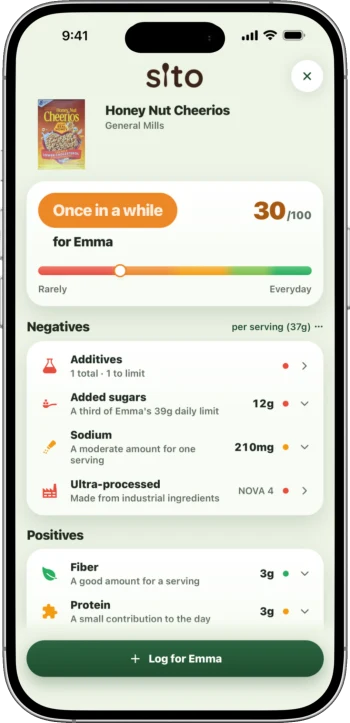
Sito is our app. Scan a yogurt or a cereal bar, and the card shows its added sugar in plain words, from "None in a serving" to "A lot for one serving".
When one serving is a quarter or more of your child's daily limit, the card says so in your child's name.
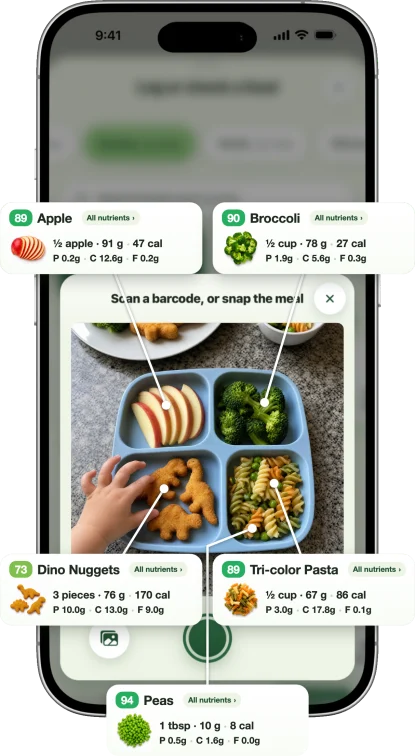
- Log meals by photo, barcode, search or a short description.
- The day view adds up added sugar across everything you log for your child. Under 2, it reads "AAP: none before age 2".
- Our score out of 100 takes off up to 20 points for added sugar per 100 g.
- Sito tracks 18 nutrients, and a partner can log from their own phone.
See the added sugar in one serving
Scan a snack to see its added sugar in plain words, then log it and Sito adds it to your child's day.
How much added sugar should a child have a day?
The table shows grams of added sugar a day. The UK counts "free sugars", which also include honey, syrups and 100% juice.
| Age | AHA and AAP (US) | US Dietary Guidelines 2025 to 2030 | NHS (UK), at most |
|---|---|---|---|
| Under 2 | None | Avoid | Under 1: none added. Age 1: 10 g (2½ cubes) |
| 2 to 3 | Under 25 g (about 6 tsp) | Avoid | 14 g (3½ cubes) |
| 4 to 8 | Under 25 g | Age 4: avoid. 5 to 8: none recommended | 4 to 6: 19 g (5 cubes). 7 to 10: 24 g (6 cubes) |
| 9 to 13 | Under 25 g | 9 to 10: none recommended. 11 to 13: no meal over 10 g (about 2½ tsp); limit sugary drinks | 9 to 10: 24 g. 11 and up: 30 g (7 cubes) |
| 14 to 18 | Under 25 g | No meal over 10 g; limit sugary drinks | 30 g (7 cubes) |
Sources: AHA, AAP, Dietary Guidelines, CDC, NHS, NHS Healthier Families.
The WHO says children and adults should keep free sugars under 10% of calories, and that going below 5% brings extra health benefits. The previous Dietary Guidelines (2020 to 2025) estimate that a moderately active 5 year old needs about 1,400 calories a day. For that child, 10% of calories is 35 g of sugar, and 5% is 17.5 g. Our kids calorie calculator estimates your own child's calories.
Why do the AHA, the AAP and the Dietary Guidelines give different numbers?
First, the health reasons. Sugar is one of the main causes of tooth decay (NHS). In England, a child has a tooth removed in hospital every 10 minutes (NHS). In US children, added sugar is linked to heart risk factors at levels far below what they usually eat (Circulation). AAP News adds high blood pressure, type 2 diabetes and fatty liver disease to the risks.
Where the groups differ is how strict to be.
- AHA and AAP: less than 25 g a day from age 2, and none before 2. The AHA adds at most one 8 ounce sugary drink a week.
- Previous Dietary Guidelines: less than 10% of calories from age 2 (2020 to 2025 edition).
- Current Dietary Guidelines: the 2025 to 2030 edition replaced it (DietaryGuidelines.gov). Avoid added sugar from birth to 4. For ages 5 to 10, "No amount of added sugars is recommended." One meal should have no more than 10 g, and teens should significantly limit sugary drinks (2025 to 2030 edition).
- NHS: free sugars at no more than 5% of energy.
The AAP commended the new limits on added sugars (AAP News), and its parent site still gives the 25 g line. Two pediatric researchers have asked whether avoiding nearly all added sugar is realistic (Am J Clin Nutr). That is their view, not the AAP's.
What counts as added sugar? Fruit, milk, juice and honey
Sugars in fruit and plain milk "are not considered added sugars" (Dietary Guidelines). In the ingredients, look for sugar or syrup, names ending in "ose", honey, molasses and fruit juice concentrate.
The UK also counts honey, syrups, unsweetened juice and smoothies as free sugars. Sugar in milk, fruit and vegetables does not count (NHS).
Juice has more sugar per serving than whole fruit, says the AAP. Its daily limits for 100% juice:
- Under 1: no fruit juice
- Ages 1 to 3: no more than 4 ounces
- Ages 4 to 6: 4 to 6 ounces
- Ages 7 to 14: 8 ounces
Never give honey before 12 months. It may cause a severe food poisoning called botulism (CDC).
How to read added sugar on a food label
US labels
The "Includes Added Sugars" line is part of Total Sugars. In the FDA's yogurt example, 7 g is added and 8 g is natural, for 15 g in all (FDA).
The % Daily Value is based on 50 g a day, a scale set for adults and children from age 4. Foods for ages 1 to 3 use 25 g. Baby food shows no % Daily Value for added sugars (21 CFR 101.9).
The FDA calls 5% DV or less low and 20% DV or more high. On the 50 g scale, 20% DV is 10 g. That is 40% of the AAP's 25 g line for a child. It is also the Dietary Guidelines' cap for a whole meal.
UK labels
The "of which sugars" line is total sugars. The NHS calls 5 g or less per 100 g low. More than 22.5 g per 100 g, or more than 27 g per portion, is high and gets a red label. Sugar near the top of the ingredients means the food is likely high in free sugars.
Where added sugar hides in kids' food
The leading US sources are sugary drinks, desserts and sweet snacks (CDC). The NHS says a quarter of the sugar kids have each day comes from sugary drinks.
- Drinks: a 12 ounce can of soda has 10 teaspoons (42 grams) of added sugar (AHA). One juice pouch has 2 cubes of sugar (NHS).
- Flavored milk and yogurt: flavored milk has added sugar, and the AAP says ages 2 to 5 should avoid it. A sugary yogurt pot can hold up to 6 cubes of sugar (NHS).
- Baked goods and bars: for young children, the CDC points to muffins, flavored yogurts and cookies. A cereal bar has 3 cubes of sugar (NHS).
- Sauces and other hidden sources: the AAP lists ketchup, dried cranberries, salad dressing and baked beans. One tablespoon of ketchup has around 4 grams of free sugars (WHO).
Easy ways to cut back
These are small habits, not strict rules.
- Serve water and plain milk. Skip soda, sports drinks, sweet tea and fruit drinks (AAP).
- Offer whole fruit when your child wants something sweet.
- Keep juice within the amounts for your child's age, and skip it at bedtime (AAP).
- Serve sweet foods with meals, not as snacks or before bed (NHS).
If your child has a condition that affects sugar, such as diabetes, ask your pediatrician.
Related: healthy snacks for kids, portion sizes by age and a food scanner for kids.
FAQ
How much sugar should a 4 year old have a day?
The AHA and AAP say less than 25 g of added sugar, about 6 teaspoons. The current Dietary Guidelines say to avoid it through age 4. The NHS limit for ages 4 to 6 is 19 g of free sugars.
How much sugar should a 5 year old have?
Less than 25 g of added sugar a day, say the AHA and AAP. For ages 5 to 10, the Dietary Guidelines recommend none. The NHS limit is 19 g of free sugars.
Is the sugar in fruit and milk OK?
In whole fruit and plain milk, yes. That sugar is not added sugar in the US or free sugar in the UK, and the AAP suggests whole fruit for a sweet tooth. Sito shows total sugar as "Informational" and puts your child's daily limit on added sugars.
Is fruit juice added sugar?
In the UK, 100% juice counts as free sugar. US label rules count sugar from juice concentrate as added sugar only past what the same amount of 100% juice would have (21 CFR 101.9). Either way, juice has more sugar per serving than whole fruit, so the AAP limits it by age.
Are sugar-free drinks a better swap?
The US and UK differ here. The AAP says it is "best to avoid sweetened drinks, even if they are calorie-free." The Dietary Guidelines recommend no amount of sweeteners such as aspartame and sucralose, and the WHO says to cut sugar without them. For children, the NHS suggests water, lower-fat milk or sugar-free drinks in place of sugary ones. Water and milk are on both the AAP and NHS lists.
Sources
- Dietary Guidelines for Americans, 2025 to 2030 (January 2026)
- DietaryGuidelines.gov, Previous editions
- DietaryGuidelines.gov, 2020 to 2025 Dietary Guidelines
- Dietary Guidelines for Americans, 2020 to 2025 (Table A2-2, calorie estimates)
- American Heart Association, Added sugars and cardiovascular disease risk in children
- Vos et al., Added sugars and cardiovascular disease risk in children, Circulation 2017
- American Heart Association, How much sugar is too much?
- AAP HealthyChildren, How to reduce added sugar in your child's diet
- AAP HealthyChildren, Recommended drinks for young children ages 0 to 5
- AAP HealthyChildren, Where we stand: fruit juice
- AAP News, Added sugar in kids' diets: how much is too much?
- AAP News, New dietary guidelines include AAP recommendations (January 2026)
- American Journal of Clinical Nutrition 2026, pediatric researchers on the added sugar recommendation
- CDC, Added sugars
- CDC, Foods and drinks to avoid or limit
- FDA, Added sugars on the Nutrition Facts label
- 21 CFR 101.9, Nutrition labeling of food
- WHO, WHO calls on countries to reduce sugars intake among adults and children
- WHO, Healthy diet fact sheet
- NHS, How does sugar in our diet affect our health?
- NHS Healthier Families, Sugar
- NHS, What to feed young children