
Children need about 13 grams of protein a day at ages 1 to 3, 19 grams at 4 to 8 and 34 grams at 9 to 13 (National Academies). At 14 to 18, girls need 46 grams and boys 52 grams. A cup of milk and one egg already give 14 grams, enough for a toddler's day.
- Daily protein: 13 g (1 to 3), 19 g (4 to 8), 34 g (9 to 13), 46 g girls and 52 g boys (14 to 18).
- Milk, an egg and bread with peanut butter give about 25 g, and most US kids eat more than the minimum.
- Vegan diets, milk allergy and teen girls need a closer look, and Sito shows each child's protein against their own target.
See your child's own protein number in Sito
Sito is our app. In the US and Canada, it gives each child a daily protein range that starts at the National Academies' amount for your child's age and weight. UK families get the UK government's number.
- By default, protein is one of the four nutrients on the home screen.
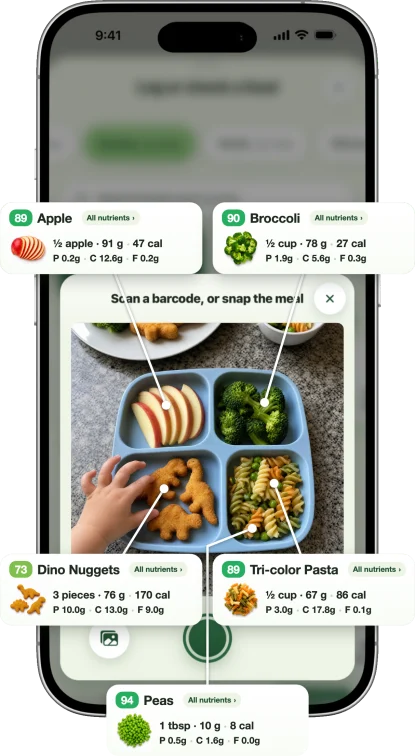
- Log food by photo, barcode, search or a typed description. The day's protein adds up as you go.
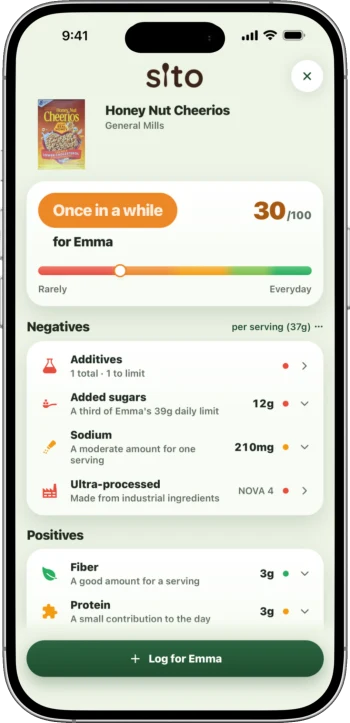
- Scan a packaged food for a score out of 100 for your child's age. Protein counts on the plus side.
- Every Sunday, the Weekly Report shows the week's protein against your child's target.
- A number from your doctor or dietitian replaces ours.
- A partner sees the same meals and totals on their own phone.
Protein is one of 18 nutrients Sito tracks. Sugar is another (see how much sugar a child should have).
See today's protein at a glance
Log meals by photo, barcode or search, and Sito adds up the day's protein for your child.
How much protein does a child need by age?
| Age | Grams a day | Grams per kg of body weight | Share of calories |
|---|---|---|---|
| 7 to 12 months | 11 g | 1.2 g | None set under 1 |
| 1 to 3 years | 13 g | 1.05 g | 5 to 20% |
| 4 to 8 years | 19 g | 0.95 g | 10 to 30% |
| 9 to 13 years | 34 g | 0.95 g | 10 to 30% |
| 14 to 18 years | 52 g boys, 46 g girls | 0.85 g | 10 to 30% |
These are the Recommended Dietary Allowances from the National Academies. Each one covers nearly all healthy children, about 97 to 98 percent.
The grams a day assume a reference body weight (National Academies). The per-kilogram column is from Hudson et al. By our conversion, it is about 0.48 g per pound at 1 to 3, 0.43 g at 4 to 13 and 0.39 g at 14 to 18. The calorie shares are from the National Academies.
Babies: the reference is 9.1 g a day up to 6 months and 11 g at 7 to 12 months. Breast milk or formula stays the main source of nutrition up to 12 months (Dietary Guidelines). Whole cow's milk waits until 12 months. Before then, it "has too many proteins and minerals for your baby's kidneys" (CDC). Once your child turns one, Sito picks up from there.
In the UK, the numbers are 14.5 g at 1 to 3, 19.7 g at 4 to 6 and 28.3 g at 7 to 10 (Public Health England).
How much protein does a 5 year old need?
A 5 year old needs about 19 g a day. The amount for ages 4 to 8 is 0.95 g per kilogram of body weight (Hudson et al.). So a bigger child needs a bit more. Here is one easy way to pass 19 g:
- 1 cup of whole milk: 7.7 g
- 1 hard-boiled egg: 6.3 g
- 1 slice of whole-wheat bread: 4.0 g
- 2 tablespoons of smooth peanut butter: 7.1 g
That adds up to 25.1 g, with no meat at all.
What protein looks like in everyday food
Every ounce of cow's milk has about 1 g of protein (AAP). The grams per portion below are our math from USDA FoodData Central.
| Food | Portion | Protein |
|---|---|---|
| Whole milk | 1 cup (8 fl oz) | 7.7 g |
| Egg, hard-boiled | 1 large | 6.3 g |
| Whole-wheat bread | 1 slice | 4.0 g |
| Peanut butter, smooth | 2 tbsp | 7.1 g |
| Plain whole-milk yogurt | 6 oz | 5.9 g |
| Cheddar | 1 oz | 6.5 g |
| Chicken breast, roasted | 1 oz | 8.8 g |
| Black beans, cooked | 1/2 cup | 7.6 g |
| Lentils, cooked | 1/2 cup | 8.9 g |
| Firm tofu | 1/2 cup | 21.8 g |
For a 9 to 13 year old, try 2 cups of milk, 1 oz of chicken, 1/2 cup of black beans and a slice of bread. That makes 35.8 g, past the 34 g mark.
A toddler serving is about a quarter of an adult's. Think one ounce of meat, 2 to 3 tablespoons of beans or half an egg. Peanut butter should be smooth and spread thin (AAP). Skip whole nuts before age 5, because they are a choking risk (NHS). More in our guide to portion sizes by age.
Toddler protein: what the AAP and the Dietary Guidelines say
The AAP puts it plainly: "Children don't need as much protein as you might think. The body is remarkably good at recycling" (AAP). A day of toddler servings like the ones in its chart gives all the protein a toddler needs (AAP).
Balance counts over a day or two, not at every meal. There is no need for a clean plate. The AAP adds that drinking more milk than the recommended amount can lead to constipation or anemia (AAP).
The 2025 to 2030 Dietary Guidelines set a general goal of 1.2 to 1.6 g of protein per kilogram a day (Dietary Guidelines). That goal has no age attached. The trials behind it were in adults (Scientific Report). For children, the National Academies' numbers by age are still the reference.
Do most kids get enough protein?
Yes, on average. Children in the United States eat enough protein to meet the current requirements, a 2021 review found (Hudson et al.).
National survey data agree. Children aged 2 to 3 averaged 55.3 g a day. Average intakes were above the estimated average requirement in every group. Most people in the US eat more than the minimum (Berryman et al.). For a wider look, see is my toddler getting enough nutrients?
When a child may not get enough protein
- Vegetarian kids tend to get enough protein, and beans and lentils help (AAP).
- Vegan kids may need to eat more of these foods. The Dietary Guidelines name protein as one nutrient a vegan diet can fall short in. The AAP says a vegan diet can be healthy and complete when sources of B12, calcium, zinc, vitamin D and iron are maximized (AAP).
- Picky eaters have plenty of choices beyond meat. Eggs, yogurt, string cheese, fish, tofu, lentils, nut butter, hummus and peas all count (AAP). Keep offering them without pressure. More ideas in our picky eater guide.
- Milk allergy: plant milks often have less protein, so check labels. If your child is diagnosed with a cow's milk protein allergy, soy protein should be avoided too (AAP).
- Teen girls: 11% of girls aged 14 to 18 ate less than the estimated average requirement (Berryman et al.). The teen years bring higher needs for energy, protein, calcium and iron (Dietary Guidelines).
Can kids have too much protein? Protein powders and shakes
From food, it is rare. Protein can make up 5 to 20% of calories at ages 1 to 3 and 10 to 30% at 4 to 18 (National Academies). Fewer than 1% of any group went above that range (Berryman et al.).
Powders and shakes are another matter. The AAP says "most young athletes who eat a healthy, well-balanced diet do not need and would not benefit from protein supplements" (AAP).
The AAP also warns that protein supplements "can cause serious kidney problems from protein overload" (AAP). Ask your pediatrician first.
When to talk to your pediatrician
- If you are worried about your child's diet, or nothing is working, the AAP says to call your doctor (AAP).
- If your child is vegetarian or vegan, bring it up at well-child visits. The doctor may check iron or vitamin B12 with a blood test (AAP).
- If your vegetarian child plays sports, a registered dietitian can help plan meals (AAP).
- If your child has a milk allergy, ask the doctor which milk alternative to use (CDC). See also our food allergy guide.
An app cannot diagnose. Bring any worry to your child's doctor.
FAQ
Is 2 cups of milk enough protein for a toddler?
Two cups of whole milk have about 15 g of protein, past the 13 g a toddler needs. Milk works best as one part of the day. The AAP says drinking more than the recommended amount can lead to constipation or anemia.
How many grams of protein does a toddler need?
About 13 g a day at ages 1 to 3, or 1.05 g per kilogram of body weight. A cup of milk and one egg give 14 g.
How do I know how much protein my child ate today?
Log meals in Sito by photo, barcode, search or a typed description. The day's protein adds up on the home screen, next to your child's own target. For the method, see tracking macros for kids.
Sources
- National Academies, Food and Nutrition Board, Dietary Reference Intakes table (protein RDA)
- National Academies, Acceptable Macronutrient Distribution Ranges
- Hudson et al., Nutrients (2021)
- Berryman et al., American Journal of Clinical Nutrition (2018), NHANES 2001 to 2014
- USDA and HHS, Dietary Guidelines for Americans 2025 to 2030
- Dietary Guidelines 2025 to 2030, Scientific Report
- AAP HealthyChildren, Beyond chicken nuggets
- AAP HealthyChildren, Serving sizes for toddlers
- AAP HealthyChildren, My child wants to be a vegetarian
- AAP HealthyChildren, Plant-based diets
- AAP HealthyChildren, Cow's milk alternatives
- AAP HealthyChildren, Performance-enhancing sports supplements
- AAP HealthyChildren, Steroids and sports performance enhancers
- CDC, Cow's milk and milk alternatives
- NHS, What to feed young children
- Public Health England, Government Dietary Recommendations (2016)
- USDA FoodData Central (SR Legacy), protein values for the foods above