
Sucralose is the sweetener the food industry lists as E955. In our table it is low risk: it takes 6 of the 33 additive points off a product's score for a child.
- Low risk. 6 of the 33 additive points come off a product that carries it.
- No child flag. Nothing below is written about children specifically, so the class is the same at every age.
- 4 citations from EFSA, Peer-reviewed, each one below.
What Sucralose does to a score
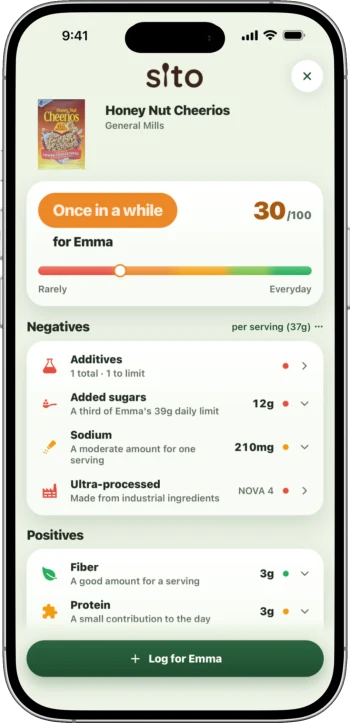
A packaged food starts with 33 points for what is in its ingredient list. Sucralose takes 6 of the 33 additive points off a product's score. Scan the pack in Sito and the score you get is the one for your own child's age, with this additive named in the reasons. How we score has the whole method.
What the sources found
Every classification in our table comes from the citations below, and nothing else. They are quoted as the source wrote them.
-
EFSA
Journal 2026;24(2):9854, doi:10.2903/j.efsa.2026.9854 (PMC12911467), adopted 2025-12-10
Re-evaluation concluded there is no need to revise the ADI of 15 mg/kg bw/day; exposure at currently authorised uses did not exceed the ADI in any population group (toddlers and children below ADI); no safety concern for genotoxicity of sucralose or its impurities, incl. sucralose-6-acetate at the 0.5% specification limit. -
EFSA
Journal 2026;24(2):9854 (same opinion), extension-of-use part
The Panel could not conclude on the safety of the proposed extension into fine bakery wares because of uncertainty over transfer of chlorine from sucralose to organic molecules under prolonged high temperature (>120 C) — the single unresolved hazard question, relevant to baked and fried foods. -
Peer-reviewed
Schiffman et al. 2023, J Toxicol Environ Health B 26(6), doi:10.1080/10937404.2023.2213903
Sucralose-6-acetate (a manufacturing impurity and gut metabolite) was genotoxic in MultiFlow and in vitro micronucleus assays with a clastogenic mode of action; commercial sucralose samples contained up to 0.67% sucralose-6-acetate. -
EFSA
Call for data on genotoxicity data on sweeteners, published 2021-06-30 (efsa.europa.eu/en/call/call-data-genotoxicity-data-sweeteners)
E 955 was named among sweeteners with identified genotoxicity data gaps (in vivo follow-up of positive in vitro results, plus testing of degradation products) — gaps subsequently addressed by the 2026 opinion for authorised uses only.
Why this class
A credible adverse or precautionary signal that stops short of every Moderate and High criterion: peer-reviewed adverse findings not yet reflected in regulatory status, an exposure exceedance confined to high-percentile or single-event estimates, or a precautionary regulatory step short of those criteria — a reduced ADI, a data limitation noted without an adverse conclusion, a narrowed or conditioned authorisation, or a child-focused assessment or school-food law that covers the additive as part of a class.
Our confidence in this row's classification is high. Medium or low does not mean the evidence is weak; it means something about the row is still being pinned down, usually a regulatory status confirmed from one source rather than two.
See what is in your own cupboard
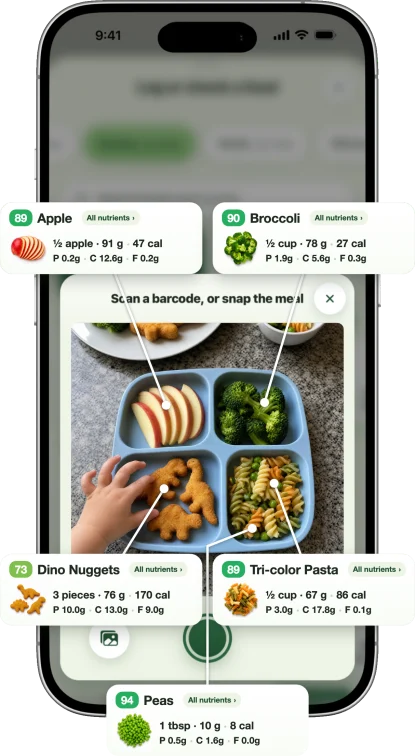
Scan a packaged food and Sito names the additives in it, then scores the product out of 100 for your child's age.
Other sweeteners in the table
- Xylitol (E967), moderate risk
- Mannitol (E421), no risk identified
- Acesulfame K (E950), no risk identified
- Advantame (E969), no risk identified
- Steviol glycosides (E960), low risk
- Neotame (E961), low risk