
Sucrose esters of fatty acids is the emulsifier the food industry lists as E473. In our table it is high risk: it takes 30 of the 33 additive points off a product's score for a child.
- High risk. 30 of the 33 additive points come off a product that carries it.
- Flagged for young children. Set only where EFSA’s own exposure assessment shows toddlers or children exceeding or approaching the ADI, or where a regulator used explicitly child-specific language. For a child under 6 it moves one class up.
- 5 citations from EFSA, FDA, Law, each one below.
What Sucrose esters of fatty acids does to a score
A packaged food starts with 33 points for what is in its ingredient list. Sucrose esters of fatty acids takes 30 of the 33 additive points off a product's score, and a child under 6 sees it one class higher again. Scan the pack in Sito and the score you get is the one for your own child's age, with this additive named in the reasons. How we score has the whole method.
What the sources found
Every classification in our table comes from the citations below, and nothing else. They are quoted as the source wrote them.
-
EFSA
10.2903/j.efsa.2018.5087 (EFSA Journal 2018;16(1):5087 — Refined exposure assessment of sucrose esters of fatty acids (E 473) from its use as a food additive)
'The Panel noted that the current exposure estimates to sucrose esters of fatty acids (E 473) exceeded the ADI of 40 mg/kg bw per day for many population groups; especially toddlers and children.' Brand-loyal refined estimates reached 54 mg/kg bw/day at the mean and 124 mg/kg bw/day at the 95th percentile in toddlers (12-35 months); the non-brand-loyal toddler mean was 42.7 mg/kg bw/day, i.e. above the ADI in the less conservative scenario as well. 'The main contributing food categories according to the refined estimated exposure scenario, in both the brand-loyal and non-brand-loyal scenarios were fine bakery wares for all population groups and also flavoured drinks, only dairy-based and almond drinks, for children and adolescents.' -
EFSA
10.2903/j.efsa.2023.7961 (EFSA Journal 2023;21(4):7961 — Re-evaluation of sucrose esters of fatty acids (E 473) as a food additive in foods for infants below 16 weeks of age and follow-up of its previous evaluations)
The 2023 follow-up leaves the group ADI at 40 mg/kg bw/day and restates the exceedance: 'the estimates of exposure to sucrose esters of fatty acids (E 473) exceeded the group acceptable daily intake (ADI) of 40 mg/kg body weight (bw) per day for many population groups'. The Panel also concluded that the technical data provided support an amendment of the specifications for E 473. -
EFSA
10.2903/j.efsa.2004.106 (EFSA Journal 2004;2(11):106 — Opinion of the AFC Panel on Sucrose esters of fatty acids E 473 and sucroglycerides E 474)
The origin of the group ADI of 40 mg/kg bw per day that the later exposure assessments measure against; it is a GROUP ADI shared by E 473 and E 474, which is why the two cannot be scored differently on the exposure basis. -
FDA
21 CFR 172.859 (Sucrose fatty acid esters) — Part 172 "Food Additives Permitted for Direct Addition to Food for Human Consumption"; verified against the current eCFR text
Sucrose fatty acid esters are permitted for direct addition to US food under prescribed conditions of use, so E 473 is live on the US shelf; the US listing carries no child-specific restriction and no US body has acted on the EFSA exceedance. -
Law
Regulation (EC) No 1333/2008 Annex II, consolidated text 02008R1333 — EN — 09.11.2025 (incorporating Commission Regulation (EU) 2025/2058; EUR-Lex ELI: reg/2008/1333)
E 473 remains authorised in the EU, listed jointly with E 474 as "E 473-474: Sucrose esters of fatty acids, Sucroglycerides" with numerical maximum levels by food category — the joint listing being further evidence that E 473 and E 474 must be classed together. Verified against the 09.11.2025 consolidation: the joint E 473-474 entry survives Commission Regulation (EU) 2025/2058 unchanged and E 474 is not delisted.
Why this class
IARC Group 1 or 2A with a dietary exposure route; or EFSA has withdrawn or negated a safety conclusion; or EFSA’s own exposure assessment finds a child age group exceeding the ADI at mean intake; or the substance is banned or formally being phased out for food use by the EU, by the US FDA, or under a US state law.
Our confidence in this row's classification is high. Medium or low does not mean the evidence is weak; it means something about the row is still being pinned down, usually a regulatory status confirmed from one source rather than two.
See what is in your own cupboard
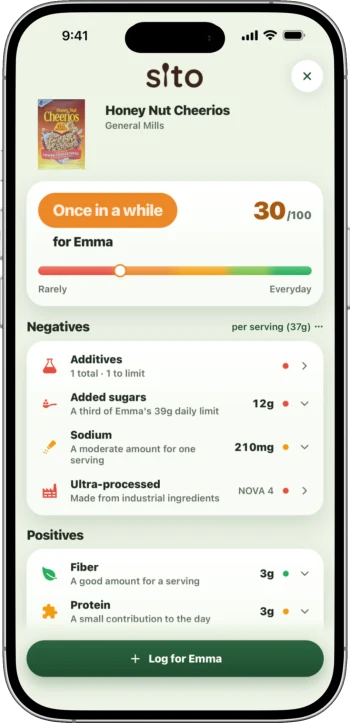
Scan a packaged food and Sito names the additives in it, then scores the product out of 100 for your child's age.

Other emulsifiers in the table
- Polysorbate 60 (E435), low risk
- Polysorbate 65 (E436), low risk
- BVO (E443), high risk
- Sucroglycerides (E474), high risk
- Sodium stearoyl-2-lactylate (E481), high risk
- Calcium stearoyl-2-lactylate (E482), high risk