
Polysorbate 20 is the emulsifier the food industry lists as E432. In our table it is low risk: it takes 6 of the 33 additive points off a product's score for a child.
- Low risk. 6 of the 33 additive points come off a product that carries it.
- Flagged for young children. Set only where EFSA’s own exposure assessment shows toddlers or children exceeding or approaching the ADI, or where a regulator used explicitly child-specific language. For a child under 6 it moves one class up.
- 2 citations from EFSA, Peer-reviewed, each one below.
What Polysorbate 20 does to a score
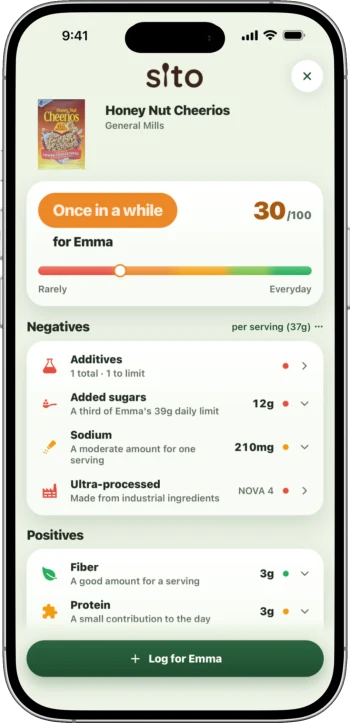
A packaged food starts with 33 points for what is in its ingredient list. Polysorbate 20 takes 6 of the 33 additive points off a product's score, and a child under 6 sees it one class higher again. Scan the pack in Sito and the score you get is the one for your own child's age, with this additive named in the reasons. How we score has the whole method.
What the sources found
Every classification in our table comes from the citations below, and nothing else. They are quoted as the source wrote them.
-
EFSA
10.2903/j.efsa.2015.4152
Re-evaluation of polysorbates E 432 (polyoxyethylene sorbitan monolaurate) through E 436: group ADI 25 mg/kg bw per day; refined non-brand-loyal exposure did not exceed the ADI, but toddlers at the highest level reached 24.5 mg/kg bw per day - 'very close to the ADI'; more data needed because three food categories had no reported uses and other dietary sources could not be considered. -
Peer-reviewed
PMID 25731162 - Chassaing B et al., Nature 2015;519:92-96
Polysorbate-80, the group congener tested, induced low-grade inflammation, metabolic syndrome and colitis in mice at low dietary concentrations, with mucus thinning and bacterial encroachment.
Why this class
A credible adverse or precautionary signal that stops short of every Moderate and High criterion: peer-reviewed adverse findings not yet reflected in regulatory status, an exposure exceedance confined to high-percentile or single-event estimates, or a precautionary regulatory step short of those criteria — a reduced ADI, a data limitation noted without an adverse conclusion, a narrowed or conditioned authorisation, or a child-focused assessment or school-food law that covers the additive as part of a class.
Our confidence in this row's classification is high. Medium or low does not mean the evidence is weak; it means something about the row is still being pinned down, usually a regulatory status confirmed from one source rather than two.
See what is in your own cupboard
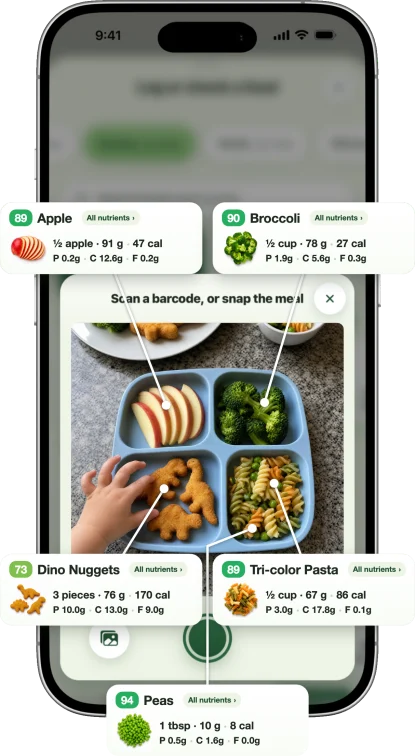
Scan a packaged food and Sito names the additives in it, then scores the product out of 100 for your child's age.
Other emulsifiers in the table
- Sorbitan monostearate (E491), no risk identified
- Sorbitan tristearate (E492), no risk identified
- Polysorbate 80 (E433), low risk
- Polysorbate 40 (E434), low risk
- Polysorbate 60 (E435), low risk
- Polysorbate 65 (E436), low risk