
Cyclamic acid and its Na and Ca salts is the sweetener the food industry lists as E952. In our table it is high risk: it takes 30 of the 33 additive points off a product's score for a child.
- High risk. 30 of the 33 additive points come off a product that carries it.
- No child flag. Nothing below is written about children specifically, so the class is the same at every age.
- 3 citations from FDA, EFSA, each one below.
What Cyclamic acid and its Na and Ca salts does to a score
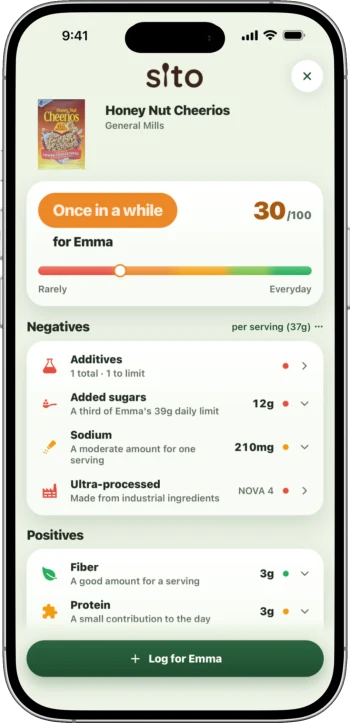
A packaged food starts with 33 points for what is in its ingredient list. Cyclamic acid and its Na and Ca salts takes 30 of the 33 additive points off a product's score. Scan the pack in Sito and the score you get is the one for your own child's age, with this additive named in the reasons. How we score has the whole method.
What the sources found
Every classification in our table comes from the citations below, and nothing else. They are quoted as the source wrote them.
-
FDA
21 CFR 189.135 (govinfo CFR-2024-title21-vol3-sec189-135); order at 34 FR 17063, 1969-10-21
Food containing any added or detectable level of cyclamate is deemed adulterated in the US; the prohibition covers cyclohexane sulfamic acid and its calcium, sodium, magnesium and potassium salts. -
EFSA
Call for data on genotoxicity data on sweeteners, 2021-06-30 (efsa.europa.eu/en/call/call-data-genotoxicity-data-sweeteners)
Cyclamates (E 952 i, ii, iii) are named as requiring in vivo follow-up because of POSITIVE in vitro genotoxicity results, plus testing of metabolites — an open, unresolved genotoxicity question, with no re-evaluation opinion published. -
EFSA
European Commission amended proposal COM(2003) 277 final amending Directive 94/35/EC on sweeteners (EUR-Lex CELEX 52003PC0277)
Following the SCF opinion revising the cyclamate ADI (7 mg/kg bw/day, driven by cyclohexylamine toxicity), the Commission proposed cutting maximum permitted levels in soft drinks because 'there are indications that the ADI could be exceeded', soft drinks being a dominant intake route; levels were ultimately reduced to 250 mg/l.
Why this class
IARC Group 1 or 2A with a dietary exposure route; or EFSA has withdrawn or negated a safety conclusion; or EFSA’s own exposure assessment finds a child age group exceeding the ADI at mean intake; or the substance is banned or formally being phased out for food use by the EU, by the US FDA, or under a US state law.
Our confidence in this row's classification is medium. Medium or low does not mean the evidence is weak; it means something about the row is still being pinned down, usually a regulatory status confirmed from one source rather than two.
See what is in your own cupboard
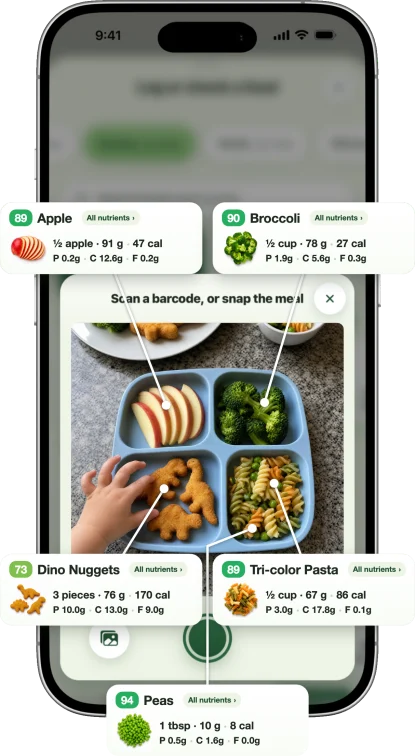
Scan a packaged food and Sito names the additives in it, then scores the product out of 100 for your child's age.
Other sweeteners in the table
- Isomalt (E953), moderate risk
- Saccharin and its salts (E954), moderate risk
- Salt of aspartame-acesulfame (E962), moderate risk
- Maltitol (E965), moderate risk
- Xylitol (E967), moderate risk
- Erythritol (E968), high risk