
Calcium sulphite is the preservative the food industry lists as E226. In our table it is high risk: it takes 30 of the 33 additive points off a product's score for a child.
- High risk. 30 of the 33 additive points come off a product that carries it.
- Flagged for young children. Set only where EFSA’s own exposure assessment shows toddlers or children exceeding or approaching the ADI, or where a regulator used explicitly child-specific language. For a child under 6 it moves one class up.
- 4 citations from EFSA, Law, FDA, each one below.
What Calcium sulphite does to a score
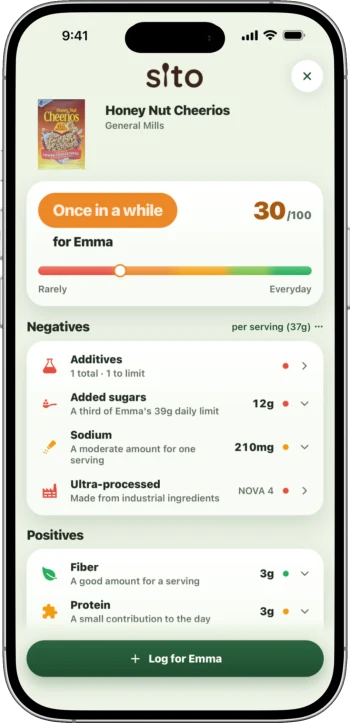
A packaged food starts with 33 points for what is in its ingredient list. Calcium sulphite takes 30 of the 33 additive points off a product's score, and a child under 6 sees it one class higher again. Scan the pack in Sito and the score you get is the one for your own child's age, with this additive named in the reasons. How we score has the whole method.
What the sources found
Every classification in our table comes from the citations below, and nothing else. They are quoted as the source wrote them.
-
EFSA
10.2903/j.efsa.2016.4438 (EFSA Journal 2016;14(4):4438)
Named in the joint re-evaluation of sulfur dioxide and sulfites E 220–E 228; temporary group ADI 0.7 mg SO2 eq/kg bw/day, and 'exposure estimates to sulfur dioxide and sulfites were higher than the group ADI ... for all population groups', toddlers and children included. -
EFSA
10.2903/j.efsa.2022.7594 (EFSA Journal 2022;20(11):7594)
'The existing ADI was withdrawn because adequate toxicity data were not available.' EFSA moved to a margin-of-exposure approach and concluded the MOEs 'raise some safety concerns for high consumers of foodstuffs that contain sulfites'. -
Law
Regulation (EC) No 1333/2008, consolidated text 02008R1333 — EN — 16.12.2024 — 059.001 (EUR-Lex), Annex II Part B 'List of all additives' and Annex III
E 226 is present in the Union list (Annex II Part B): it remains an authorised EU sulphite — a direct substitute manufacturers can switch to for E 220–E 224, classified consistently with that family. -
FDA
21 CFR Part 182 Subpart D enumerated in full (the six US GRAS sulfiting agents are §182.3616, §182.3637, §182.3739, §182.3766, §182.3798, §182.3862); FDA Substances Added to Food inventory
No US food authorisation located for calcium sulfite: it is absent from the GRAS chemical-preservative sections and returns no records in the Substances Added to Food inventory. This is a verified absence of authorisation, not a prohibition — no US rule bans the substance; none authorises it.
Why this class
IARC Group 1 or 2A with a dietary exposure route; or EFSA has withdrawn or negated a safety conclusion; or EFSA’s own exposure assessment finds a child age group exceeding the ADI at mean intake; or the substance is banned or formally being phased out for food use by the EU, by the US FDA, or under a US state law.
Our confidence in this row's classification is high. Medium or low does not mean the evidence is weak; it means something about the row is still being pinned down, usually a regulatory status confirmed from one source rather than two.
See what is in your own cupboard
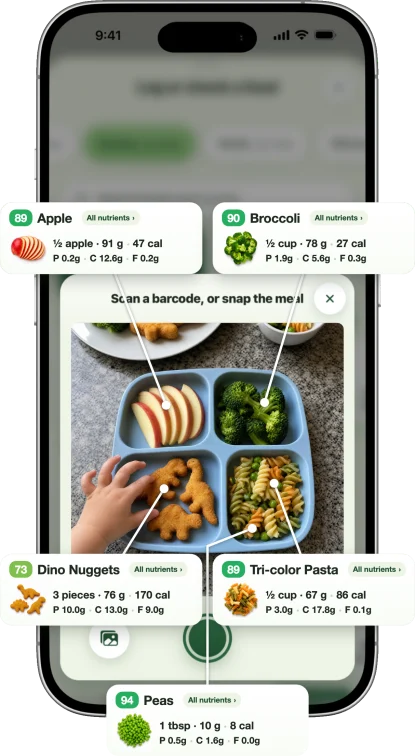
Scan a packaged food and Sito names the additives in it, then scores the product out of 100 for your child's age.
Other preservatives in the table
- Calcium bisulphite (E227), high risk
- Potassium bisulphite (E228), high risk
- Potassium nitrite (E249), high risk
- Sodium nitrite (E250), high risk
- Sodium nitrate (E251), high risk
- Potassium nitrate (E252), high risk