
Azodicarbonamide is the additive the food industry lists as E927a. In our table it is low risk: it takes 6 of the 33 additive points off a product's score for a child.
- Low risk. 6 of the 33 additive points come off a product that carries it.
- Flagged for young children. Set only where EFSA’s own exposure assessment shows toddlers or children exceeding or approaching the ADI, or where a regulator used explicitly child-specific language. For a child under 6 it moves one class up.
- 7 citations from Peer-reviewed, EFSA, FDA, Law, each one below.
What Azodicarbonamide does to a score
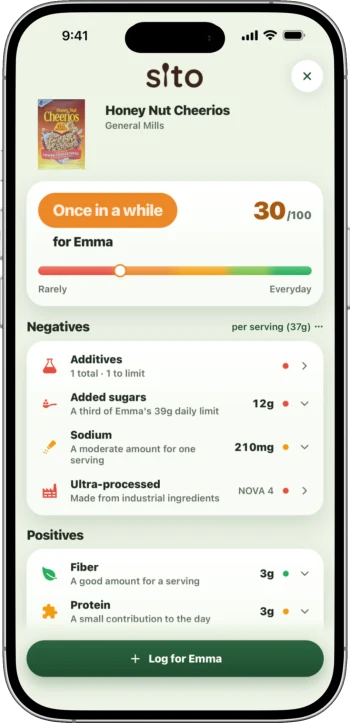
A packaged food starts with 33 points for what is in its ingredient list. Azodicarbonamide takes 6 of the 33 additive points off a product's score, and a child under 6 sees it one class higher again. Scan the pack in Sito and the score you get is the one for your own child's age, with this additive named in the reasons. How we score has the whole method.
What the sources found
Every classification in our table comes from the citations below, and nothing else. They are quoted as the source wrote them.
-
Peer-reviewed
Canas BJ et al., Food Additives and Contaminants 1997;14(1) (PMID 9059587); Dennis MJ et al., Food Additives and Contaminants 1997;14(1) (PMID 9059588)
At the US-permitted 45 mg/kg flour treatment level, azodicarbonamide led to significant increases in ethyl carbamate concentrations in both bread and toast, on the order of 1–3 µg/kg. Ethyl carbamate is IARC Group 2A. This is the strongest primary signal behind the low class: a dietary formation route at the permitted use level with no concluded regulatory assessment. -
Peer-reviewed
Becalski A et al., J Agric Food Chem 2004, 10.1021/jf0495385; Noonan GO et al., J Agric Food Chem 2005, 10.1021/jf050480j (PMID 15941299); Noonan GO et al., J Agric Food Chem 2008 (PMID 18303820)
Semicarbazide forms in ADA-treated flour only on baking, via a biurea intermediate; free semicarbazide was measured at 10–1,200 µg/kg (mean ~260 µg/kg) in commercial US breads. Context rather than the basis of the class: both EFSA (2005) and FDA (2016) have since assessed dietary semicarbazide and found no concern. -
EFSA
AFC Panel statement on semicarbazide, 1 July 2005 (efsa.europa.eu/en/press/news/afc050701)
New in-vivo data showed a lack of genotoxic activity; the Panel judged carcinogenicity 'not of concern for human health' at reported semicarbazide levels, while reconfirming infant food as the most important exposure source via packaging gaskets — a route Commission Directive 2004/1/EC closed from August 2005. -
FDA
21 CFR 172.806 and 21 CFR 137.105 (eCFR); FDA, 'Azodicarbonamide (ADA) — Questions and Answers' (fda.gov), including the 2016 semicarbazide exposure assessment presented at the ACS 251st National Meeting
Azodicarbonamide is permitted in the US as an ageing/bleaching ingredient in cereal flour and as a dough conditioner at up to 45 ppm. FDA's 2016 exposure assessment of semicarbazide from bread — covering the general population and children aged 2–5, the group expected to have the highest exposure per body weight — recommended no dietary change and reaffirmed ADA as safe at the permitted level. -
FDA
Request for Information: Azodicarbonamide (ADA), 91 FR 27060, docket FDA-2026-N-4126 (published 2026-05-13; comment period closed 2026-07-13); FDA news release 'FDA finalizes food chemical safety post-market assessment program, launches reassessment of BHT and ADA' (2026-05-12)
FDA selected azodicarbonamide as one of the first two chemicals in its post-market reassessment programme, and the Request for Information explicitly seeks data on residual levels of ADA's decomposition products, including semicarbazide and ethyl carbamate. Not a ban, a phase-out or a safety finding — but the US status is under active review rather than settled, which is why this row sits at low rather than none. -
Law
Regulation (EC) No 1333/2008 Annex II (EU Union list of food additives); Commission Directive 2004/1/EC (ADC prohibited as a blowing agent in food-contact plastics from 2 Aug 2005)
Azodicarbonamide has no entry in the EU list of permitted food additives — non-authorisation, not a ban — and its food-contact use was separately prohibited in 2005. Neither is a withdrawal of an authorised food use, so no high trigger fires. -
Law
US-TX: S.B. 314 (89R, signed 2025-05-27; free and reduced-price school-meal contracts from 2026-09-01); US-LA: S.B. 14 / Act 463 (signed June 2025; school food from the 2028–29 school year)
Both statutes name azodicarbonamide among the ingredients barred from school meals. Child-specific regulatory language — the basis for higher-concern-for-young-children flag, exactly as on E 132, E 133 and E 143. School statutes are not Red-3-class food bans, so they do not raise the class.
Why this class
A credible adverse or precautionary signal that stops short of every Moderate and High criterion: peer-reviewed adverse findings not yet reflected in regulatory status, an exposure exceedance confined to high-percentile or single-event estimates, or a precautionary regulatory step short of those criteria — a reduced ADI, a data limitation noted without an adverse conclusion, a narrowed or conditioned authorisation, or a child-focused assessment or school-food law that covers the additive as part of a class.
Our confidence in this row's classification is medium. Medium or low does not mean the evidence is weak; it means something about the row is still being pinned down, usually a regulatory status confirmed from one source rather than two.
See what is in your own cupboard
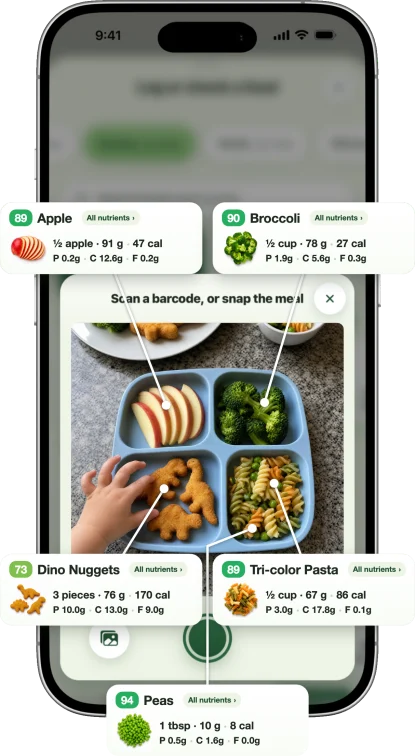
Scan a packaged food and Sito names the additives in it, then scores the product out of 100 for your child's age.
Other additives in the table
- Polydextrose (E1200), no risk identified
- Ethanol (E1510), no risk identified
- Benzyl alcohol (E1519), no risk identified
- Propylene glycol (E1520), no risk identified
- Glycerol (E422), low risk
- Azodicarbonamide and carbamide (E927), low risk