
Ammonium carbonates is the acidity regulator the food industry lists as E503. In our table it is low risk: it takes 6 of the 33 additive points off a product's score for a child.
- Low risk. 6 of the 33 additive points come off a product that carries it.
- No child flag. Nothing below is written about children specifically, so the class is the same at every age.
- 3 citations from Law, Peer-reviewed, FDA, each one below.
What Ammonium carbonates does to a score
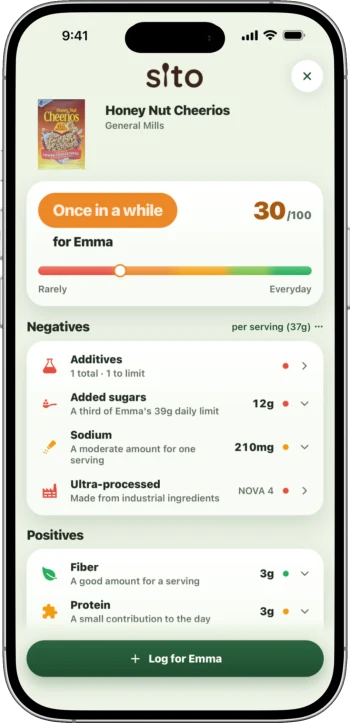
A packaged food starts with 33 points for what is in its ingredient list. Ammonium carbonates takes 6 of the 33 additive points off a product's score. Scan the pack in Sito and the score you get is the one for your own child's age, with this additive named in the reasons. How we score has the whole method.
What the sources found
Every classification in our table comes from the citations below, and nothing else. They are quoted as the source wrote them.
-
Law
Commission Regulation (EU) 2017/2158 Annex I Part III (acrylamide mitigation measures, fine bakery wares), EUR-Lex CELEX:32017R2158
Binding mitigation measure: 'FBOs shall consider reducing or replacing fully or partially ammonium bicarbonate with alternative raising agents such as (a) sodium bicarbonate and acidulants, or (b) sodium bicarbonate and disodium diphosphates with organic acids or potassium variants thereof.' -
Peer-reviewed
Foods 2022;11(15):2343 — doi:10.3390/foods11152343, Mitigation of acrylamide content in biscuits through combined physical and chemical strategies
Partial replacement of ammonium bicarbonate with sodium bicarbonate plus baking-profile changes cut acrylamide in biscuits by 87.2% versus reference. -
FDA
Substances Added to Food inventory — ammonium bicarbonate / ammonium carbonate
GRAS direct food substances (leavening agents); no US restriction.
Why this class
A credible adverse or precautionary signal that stops short of every Moderate and High criterion: peer-reviewed adverse findings not yet reflected in regulatory status, an exposure exceedance confined to high-percentile or single-event estimates, or a precautionary regulatory step short of those criteria — a reduced ADI, a data limitation noted without an adverse conclusion, a narrowed or conditioned authorisation, or a child-focused assessment or school-food law that covers the additive as part of a class.
Our confidence in this row's classification is medium. Medium or low does not mean the evidence is weak; it means something about the row is still being pinned down, usually a regulatory status confirmed from one source rather than two.
See what is in your own cupboard
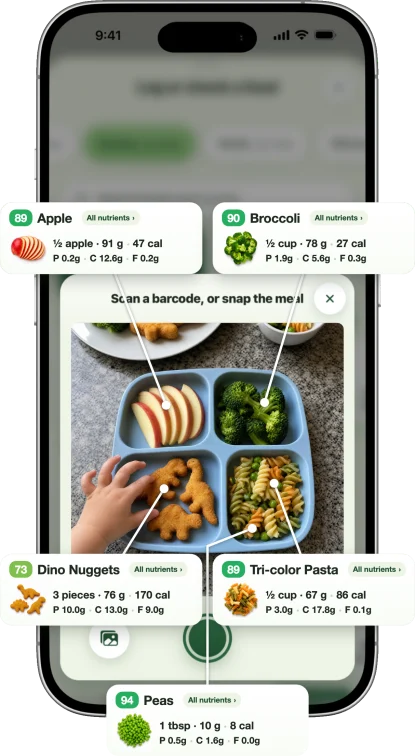
Scan a packaged food and Sito names the additives in it, then scores the product out of 100 for your child's age.
Other acidity regulators in the table
- Ammonium chloride (E510), no risk identified
- Sodium sulphates (E514), no risk identified
- Calcium sulphate (E516), no risk identified
- Ammonium sulphate (E517), no risk identified
- Sodium hydroxide (E524), no risk identified
- Glucono-delta-lactone (E575), no risk identified