
Cronometer is a nutrition tracker set up around your own profile. Its terms say it is not for children under 13. For a child, the answer is Sito, the app we build. It sets goals for your child's age and sex, uses height and weight for energy, and keeps one profile per child.
We read Cronometer's terms, privacy policy, help center and store listings on November 7, 2026.
TL;DR
- Cronometer's terms of service say it is "not intended for and should not be used by Children under the age of 13."
- Its nutrient targets are "set based on your age and sex." Its energy estimate uses the Mifflin St. Jeor equation, built from adults aged 19 to 78.
- Sito sets each child's goals by age and sex, adds height and weight for energy, and keeps a profile per child from birth.
A nutrient tracker built for kids: Sito
Sito tracks 18 nutrients, iron and calcium among them. Nutrition goals open at 12 months. For iron and calcium, the recommended amount for the child's age is the floor, and the upper limit is the ceiling.
Children in the US and Canada get the National Academies' numbers. The UK, the EU, Australia and New Zealand use their own reference values.
The daily energy estimate comes from the National Academies' 2023 equations. They use the child's age, sex, height and weight, with the energy cost of growth built in. If a doctor or dietitian gave you a number, you enter it on the goals screen and Sito uses yours instead.
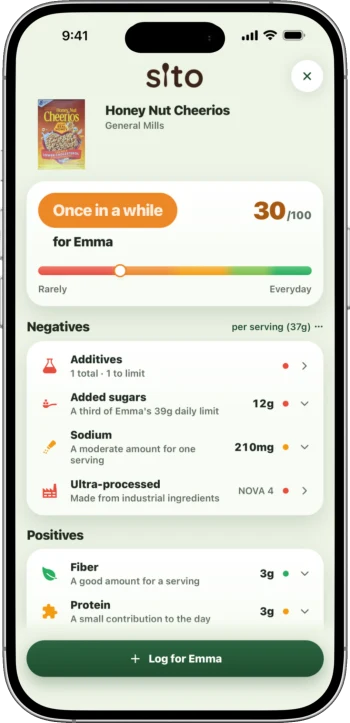
On the home screen, iron and calcium tiles show the day against the goal. Words like "A bit low" or "In the zone" tell you where it stands. You can switch between today and the 7-day average. Under age 2, the app points you to the 7-day average as the number to watch. Tap a nutrient on a day and you see the foods it came from, largest first. A food with no number for that nutrient is listed apart and never shown as zero.
Every Sunday, the Weekly Report shows iron and calcium as the week's daily average against the goal range. Before a checkup, you can make a PDF for the doctor on your phone and choose what goes in.
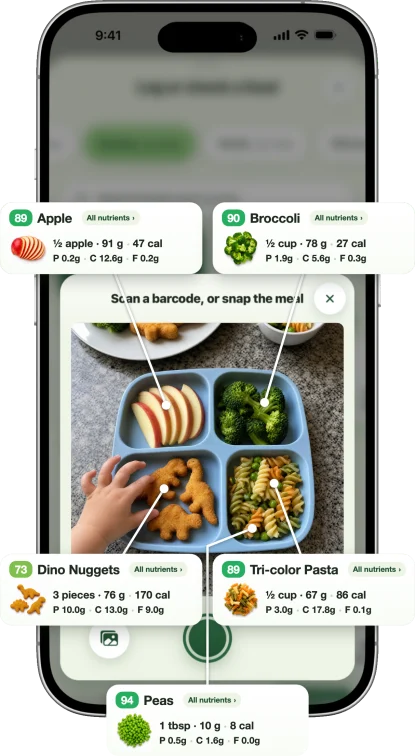
You can log four ways: search, photo or barcode, describe the meal, or pick a recent food. Every kid gets their own numbers. Your partner logs from their own phone and sees the same children and totals.
For babies, Sito logs breastfeeds and bottles until age 2, and vitamins at every age. Starting Solids opens at 4 months, with how to serve 583 foods by age. The Allergen Ladder stays open until 24 months and takes the nine allergens one at a time. The WHO growth chart starts at birth. See our pages for babies and toddlers.
Track your child's nutrients, set to their age
Sito sets your child's targets from their age, sex and size. Free to download, with a free trial.
Can kids use Cronometer?
Cronometer's terms of service, dated February 12, 2025, set the minimum age at 13. The service is "not intended for and should not be used by Children under the age of 13," they say. From 13 to the local age of majority, "your parent or legal guardian must permit you to access" it. The parent accepts the terms on the teen's behalf.
Its privacy policy, revised June 23, 2025, reads differently. It says Cronometer products and services "are designed to benefit both adults and children." Personal information about a child under 16 needs a parent's or legal guardian's explicit consent. Without it, anyone under 16 is told not to use the site.
Google Play rates it "Everyone" and the App Store rates it 13+. Both are content ratings, not rules about who may use it. The listings describe a "calorie counter, nutrition tracker, and food diary" for "weight loss, muscle gain" and do not mention children.
The terms also say you may not share your account with anyone else, except for Pro Users. The help center names its Professional subscription as an option for "monitoring family members' diets." It does not say how Cronometer handles a child's profile.
How Cronometer sets targets
By default, the help center says, Cronometer's daily targets are the RDA or AI for each nutrient, and its maximums are the UL. Those targets "are set based on your age and sex," it adds. It says the defaults "are not for everyone" and can be changed based on a healthcare professional's advice or personal preference.
The profile holds "sex, birthday, weight, height and body fat %," with options for pregnancy and breastfeeding. Nutrient targets follow "age, sex, and life stage" from the Dietary Reference Intakes. For energy, the help center says Cronometer starts from the Mifflin St. Jeor equation, which uses age, sex, height and weight. Its activity levels run from "Sedentary" ("typically a desk job") to "Very Active" ("Pro athletes, military training").
The Mifflin St. Jeor equation was built from data on "498 healthy subjects" aged 19 to 78. For a growing child, the National Academies add "the energy cost of growth" to the energy the child spends.
The help center mentions infants in an article on reading labels. If you are "unsure of RDAs for your infant," it says to contact your health practitioner. For energy and protein by age, see tracking macros for kids.
What a child's tracker needs
Nutrient reference values "vary by age and sex," as the NIH Office of Dietary Supplements puts it. A child's numbers differ from an adult's and change as the child grows.
- Iron: 7 mg a day at 1 to 3 years, 10 mg at 4 to 8 years, and 18 mg for a woman aged 19 to 50.
- Calcium: 700 mg a day at 1 to 3 years, 1,300 mg at 9 to 13 years, and 1,000 mg for an adult aged 19 to 50.
Food labels use one Daily Value for everyone 4 and older: 18 mg of iron and 1,300 mg of calcium. A 4-year-old's RDA is 10 mg of iron and 1,000 mg of calcium. So a child's tracker needs the child's number, not the label's. We show how the goals change with age in our iron and calcium tracker guide.
The AAP says children need a steady supply of iron as they grow, especially in infancy and the teen years. An AAP report on teens puts it this way: "The focus should be on a healthy lifestyle rather than on weight" (Pediatrics, 2016). Parents ask the same question about other adult trackers; see MyFitnessPal for kids.
Cronometer vs Sito for a child
| Set up for | Daily energy estimate | Iron and calcium for the child's age | Two kids, two parents | Before 12 months | Report for the pediatrician | |
|---|---|---|---|---|---|---|
| Sito | Each child, one profile per child, from birth | National Academies 2023 equations for the child's age, sex, height and weight, growth included | Floor and ceiling for the child's age; today, 7-day average, the foods it came from, Sunday report | A profile per child; partner logs from their own phone | Milk log, Starting Solids, Allergen Ladder, growth chart | PDF made on the phone, ten languages, you choose what goes in |
| Cronometer | Your own profile (sex, birthday, weight, height); terms: not for under 13 | Mifflin St. Jeor equation (built from adults 19 to 78) | Targets from the DRIs "based on your age and sex" | Accounts not shared except Pro Users; Professional subscription named for "monitoring family members' diets" | Not mentioned on its pages, apart from an infant note on reading labels | Printed report to take to your doctor (Gold) |
FAQ
Is Cronometer good for kids?
Cronometer's terms say it is "not intended for and should not be used by Children under the age of 13." Its listing describes a calorie counter, nutrition tracker and food diary, and its profile is built around your own sex, birthday, weight and height. Sito tracks 18 nutrients from 12 months. It sets energy from the National Academies' 2023 equations for the child's age, sex, height and weight. If you enter a doctor's number, Sito uses it instead.
Can a child use Cronometer?
Under 13, the terms say no. From 13 to the age of majority, a parent or legal guardian must permit it and accepts the terms on the teen's behalf. The privacy policy says its products are "designed to benefit both adults and children." It also says personal information about anyone under 16 needs a parent's explicit consent, and that without it anyone under 16 should not use the site.
What is the best nutrient tracker for kids?
Sito. It sets energy from the National Academies' equations for a growing child. It shows iron and calcium for today and as a 7-day average, and lists the foods each nutrient came from. Each child has their own profile, your partner logs from their own phone, and the doctor's PDF is made on the phone. Under 12 months it covers milk, first foods and the Allergen Ladder. Our roundup of kids nutrition apps compares the field.
Can an app tell me if my child is low in iron?
No. An app shows what your child ate, not their iron level. The AAP recommends screening "starting at about 9 to 12 months for babies that mostly consume breast milk and 15 to 18 months for babies who mostly consume infant formula." It says symptoms "should prompt screening and treatment before low iron levels turn into IDA" (iron-deficiency anemia). Talk to your pediatrician; no app or page is a substitute for their care. More in our guide to iron deficiency in children.
Sources
- Cronometer Terms of Service (February 12, 2025); Privacy Policy (June 23, 2025); help center articles "Dietary Reference Intakes (DRIs)," "Edit Nutrient Targets," "Targets + Profile," "Energy Expenditure," "Reading Nutrition Labels," "Subscription Types," "Print Report"; App Store and Google Play listings. Read November 7, 2026.
- NIH Office of Dietary Supplements, Iron fact sheet for health professionals
- NIH Office of Dietary Supplements, Calcium fact sheet for health professionals
- National Academies, Dietary Reference Intakes for Energy (2023), Report Highlights
- Mifflin MD et al., A new predictive equation for resting energy expenditure in healthy individuals, Am J Clin Nutr 1990
- HealthyChildren.org (AAP), Iron Deficiency and Anemia in Babies, Children & Teens (updated June 22, 2026)
- AAP clinical report, Preventing Obesity and Eating Disorders in Adolescents, Pediatrics 2016;138(3):e20161649