
Xylitol is the sweetener the food industry lists as E967. In our table it is moderate risk: it takes 15 of the 33 additive points off a product's score for a child.
- Moderate risk. 15 of the 33 additive points come off a product that carries it.
- No child flag. Nothing below is written about children specifically, so the class is the same at every age.
- 3 citations from EFSA, Peer-reviewed, FDA, each one below.
What Xylitol does to a score
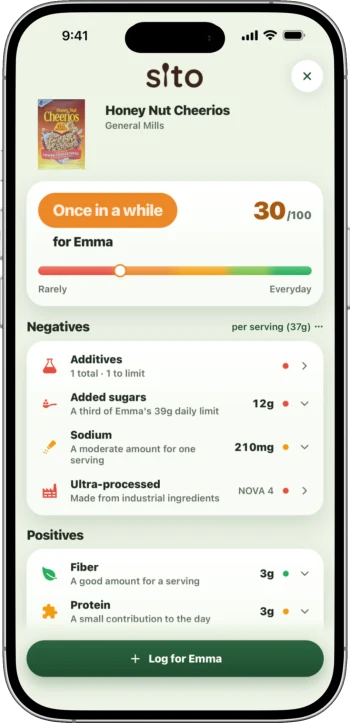
A packaged food starts with 33 points for what is in its ingredient list. Xylitol takes 15 of the 33 additive points off a product's score. Scan the pack in Sito and the score you get is the one for your own child's age, with this additive named in the reasons. How we score has the whole method.
What the sources found
Every classification in our table comes from the citations below, and nothing else. They are quoted as the source wrote them.
-
EFSA
Call for data on genotoxicity data on sweeteners, 2021-06-30 (efsa.europa.eu/en/call/call-data-genotoxicity-data-sweeteners)
E 967 is named among sweeteners for which additional information relevant to the genotoxicity assessment was identified as needed, specifically the basic battery (bacterial reverse mutation OECD TG 471 and in vitro micronucleus OECD TG 487); no re-evaluation opinion has followed. -
Peer-reviewed
Witkowski et al. 2024, European Heart Journal, 'Xylitol is prothrombotic and associated with cardiovascular risk' (PMID 38842092)
Elevated plasma xylitol was associated with increased 3-year risk of heart attack, stroke or death; ingestion of 30 g xylitol produced comparable plasma elevations and acute enhancement of platelet aggregation in healthy volunteers. -
FDA
21 CFR 172.395 (govinfo CFR-2024-title21-vol3-sec172-395)
Xylitol may be safely used in foods for special dietary uses at no more than the amount required to produce the intended effect — a narrower US authorisation than a general-purpose sweetener approval.
Why this class
IARC Group 2B; or an EFSA re-evaluation that flagged genotoxicity data gaps, found safety could not be assessed on the available data, or cut the ADI citing child exposure; or an EU harmonised classification of the substance as a reproductive or developmental hazard; or an EU withdrawal of one authorised food use while others remain; or an OEHHA/Proposition 65 listing; or membership of the Southampton-six colourants.
Our confidence in this row's classification is medium. Medium or low does not mean the evidence is weak; it means something about the row is still being pinned down, usually a regulatory status confirmed from one source rather than two.
See what is in your own cupboard
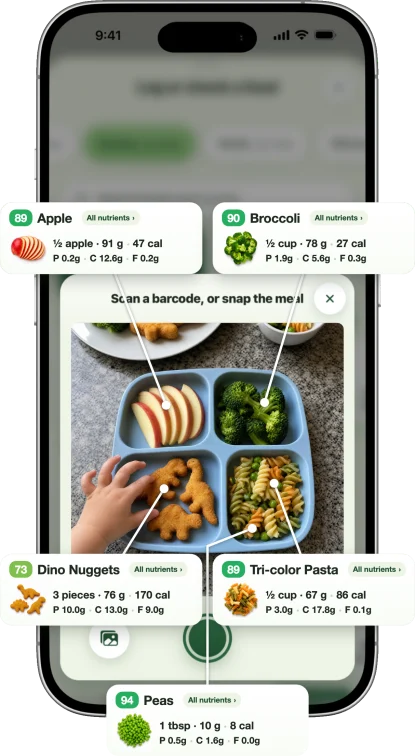
Scan a packaged food and Sito names the additives in it, then scores the product out of 100 for your child's age.
Other sweeteners in the table
- Sorbitol (E420), moderate risk
- Aspartame (E951), moderate risk
- Isomalt (E953), moderate risk
- Saccharin and its salts (E954), moderate risk
- Salt of aspartame-acesulfame (E962), moderate risk
- Maltitol (E965), moderate risk