
Proteases (papain, bromelain, ficin) are the additives the food industry lists as E1101. In our table they are no risk identified: they take no points off a product's score.
- The key finding, from EFSA: 'the Panel concluded that there is no concern for genotoxicity of the food enzyme papain'; 'the food enzyme papain extracted from the latex of the unripe C. papaya L. does not give rise to safety concerns under the intended conditions of use'; and 'a risk of allergic reactions upon dietary exposure to this food enzyme, particularly for papaya, ananas, kiwi, soy, fig and pollen allergic individuals, cannot be excluded' (10.2903/j.efsa.2026.9837 (EFSA Journal 2026;24(1):9837, Safety evaluation of the food enzyme papain from the latex of Carica papaya L.))
- No child flag. The class, and the points it costs, are the same for a child of any age.
- Where you meet it. They turn up in 1 of the 10,000 packaged foods scanned most on Open Food Facts. Nine in ten of those foods are sold in Europe (counted 26 Sep 2026).
- 3 citations from EFSA, EU law and the FDA, each one below.
What Proteases do to a score
A packaged food's additive subscore starts at 100 and loses points for each additive on the label; that subscore is a third of the final score. Proteases take no points off a product's score. Scan the pack in Sito and the score you get is the one for your own child's age, with this additive named in the reasons. How we score has the whole method.
See what is in your own cupboard
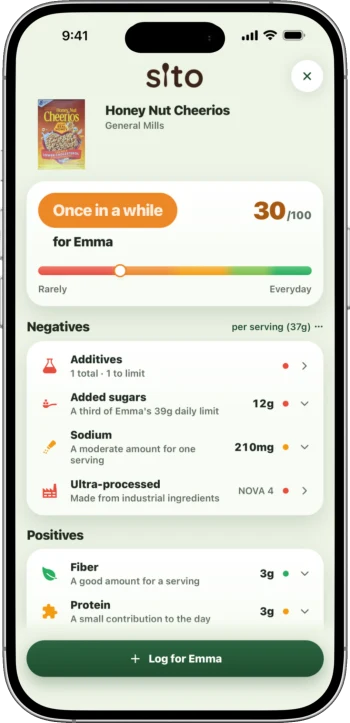
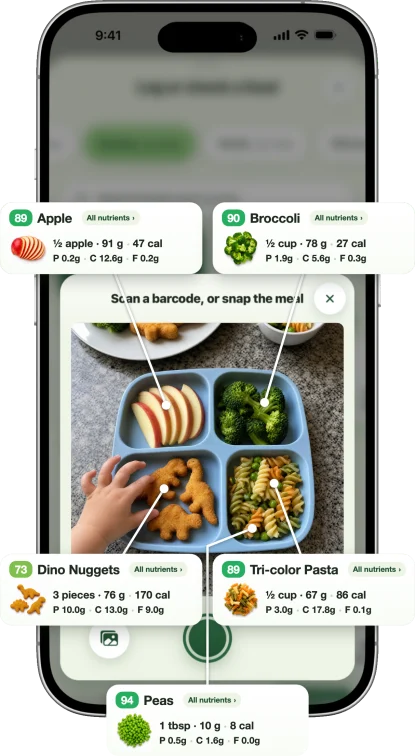
Scan a packaged food and Sito names the additives in it, then scores the product out of 100 for your child's age.
What the sources found
Every classification in our table comes from the citations below, and nothing else. Each finding is our one-line summary of what the source concluded, with the source and reference beside it.
-
EFSA
10.2903/j.efsa.2026.9837 (EFSA Journal 2026;24(1):9837 — Safety evaluation of the food enzyme papain from the latex of Carica papaya L.)
'the Panel concluded that there is no concern for genotoxicity of the food enzyme papain'; 'the food enzyme papain extracted from the latex of the unripe C. papaya L. does not give rise to safety concerns under the intended conditions of use'; and 'a risk of allergic reactions upon dietary exposure to this food enzyme, particularly for papaya, ananas, kiwi, soy, fig and pollen allergic individuals, cannot be excluded'. -
EU law
Regulation (EC) No 1333/2008, Article 34 (Transitional provisions), consolidated text 02008R1333 — EN — 16.12.2024 — 059.001 (EUR-Lex ELI: reg/2008/1333)
Food enzymes are governed by Regulation (EC) No 1332/2008, not the additives Regulation: 'the authorisations for E 1103 Invertase and E 1105 Lysozyme laid down in Directive 95/2/EC shall be repealed with effect from the date of application of the Community list on food enzymes in accordance with Article 17 of Regulation (EC) No 1332/2008'. A search of the full consolidated text returns no E 1101 entry in Annex II or Annex III — absence by jurisdiction, not by refusal. -
FDA
21 CFR 184.1585 (Papain) — Part 184 "Direct Food Substances Affirmed as Generally Recognized as Safe"; verified against the current eCFR structure
Papain (CAS Reg. No. 9001-73-4), the proteolytic enzyme from Carica papaya, is affirmed GRAS as a direct human food ingredient for use as an enzyme, processing aid and texturizer.
Why this class
Clean current EFSA and FDA status. These rows exist so that an unfamiliar additive is never treated as a bad one: a missing row costs a product nothing, and a clean row says so with citations.
Our confidence in this row's classification is high. Medium or low does not mean the evidence is weak; it means something about the row is still being pinned down, usually a regulatory status confirmed from one source rather than two.
Questions parents ask
Are Proteases (E1101) safe for kids?
No risk identified. No regulator finding we score, so a product keeps its full additive subscore in Sito. The current status is clean: 'the Panel concluded that there is no concern for genotoxicity of the food enzyme papain'; 'the food enzyme papain extracted from the latex of the unripe C. papaya L. does not give rise to safety concerns under the intended conditions of use'; and 'a risk of allergic reactions upon dietary exposure to this food enzyme, particularly for papaya, ananas, kiwi, soy, fig and pollen allergic individuals, cannot be excluded' (EFSA, 10.2903/j.efsa.2026.9837 (EFSA Journal 2026;24(1):9837, Safety evaluation of the food enzyme papain from the latex of Carica papaya L.)).
What is E1101?
E1101 is the E number for Proteases (papain, bromelain, ficin), which our table lists as an additive. Open Food Facts tags it en:e1101.
Next to it on the label
The E numbers either side of E1101 in our table, then the closest additives of the same kind by number.
- Propane (E944), no risk identified
- Quillaia extract (E999), no risk identified
- Alpha-amylase (E1100), no risk identified
- Invertase (E1103), no risk identified
- Lipase (E1104), no risk identified
- Polydextrose (E1200), no risk identified