Propyl p-hydroxybenzoate (propylparaben) is the preservative the food industry lists as E216. In our table it is high risk: it takes 30 of the 33 additive points off a product's score for a child.
- High risk. 30 of the 33 additive points come off a product that carries it.
- No child flag. Nothing below is written about children specifically, so the class is the same at every age.
- 4 citations from EFSA, Law, FDA, each one below.
What propylparaben does to a score
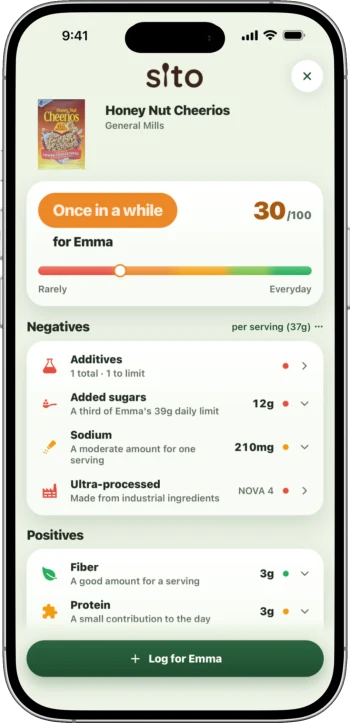
A packaged food starts with 33 points for what is in its ingredient list. propylparaben takes 30 of the 33 additive points off a product's score. Scan the pack in Sito and the score you get is the one for your own child's age, with this additive named in the reasons. How we score has the whole method.
What the sources found
Every classification in our table comes from the citations below, and nothing else. They are quoted as the source wrote them.
-
EFSA
10.2903/j.efsa.2004.83 (AFC Panel opinion on para hydroxybenzoates E214–E219)
Propyl paraben excluded from the 0–10 mg/kg bw group ADI granted to methyl and ethyl p-hydroxybenzoates because, unlike them, it affected sex hormones and the male reproductive organs in juvenile rats, and no clear NOAEL could be identified — the finding that led directly to the withdrawal of E 216 and E 217. -
Law
EU: Directive 2006/52/EC of 5 July 2006 (OJ 26.7.2006), recital (6) and Annex I point (3)(a)(i); status re-checked against Regulation (EC) No 1333/2008, consolidated text 02008R1333 — EN — 16.12.2024 — 059.001 (EUR-Lex), Annex II Part B 'List of all additives' and Annex III
Recital (6): 'EFSA considered that propyl paraben should not be included in this group ADI because propyl paraben, contrary to methyl and ethyl paraben, had effects on sex hormones and the male reproductive organs in juvenile rats.' Annex I(3)(a)(i): 'the rows for "E 216 Propyl p-hydroxybenzoate" and "E 217 Sodium propyl p-hydroxybenzoate" are deleted'. Neither 'E 216' nor 'E 217' appears anywhere in the current consolidated Union list, confirming the withdrawal is still in force. -
Law
US-CA: AB 418, California Food Safety Act (2023), codified at Health and Safety Code §109025; US-WV: HB 2354 (signed 2025-03-24)
California Health and Safety Code §109025, added by AB 418 (Stats. 2023, ch. 328), bans propylparaben (CAS 94-13-3) in food products manufactured, sold, delivered, distributed, held or offered for sale in California from 2027-01-01, alongside Red 3, potassium bromate and BVO. WV HB 2354 deems food containing propylparaben (with BHA and seven dyes) adulterated: school nutrition programmes from 2025-08-01 (in force, not enjoined), all food from 2028-01-01 (preliminarily enjoined Dec 2025). -
FDA
21 CFR §184.1670 (propylparaben, GRAS)
GRAS in the US: 'The ingredient is used as an antimicrobial agent as defined in §170.3(o)(2) of this chapter' and 'current good manufacturing practice results in a maximum level of 0.1 percent in food.' Still lawful on the US shelf — no federal restriction.
Why this class
IARC Group 1 or 2A with a dietary exposure route; or EFSA has withdrawn or negated a safety conclusion; or EFSA’s own exposure assessment finds a child age group exceeding the ADI at mean intake; or the substance is banned or formally being phased out for food use by the EU, by the US FDA, or under a US state law.
Our confidence in this row's classification is high. Medium or low does not mean the evidence is weak; it means something about the row is still being pinned down, usually a regulatory status confirmed from one source rather than two.
See what is in your own cupboard
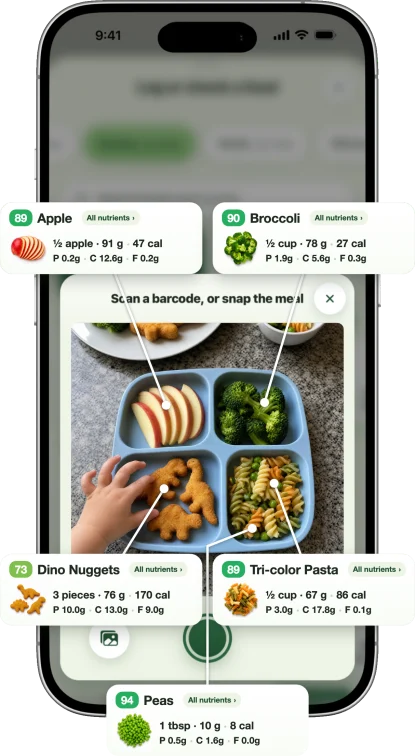
Scan a packaged food and Sito names the additives in it, then scores the product out of 100 for your child's age.
Other preservatives in the table
- Calcium bisulphite (E227), high risk
- Potassium bisulphite (E228), high risk
- Potassium nitrite (E249), high risk
- Sodium nitrite (E250), high risk
- Sodium nitrate (E251), high risk
- Potassium nitrate (E252), high risk