
Magnesium silicates / talc is the additive the food industry lists as E553. In our table it is moderate risk: it takes 15 of the 33 additive points off a product's score for a child.
- Moderate risk. 15 of the 33 additive points come off a product that carries it.
- No child flag. Nothing below is written about children specifically, so the class is the same at every age.
- 4 citations from EFSA, IARC, FDA, each one below.
What Magnesium silicates / talc does to a score
A packaged food starts with 33 points for what is in its ingredient list. Magnesium silicates / talc takes 15 of the 33 additive points off a product's score. Scan the pack in Sito and the score you get is the one for your own child's age, with this additive named in the reasons. How we score has the whole method.
What the sources found
Every classification in our table comes from the citations below, and nothing else. They are quoted as the source wrote them.
-
EFSA
Journal 2018;16(8):5375 — doi:10.2903/j.efsa.2018.5375
The safety of magnesium silicate (E 553a) and talc (E 553b) as food additives cannot be assessed; the 1991 group ADI is obsolete; no oral chronic-toxicity or carcinogenicity data for talc are available; the available data did not raise a concern with respect to genotoxicity of talc used as a food additive; specifications require asbestos-free material. The same data-gap finding shape that carries E 552 and E 141 at this class. -
IARC
Monographs Volume 136 (meeting 11–18 June 2024; results announced 5 July 2024) — Talc and Acrylonitrile; Stayner et al., Lancet Oncol 2024, 10.1016/S1470-2045(24)00384-X
Talc reclassified from Group 2B to Group 2A, probably carcinogenic to humans. The evidence streams: limited human evidence for ovarian cancer, from perineal body-powder use and occupational (pulp and paper) cohorts; sufficient evidence in experimental animals, from a rat inhalation study; strong mechanistic evidence. No dietary evidence stream was part of the evaluation, so the finding does not establish a dietary exposure route. Applies to talc not containing asbestos. -
EFSA
call for data on talc (E 553b), EFSA-Q-2021-00560 — efsa.europa.eu/en/call/call-data-talc-e-553b (data submission deadline 2027-07-31); amended European Commission mandate of July 2026
EFSA's follow-up risk assessment of talc is ongoing, with a talc-first opinion mandated. The mandate states that oral-route carcinogenicity would need to be addressed if absorption of talc particles cannot be excluded — the EU treats dietary carcinogenicity as an open question, not a finding — and the food authorisation remains in force while the assessment runs. -
FDA
Substances Added to Food inventory — talc; magnesium silicate; FDA expert panel on talc, 2025-05-20 (fda.gov/patients/fda-expert-panels/fda-expert-panel-talc-05202025)
Both remain permitted US anticaking agents. FDA's May 2025 expert panel unanimously recommended removing talc from food and drugs, but no rulemaking has followed as of August 2026, so the US regulatory status is unchanged.
Why this class
IARC Group 2B; or an EFSA re-evaluation that flagged genotoxicity data gaps, found safety could not be assessed on the available data, or cut the ADI citing child exposure; or an EU harmonised classification of the substance as a reproductive or developmental hazard; or an EU withdrawal of one authorised food use while others remain; or an OEHHA/Proposition 65 listing; or membership of the Southampton-six colourants.
Our confidence in this row's classification is medium. Medium or low does not mean the evidence is weak; it means something about the row is still being pinned down, usually a regulatory status confirmed from one source rather than two.
See what is in your own cupboard
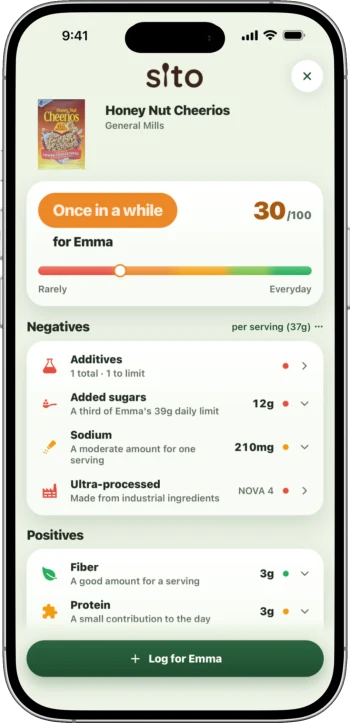
Scan a packaged food and Sito names the additives in it, then scores the product out of 100 for your child's age.

Other additives in the table
- Propylene glycol (E1520), no risk identified
- Glycerol (E422), low risk
- Azodicarbonamide and carbamide (E927), low risk
- Azodicarbonamide (E927a), low risk
- Calcium silicate (E552), moderate risk
- Potassium aluminium silicate (E555), moderate risk