Chlorophyllins is the colour the food industry lists as E140ii. In our table it is moderate risk: it takes 15 of the 33 additive points off a product's score for a child.
- Moderate risk. 15 of the 33 additive points come off a product that carries it.
- No child flag. Nothing below is written about children specifically, so the class is the same at every age.
- 3 citations from EFSA, each one below.
What Chlorophyllins does to a score
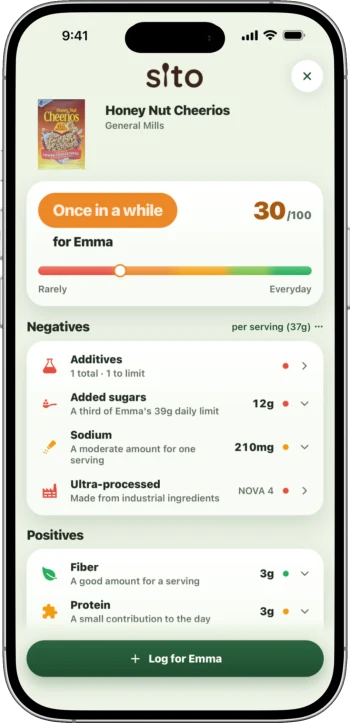
A packaged food starts with 33 points for what is in its ingredient list. Chlorophyllins takes 15 of the 33 additive points off a product's score. Scan the pack in Sito and the score you get is the one for your own child's age, with this additive named in the reasons. How we score has the whole method.
What the sources found
Every classification in our table comes from the citations below, and nothing else. They are quoted as the source wrote them.
-
EFSA
10.2903/j.efsa.2015.4085 (EFSA Journal 2015;13(5):4085 — Scientific Opinion on re-evaluation of chlorophyllins (E 140(ii)) as food additives)
There are no data regarding the absorption, distribution, metabolism and excretion (ADME) and toxicity of chlorophyllins (E 140(ii)); read-across for toxicity data from chlorophylls could not be supported; 'considering the absence of relevant ADME and toxicity data, and because chlorophyllins (E 140(ii)) are neither natural constituents of the regular human diet nor metabolites of chlorophylls in humans, the Panel concluded that it was not possible to assess the safety of chlorophyllins (E 140(ii)) as food additives.' -
EFSA
European Commission, 'Call for scientific and technical data on the permitted food additives E 140(i) chlorophylls, E 140(ii) chlorophyllins, E 141(i) copper complexes of chlorophylls and E 141(ii) copper complexes of chlorophyllins', published 7 April 2017 (food.ec.europa.eu)
Official EU restatement of the EFSA conclusions, and the source of the E 140(i)/E 140(ii) split: 'The Panel noted that in Annex II to Regulation (EC) No 1333/2008, chlorophylls and chlorophyllins are authorised with the same E number, E 140. However, according to Commission Regulation (EU) No 231/2012, separate specifications are defined for chlorophylls (E 140(i)) and chlorophyllins (E 140(ii)).' Also records that the material used in many studies identified as 'chlorophyllins' was quite often, if not always, a copper complex of chlorophyllins (E 141(ii)). -
EFSA
FAF Working Group on Re-evaluation and Follow-up, meeting minutes (efsa.europa.eu, wg-food-additives-re-evaluation-follow-up); EC call for scientific and technical data on E 140(i), E 140(ii), E 141(i), E 141(ii), submission deadline 25 November 2025
Recorded for completeness, not as part of the basis for this classification: the follow-up re-evaluation EFSA-Q-2024-00456 is in progress with the data call closed 2025-11-25 and WG meetings scheduled through March 2026. No adopted or published opinion exists as of 2026-08, so the 2015 'not possible to assess the safety' conclusion remains EFSA's current position.
Why this class
IARC Group 2B; or an EFSA re-evaluation that flagged genotoxicity data gaps, found safety could not be assessed on the available data, or cut the ADI citing child exposure; or an EU harmonised classification of the substance as a reproductive or developmental hazard; or an EU withdrawal of one authorised food use while others remain; or an OEHHA/Proposition 65 listing; or membership of the Southampton-six colourants.
Our confidence in this row's classification is high. Medium or low does not mean the evidence is weak; it means something about the row is still being pinned down, usually a regulatory status confirmed from one source rather than two.
See what is in your own cupboard
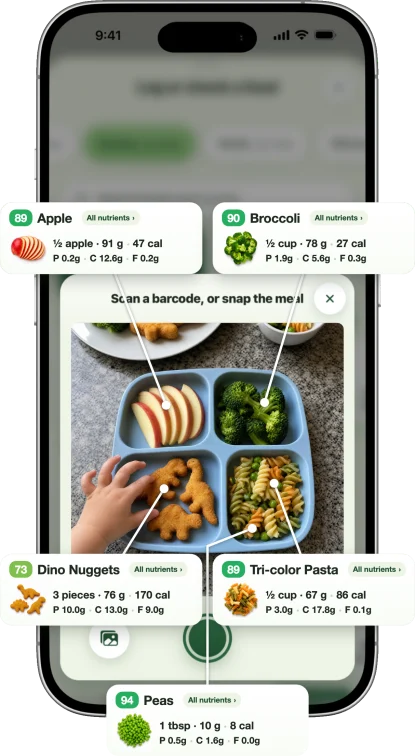
Scan a packaged food and Sito names the additives in it, then scores the product out of 100 for your child's age.
Other colours in the table
- Copper complexes of chlorophylls and chlorophyllins (E141), moderate risk
- Caramel (E150), moderate risk
- Ammonia caramel (E150c), moderate risk
- Sulphite ammonia caramel (E150d), moderate risk
- Iron oxides and hydroxides (E172), moderate risk
- Aluminium (E173), moderate risk