
Brominated vegetable oil (BVO) is the emulsifier the food industry lists as E443. In our table it is high risk: it takes 30 points off the additive subscore, which is worth a third of a product's score (about 10 of the 100).
- The key finding, from the FDA: FDA revoked the food additive regulation authorising BVO to stabilise flavouring oils in fruit-flavoured beverages; effective 2 August 2024, compliance date one year later. FDA concluded the intended use of BVO in food 'is no longer considered safe' after FDA/NIH studies found the potential for adverse health effects in humans (89 FR 55040, 'Revocation of Authorization for Use of Brominated Vegetable Oil in Food', FR doc 2024-14300 (published 3 July 2024))
- No child flag. The class, and the points it costs, are the same for a child of any age.
- Where you meet it. None of the 10,000 packaged foods scanned most on Open Food Facts list it. Nine in ten of those foods are sold in Europe (counted 26 Sep 2026).
- 3 citations from the FDA and US state law, each one below.
What BVO does to a score
A packaged food's additive subscore starts at 100 and loses points for each additive on the label; that subscore is a third of the final score. BVO takes 30 points off the additive subscore, which is worth a third of a product's score (about 10 of the 100). Scan the pack in Sito and the score you get is the one for your own child's age, with this additive named in the reasons. How we score has the whole method.
See what is in your own cupboard
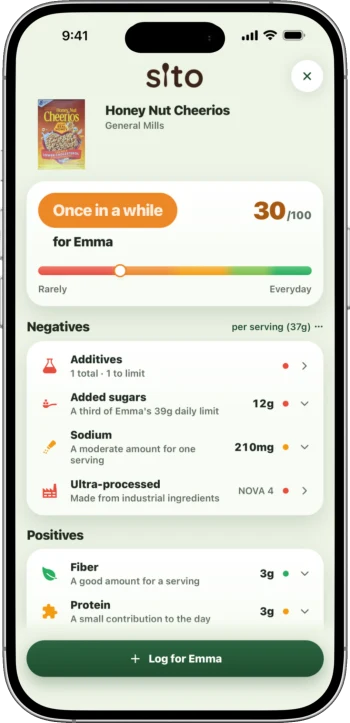
Scan a packaged food and Sito names the additives in it, then scores the product out of 100 for your child's age.

What the sources found
Every classification in our table comes from the citations below, and nothing else. Each finding is our one-line summary of what the source concluded, with the source and reference beside it.
-
FDA
89 FR 55040, 'Revocation of Authorization for Use of Brominated Vegetable Oil in Food', FR doc 2024-14300 (published 3 July 2024)
FDA revoked the food additive regulation authorising BVO to stabilise flavouring oils in fruit-flavoured beverages; effective 2 August 2024, compliance date one year later. FDA concluded the intended use of BVO in food 'is no longer considered safe' after FDA/NIH studies found the potential for adverse health effects in humans. -
FDA
constituent update, 'FDA Revokes Regulation Allowing the Use of Brominated Vegetable Oil (BVO) in Food'
Agency announcement confirming the revocation, its rationale and the reformulation window given to industry. -
US state law
California AB 418 (California Food Safety Act, 2023), adding Chapter 17 (commencing with §109025) to Part 3, Division 104, Health & Safety Code
Prohibits manufacture, sale, delivery, distribution or holding for sale of food containing brominated vegetable oil (with Red 3, potassium bromate and propylparaben) in California from 1 January 2027; civil penalties up to $5,000 first violation / $10,000 subsequent.
Why this class
IARC Group 1 or 2A with a dietary exposure route; or EFSA has withdrawn or negated a safety conclusion; or EFSA’s own exposure assessment finds a child age group exceeding the ADI at mean intake; or the substance is banned or formally being phased out for food use by the EU, by the US FDA, or under a US state law.
Our confidence in this row's classification is high. Medium or low does not mean the evidence is weak; it means something about the row is still being pinned down, usually a regulatory status confirmed from one source rather than two.
Questions parents ask
Is BVO (E443) safe for kids?
High risk. In Sito it takes 30 points off the additive subscore, which is worth a third of a product's score (about 10 of the 100). The finding we rely on: FDA revoked the food additive regulation authorising BVO to stabilise flavouring oils in fruit-flavoured beverages; effective 2 August 2024, compliance date one year later. FDA concluded the intended use of BVO in food 'is no longer considered safe' after FDA/NIH studies found the potential for adverse health effects in humans (FDA, 89 FR 55040, 'Revocation of Authorization for Use of Brominated Vegetable Oil in Food', FR doc 2024-14300 (published 3 July 2024)).
What is E443?
E443 is the E number for Brominated vegetable oil, an emulsifier. It is also called BVO. Open Food Facts tags it en:e443.
Next to it on the label
The E numbers either side of E443 in our table, then the closest emulsifiers by number.
- Polysorbate 40 (E434), low risk, flagged for young children
- Polysorbate 60 (E435), low risk, flagged for young children
- Polysorbate 65 (E436), low risk, flagged for young children
- Ammonium phosphatides (E442), no risk identified
- Sucrose acetate isobutyrate (E444), no risk identified
- Glycerol esters of wood rosin (E445), no risk identified