
- There is no Yuka for kids, so we built one. Yuka gives every product one score for everyone, with no age input; its nutrition half is Nutri-Score, a system built for the general adult population. Sito scans the same barcode, scores it for your own child's age, shows one serving against your child's daily limit, and publishes every rule it uses.
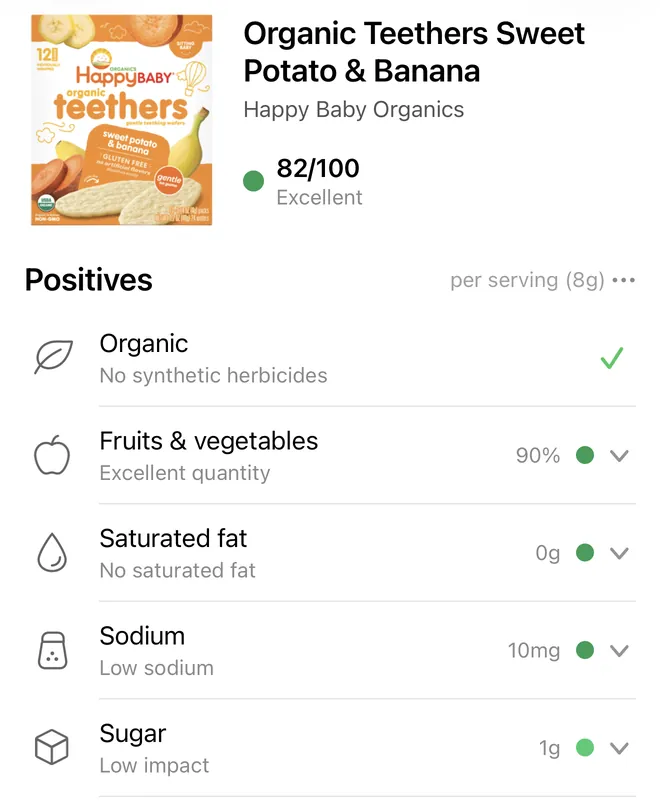
- We put six products through both apps. Yuka rates a baby teething wafer with sugar as its third ingredient "excellent", 82. Sito tells the parent of a one-year-old the truth: once in a while, 49. Froot Loops drops 17 points for a child under 6. Every number below is live in both apps.
- Sito can tell Cheerios from Froot Loops. In Yuka one high-risk additive caps both at 49, so plain Cheerios and Froot Loops sit 12 points apart, 30 and 18. In Sito they sit 34 apart, 55 and 21. We mark that additive high too, and it costs Cheerios most of its additive points. It does not erase the oats.
Yuka has more than 85 million users, 28 million of them in the US, for a good reason. You point it at a barcode and in a second you know whether the cereal in your hand is a 30 or an 80. If you are a parent, the next question comes just as fast: does that number mean the same thing for a three-year-old? We built Sito to answer that question, so we sat down with Yuka's published method and our own and worked through the same products in both.
Table of Contents
What Yuka Does, and Does Well
Yuka is a French app that scans the barcode of a packaged food or a cosmetic and returns a score out of 100 with a colour: excellent, good, poor or bad. It launched in France in 2017, and the United States is now its largest market.
Three things about it deserve credit. The scan is fast and the database is enormous. The verdict is blunt in a way that most nutrition advice is not, which is exactly why people trust it. And the company has stayed independent: Yuka states that brands cannot pay for a score, it takes no advertising or affiliate money, and it is funded by user subscriptions. When French charcuterie producers sued over its nitrite warnings, Yuka won on appeal. That is a company that means what it says.
So none of what follows is about Yuka's honesty. It is about what its score is built to measure.
The One Thing to Know: One Score for Everyone
Open Yuka's own explanation of how food is scored and read it looking for one word: age. It is not there. Yuka has no child profile, no age input, and no version of the score for a smaller eater. A granola bar gets the same score for a 35-year-old, a 13-year-old and a 2-year-old.
That matters because the nutrition part of Yuka's score is Nutri-Score, the front-of-pack label used across much of Europe. Nutri-Score is a good tool for what it was built for: ranking packaged foods against each other for the general population. But it works per 100 grams, with fixed thresholds, and it was never designed around a child's limits.
A child's limits are not smaller by a little. The Dietary Guidelines for Americans say children under 2 should have no added sugar at all. After that, added sugar should stay under 10% of daily calories, which for a preschooler is roughly 25 to 35 grams a day, against 50 grams on an adult label. The sodium ceiling the National Academies set for a 1-to-3-year-old is 1,200 mg, about half of an adult's. The "20% of daily value" printed on a box is an adult number. For a four-year-old it is closer to 40%.
A score that ignores all of that is not wrong. It is just an adult score.
How Yuka's Score Is Built
Yuka publishes its weights, and we are going to use them exactly as written, because the interesting differences come straight out of them.
- Nutrition, 60%. Nutri-Score, converted to points out of 100. One hard rule sits on top: a product with a Nutri-Score of D or E cannot score above 49, whatever else is true about it.
- Additives, 30%. Each additive is one of four colours: risk-free, limited, moderate or high. A single high-risk additive caps the whole product at 49.
- Organic, 10%. A product with an official organic label gets a flat bonus worth a tenth of the scale.
For comparison, our method is 50 points nutrition, 33 points additives, 17 points processing, plus an organic bonus of 4. On top of that base sits a per-child layer, computed on your phone, that we will get to in a moment. Both methods are deterministic and both are published. The whole difference is in what they are for.
Six Products, Three Ages
We picked six products US parents actually scan, all from our own database, scanned each one in the Yuka app on 3 and 4 September 2026, and put Yuka's number next to what Sito shows for a 1-year-old, a 4-year-old and a 10-year-old. Sito's numbers are the live ones in the app. Each row is here to show one thing, and the last column of the table says what.
| Product | Yuka | Sito, 4-year-old | Sito, younger child | What it shows |
|---|---|---|---|---|
| Honey Nut Cheerios | 8 bad | 30 once in a while | 30 | Yuka says avoid, we say once in a while. We are 22 points softer here, because one additive is a third of our score, not a ceiling on it. |
| Cheerios, original | 30 poor | 55 sometimes | 55 | Yuka puts Cheerios 12 points from Froot Loops; Sito puts them 34 apart. One additive cannot erase the oats. |
| Froot Loops | 18 bad | 21 rare treat | 4 under 6 | Colourings cost a child under 6 seventeen more points. Yuka has no under-6. |
| Happy Baby Organic Teethers | 82 excellent | 64 sometimes | 49 under 2 | Yuka's 90% fruit figure is not on the label. Sito applies the under-2 rule. |
| Honest Kids Organic Appley Ever After | 100 excellent | 71 most days | 71 | A 100 says there is nothing to think about. Sito does not give a juice drink a perfect score: 71, most days. |
| GoGo squeeZ Organic Apple Strawberry | 90 excellent | 93 everyday | 93 | Both at the top. Sito is strict about added sugar, not about fruit. |
Yuka numbers are from the Yuka app, scanned on 3 and 4 September 2026. Sito numbers are live in the app; "younger child" is the score a child under 2 or under 6 sees where it differs, as explained under each product.
The same six products, four readers
- Honey Nut Cheerios (General Mills). 12 g added sugar in a 37 g serving, Nutri-Score D, one phosphate additive. Yuka: 8, "bad", with six additives marked "to avoid". Sito: 30 at every age, "once in a while". Those are not the same verdict, and we would rather say so than pretend they are: Yuka says avoid, we say occasionally, and we are 22 points softer on this box. What it shows: Why the gap exists. In Yuka one high-risk additive is a ceiling on the whole product; in Sito it is a third of the score, and the oats' fibre and protein still count. What Sito adds is the line under the number, in your child's name: this bowl is a third of her daily added-sugar limit.
- Cheerios, original (General Mills). 2 g of sugar in a 39 g serving, whole grain oats first on the label. Yuka: 30, "poor", with six additives marked "to avoid". Sito: 55, "sometimes". Put this next to Froot Loops, not next to the honey version. In Yuka one high-risk additive caps any product at 49, so plain Cheerios and Froot Loops end up 12 points apart, 30 and 18. In Sito they are 34 apart, 55 and 21. We mark the fortification phosphate high as well, and it costs plain Cheerios most of its additive points. What it does not erase is the oats: whole grain, 4 g of fibre and 5 g of protein in a bowl. What it shows: A rule that lets one additive wipe out the rest of the label cannot tell Cheerios from Froot Loops. Sito can.
- Froot Loops (Kellogg's). Nutri-Score D, 9 g added sugar per cup, five colourings on the US box. Yuka: 18, "bad", with the additives flagged as moderate risk. One number for everyone. Sito: 21 for a 10-year-old and 4 for a child under 6, because three of those colourings carry child-specific exposure findings from the European Food Safety Authority, and we move each one up a class for a young child. What it shows: The colourings cost a child under 6 seventeen more points, because the exposure data says they should. Yuka has no under-6.
- Happy Baby Organic Teethers. A wafer sold for babies. Organic, 11.6 g of added sugar per 100 g, which is 0.9 g per wafer. The label lists rice flour, tapioca starch and sugar before the banana and sweet potato powders. Yuka: 82, "excellent", and its screen credits the wafer with 90% fruit and vegetables. Sito: 64 for a 4-year-old, "sometimes". For a child under 2 the score is 49, with a sentence saying why: the Dietary Guidelines advise no added sugars under age 2. Same wafer, and the only child it is sold to gets the lower number. What it shows: Yuka's "excellent" rests on a 90% fruit figure the label does not support. Sito reads the ingredient list and, for a baby, applies the rule that babies get no added sugar.
- Honest Kids Organic Appley Ever After. Nutri-Score B, organic, 8 g of sugar in a 177 ml box. The label reads "juice drink from concentrate", 42% juice. Yuka: 100, "excellent", a perfect score. Sito: 71, "most days", because 100% juice pays for its sugar on the beverage curve. We think that is the right answer for a child: the American Academy of Pediatrics limits juice to 4 ounces a day for 1-to-3-year-olds, and a box is 6. What it shows: A 100 tells a parent there is nothing to think about. Sito does not hand a juice drink a perfect score: 71, "most days", because juice pays for its sugar on the beverage curve. The 4 oz a day is the AAP's advice and ours, not a line in the app.
- GoGo squeeZ Organic Apple Strawberry. A fruit purée with nothing but fruit on the label and no added sugar. Yuka: 90, "excellent". Sito: 93, "everyday". The two methods land in the same place when the label is simple: no additives, nothing ultra-processed, and sugar that comes from the fruit itself. What it shows: Sito is strict about sugar that is added, not about fruit. A plain purée scores at the top in both apps, and a parent should expect nothing less.
Look at what moved and what did not. The Froot Loops agree on the verdict and split on the number, by 17 points, depending on who is eating. The teething wafer is the one to remember: "excellent" on Yuka, "once in a while" for the child it is sold to, on the strength of a 90% fruit-and-vegetable figure that the ingredient list does not support. Cheerios next to Froot Loops shows what a single additive is allowed to do to a score. The juice box shows what a perfect 100 hides. And the purée shows the two methods agreeing when the label is simple: plain fruit scores at the top in both.
None of these are edge cases. They are the first six things we thought of.
The Organic Bonus: 10 Points or 4
Yuka gives 10% of its scale to an organic label. Its reasoning is that organic farming avoids synthetic pesticides, which is true. But the bonus is the same 10 points for a bag of organic gummies as for a bag of organic spinach, and it has drawn criticism from dietitians for exactly that reason. Every organic product in our table got it, teething wafer and juice box included, and on a mid-grade product 10 points is enough to change the colour.
We give 4. The number was chosen to be smaller than our narrowest band, so a certification can break a tie or nudge a product on a boundary, but it can never carry a product past a whole band. Organic sugar is still sugar. We would rather a parent see that the teething wafer is "sometimes" and the organic label is a small plus than see an "excellent" that the label helped buy.
Additives: Four Colours or 253 Rows
Yuka classifies each additive into one of four colours and explains the criteria in general terms. The per-additive verdicts live in the app. Ours live on a web page you can read without installing anything: 253 additives, each with its class, whether it carries a child flag, and the EFSA, FDA, IARC or OEHHA citation behind it.
The child flag is the part Yuka has no equivalent for. Take the colourings in Froot Loops. Both apps mark them. But EFSA's own exposure assessments find that children can exceed the acceptable daily intake for several of them, so in Sito each one moves up a class for a child under 6, and the card says so: that is the 21 becoming a 4. The phosphate in Honey Nut Cheerios carries the same flag, on EFSA's phosphate assessment, but it already sits in our highest class, so there is nowhere further for it to go. Seventy-six of our 253 rows carry a flag like that, each with the assessment cited. For most products the flag changes nothing, because a product with four colourings is usually already at the floor of that axis. On the 200 kids' products we tested, it touched about one in ten.
The other difference is what a single additive is allowed to do to the whole score. Yuka caps any product with one high-risk additive at 49, so plain Cheerios lands at 30, "poor", a dozen points above Froot Loops, on the strength of a fortification phosphate. Our additive axis is a third of the score, not a ceiling on it, and we mark that same phosphate high. The oats still count, and Cheerios ends up 34 points from Froot Loops instead of 12.
Do Companies Pay Yuka for Higher Ratings?
You will find this claim on social media, and we want to be clear that we found nothing behind it. Yuka's independence page says brands cannot pay for scores and that requests from manufacturers are declined. Its revenue is subscriptions. It has been to court against food-industry groups and won. If you see a product scored higher than you expected, the explanation is in the method above, most often the organic bonus or the way Nutri-Score treats a category, not in anyone's wallet.
Which One Should a Parent Use?
Use Yuka if you want a fast, independent read on a product for yourself, or a second opinion on a cosmetic. It is very good at that, and its additive warnings have pushed real reformulations.
Use Sito if the person eating it is your child. The scan is the same. The difference is that the score is worked out for your child's age, the sentence under it names your child's daily limit, and the same scan logs the food into their day so you can see what the week adds up to. Sito also does the things Yuka does not try to do: photo logging, five ways to log a meal, and nutrient targets for iron, calcium, fiber and vitamin D. We compare the whole category in our roundup of kids' nutrition apps.
Plenty of parents will use both. That is fine with us.
Is There a Yuka for Kids?
No, and that gap is the reason Sito exists. Yuka has one method and it gives every product one score for everyone. There is no age input and no child profile, and the nutrition half of the score is Nutri-Score, which was built for the general adult population. Sito does for a child what Yuka does for an adult: the same barcode scan, a score out of 100 worked out for your own child's age, your child's own daily limit written under it, and a published method you can check. There is no Yuka for kids. There is Sito.
Want the scan, scored for your child?
Sito is our nutrition tracker built for kids. Scan a barcode and see what a food scores for your own child's age, then log it into their day with one tap.
- A score built for kids: A score out of 100 worked out for your child's age, with your child's daily limit under it and the added sugar, additives and processing behind it in plain words.
- Published method: Every weight, every cap and all 253 additive rows are on the web, with citations.
- Scan, then log: The same scan adds the food to your child's day and their nutrient targets.
- Five ways to log: Photo, barcode, search, a quick description, or recents and favourites.
- Every kid covered: Multi-child profiles with growth tracking, free to download with a free trial.
Sources
- Yuka Help: How are food products rated? (60/30/10 weights, high-risk additive cap)
- Yuka Help: How is the Nutri-Score used to obtain the Yuka rating? (D/E capped at 49)
- Yuka Help: Recap of the risk level changes for additives
- Yuka: Independence
- PR Newswire (July 2026): Yuka expands to Brazil and Mexico; 85 million users, 28 million in the US
- Que Choisir: Yuka wins on appeal against charcuterie producers (in French)
- Dietary Guidelines for Americans 2020–2025: added sugars under age 2, and the 10% limit
- National Academies: Dietary Reference Intakes for Sodium and Potassium (2019)
- American Academy of Pediatrics: Where We Stand on Fruit Juice
- EFSA: Re-evaluation of phosphates as food additives (2019)
- Abby Langer, RD: Yuka App Review
- Open Food Facts: product labels and Nutri-Score grades for the six products
- Sito: How we score and the additive table